.svg)
.jpg)
Artificial Intelligence is like a winter storm blasting through the markets, affecting a wide range of industries, some for the better, others worse. This installment aims to address the winners and losers from this cycle to assist sophisticated institutional investors and risk managers in considering various exposures. We again are reminded of a pair of Kaminoans overseeing a massive facility in Star Wars Episode II: Attack of the Clones.
Nearly every day brings a fresh batch of articles on AI, its implications and impact on the market. From our perspective, the tool will facilitate a significant amount of the drudgery associated with many white-collar jobs. The near-time implication is that via technology, those “tasks” will become faster, better, and cheaper, with the upshot being that the need for entry-level positions in many fields is likely to become scarcer. Additionally, AI leverages the time and impact of many in the workforce. The analogy that comes to mind is the development of the power loom during England’s Industrial Revolution whereby one worker advanced from controlling just one loom to multiple looms.

While some might view AI as an independent development, our view is that it will soon be joined by multiple other technologies to reset a variety of industries. Improved robotics, energy generation, batteries, computing, communications, and other technologies are converging to create a potentially much faster rate of growth of economic output.
Now for the difficult part of identifying the winners and in turn, the losers. Below is a partial list, which is likely to change as technologies emerge.
Chip Firms – NVIDIA has been a market darling for the past several years, having benefited from the massive demand for its latest data center chips and hardware. Others are joining the race, and the entire chip-making ecosystem has benefitted. Perhaps the major threat to the chip makers is the rapid development of new technologies such as light-based systems and quantum computing.
Data Centers – The demand for data centers has far outpaced supply, thereby creating a tailwind for most of the industry. There is talk of space-based data centers, but the lifting costs need to decline substantially before this begins to make sense. In the meantime, access to chips, energy, and well-located land has been a constraining factor, which buoys existing facilities.
Software Security Firms – With an ever-increasing volume of data and an increasing reliance on that data, security becomes far more important. Adding to the demand is the ability for scammers to use AI, thereby increasing the complexity in keeping systems safe. The incumbents have an advantage, but as usual, new technology will enable others to join the race.
Energy – Access to energy has been a constraining factor for many of the data centers, thereby providing an opportunity for those firms that can quickly develop effective power solutions.
Platforms – Many of the tech giants/platform firms (Alphabet/Google, Meta, Amazon, Oracle, Microsoft, etc.) are pouring billions into AI in the hopes of becoming a major source for AI users. These firms are populated with some of the smartest people and presumably see the potential of emerging technology. Given the massive wealth created from the development of the internet, AI appears well-suited to be a core functionality soon.
AI-focused Defense – AI is likely to prove to be very useful in a variety of defense applications and is currently being used in the Ukraine War.
Consumers – With any technology revolution, most of the value is not captured by the producers due to competition but instead by consumers. A broad swath of services (and increasingly goods) will become better, cheaper, and faster.
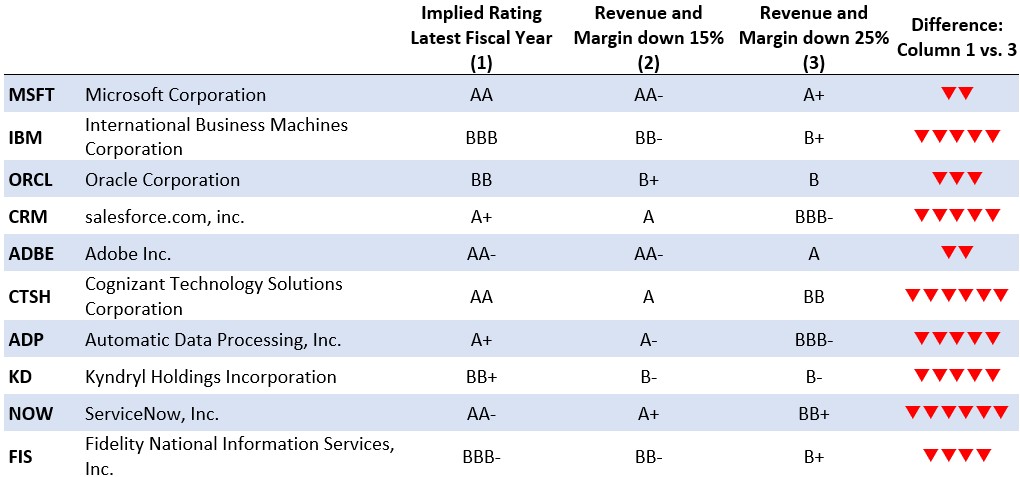
SaaS - The market has spoken recently, suggesting that the software firms will be major losers as the cost of developing software has plunged because of the software capabilities of AI. We agree that development and maintenance costs will decline, but the issue is convenience and switching costs. For some, switching is easy, others, not so much. The example we often consider is Microsoft’s Excel replacing Lotus 1-2-3 ages ago. Microsoft owned the operating system most PCs ran on and enabled its product to read Lotus 1-2-3 files. Since Microsoft Excel was already at users’ fingertips and the software was bundled with the operating system, switching was painless. Conversely, software which is integrated into firms’ operations such as Salesforce or QuickBooks might face greater switching costs. Below is a summary of declines in revenues and margins for some of the largest SaaS firms:
Professional services – Particularly those services based on expertise and data-crunching (e.g., accounting, audit, consulting, data analysis, law, tax, etc.) are under massive threat because many of the core tasks can be automated today. While diffusion of this capability takes time, soon it is likely to result in margin pressure.
Advertising Firms – The process of creating, testing, and posting advertisements has become significantly easier, thereby reducing a significant portion of the typical value provided by ad firms. However, creativity remains in short supply, and well-conceived, well-run campaigns will continue to add value.
Traditional Media/Entertainment – AI enables vastly more interesting and engaging forms of news and entertainment than was previously the case. A simple example is enabling the viewer to have a more focused interaction with branching news stories depending on the viewer’s interest.
Traditional Retailers – The task of finding and securing items has become vastly easier with the internet. AI will continue to expand that development.
Traditional Education – The most effective form of learning is via a tutor with infinite knowledge and patience. AI appears to fit the bill. Homework assignments are now ineffective teaching tools.
Legacy Everything – Given the fact that AI is highly disruptive, many traditional industries will be challenged.
Available productivity has already increased dramatically, and a major limiting factor now is the application of that productivity. Stated otherwise, AI is yet to fully diffuse throughout the economy. However, productivity increases are not a measure of human flourishing. It is likely that many who are laid off will have difficulty finding jobs with tasks that are not better suited for AI. Stated otherwise, the human capital input to the economy will become less critical than it was previously. (Today’s 92K job loss might be an early indicator.) We have made similar comments about the decreasing importance of land to economic output.
Democracies may be more responsive to displaced workers than authoritarian countries would be. The form of such a response is yet to be seen and will likely be carefully crafted so as not to scare away capital.
Critically, the second and third order consequences are often much more severe than the first order consequences. The banks, AIG, Fannie Mae, and Freddie Mac were bailed out in 2008 because of the knock-on effects of their potential collapse. If AI causes significant margin pressure for businesses and leads to layoffs, the knock-on effects are likely to be similarly notable.
The reality is that technology is moving rapidly and that it is hard to predict how AI will be used and accepted. We will aim to provide updates as the technology develops.
Our suspicion is that we will soon be revisiting this area as AI and related technologies develop.


.jpg)