.svg)
Like companies, sovereign areas have strategies. Those strategies are manifested in a variety of ways, often with significant impacts on business. Making the discussion particularly interesting is the continued digitalization and globalization of many businesses.
Exactly where are the headquarters of Wikipedia, YouTube, and TikTok? Does it matter? Given the fact that an increasing portion of businesses, particularly leading businesses that operate both globally and digitally, domicile is becoming increasingly irrelevant. The software geniuses dreaming up the next DocuSign could be anywhere in the world and often are. Furthermore, while tariffs have significant impacts on hard goods, they rarely touch the increasingly valuable soft goods, which can easily sidestep tariffs by establishing local subsidiaries. Hence, our premise is that the location of businesses is becoming increasingly less relevant.
In medieval England, the “scot” was a local tax imposed for maintenance or services. To get away scot-free, originally spelled “scotfre,” would mean being exempt from this tax.
In finding a location for talent and incorporation, firms seek to balance competing interests: productivity, tax efficiency, and governmental oversight.
Unfortunately for efficiency-seeking chief executives and financial officers, the enemy has a vote. Should countries that offer markets for firms’ products feel they are losing substantial tax revenue and oversight authority, they can pass laws to collect “lost” taxes or impose fines to exert oversight authority. See taxes and fines imposed on Apple in Europe as an example.
Regardless, if our premise (that the location of businesses is becoming increasingly less relevant) is accurate, then the natural question is what the impact is and how firms should adjust. Before addressing this question, it is worthwhile examining the approaches of two major business centers.
The country has catapulted itself to the heights of GDP per capita (up from approximately $5K as of 1980 to $90K currently) by providing an ultra-business-friendly environment: no income taxes for foreign-sourced income, no capital gains taxes, no estate taxes, little corruption, and a highly educated workforce. With the vicissitudes of political actions in China (e.g., the Hong Kong turmoil), many companies have selected Singapore as their Asian base and many as their headquarters. Ireland has experienced similarly remarkable growth in GDP per capita, though note that some of these figures may be skewed due to firms reincorporating in these geographies, though lacking significant operations.
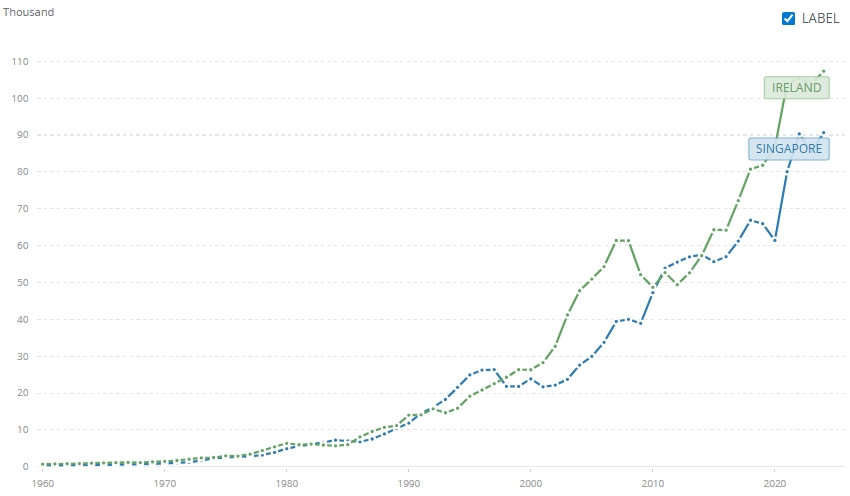
Of course, there is a downside: as the small nation has become increasingly prosperous, the cost of everything has risen. Nonetheless, its citizens have realized a massive increase in their standard of living.
Though attractive for investors through stable periods, city-states by their nature are militarily vulnerable. China has fully exerted control over Hong Kong, despite claims they would permit high levels of autonomy. Singapore faces similar risks from China.
History was recently made with a self-proclaimed socialist being elected the city’s mayor. Promises were made regarding free bus service, rent control, reduced food prices, and a variety of other goodies. A reasonable question might be how the supposed capitalistic capital of the world elects a socialistic mayor. In our opinion, there is a deeper issue afoot and that is many of the city’s denizens feel left out or falling behind and that Mamdani provides a means of obtaining some balance. Perhaps this is an early indication of the impact of AI and related technologies whereby the value of labor has declined on a relative basis. (The below graph indicates NYC’s per capita GDP has risen, but at a far lower rate than Singapore’s.)
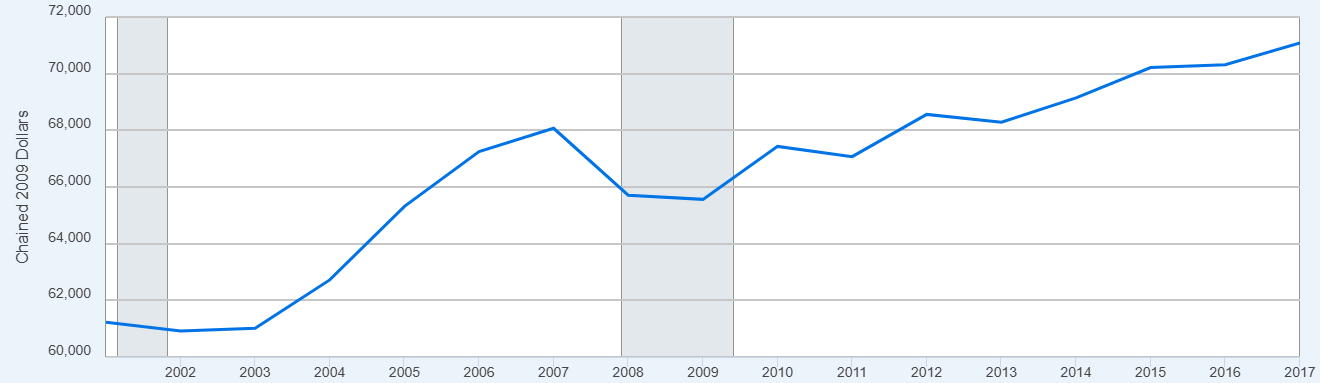
In contrast to Singapore, Mamdani plans significant increases in taxes, particularly on the wealthy and high-earning citizens. Regarding the possible flight of the wealthy and high earners, Mamdani has stated that the bulk of those leaving New York stay in the tri-state area.
While Mr. Mamdani is rolling out his plans, some in his party are torn between supporting him and distancing themselves for fear that proposals will become unworkable. Note that the shift of Citadel out of Chicago is an indication of the trend, but in a parallel city.
Switzerland and Monaco pride themselves on being destinations for the wealthy, having long benefited from the multitude of services for the wealthy, with banking, wealth management, and estate planning being at the top of the list. Reaffirming this view is Switzerland’s recent rejection of a proposal to tax inheritances of the super-rich. Likewise, the postage stamp area of Monaco has long been a refuge for the rich and glamorous well before the golden era of Prince Rainier and Grace Kelly.
London used to be the domicile of choice for many of the wealthy and many corporations because of its cosmopolitan nature and trusted rule of law. Unfortunately, the rise in taxes on the non-Doms has resulted in an exodus.
While many believe that current conditions are immutable, history teaches us a different lesson. The great cities of yore are now more of an afterthought from a historical perspective. Mesopotamia, Babylon, Constantinople/Istanbul, Athens, Rome, Vienna, Venice, Madrid, Amsterdam, Paris, and London were all once world-dominating cities, but for various reasons lost their preeminence. Business and all the benefits that those organizations offer seek the most hospitable environment.
Corporations are typically designed to enhance shareholder wealth. The “sea change” is that many of the leading firms can now more easily operate in more places. Hence, our view is that over time, to an increasing extent, they will. However, it will take time for the alternative venues to build up the proper infrastructure (e.g., schools, communities, law firms, court systems, etc.) to compete more broadly with the established centers.
Our business is fascinating in part because it is constantly changing. From a competitive perspective, firms are forced to become as efficient as possible and the effort to seek that efficiency will have major implications over time. The current leaders might experience increased difficulty as their relative appeal slips.


.jpg)