.svg)

The lyrics of the Rolling Stones' iconic song are a reminder to us all that there is a gap (often large) between aspirations and reality. This installment attempts to identify some of those larger gaps and how they might play out in the markets.

Given that we are approaching the one-year anniversary of the current administration, we will start here. The latest development is an attempted regime change in Venezuela.
From our perspective, regime changes are always daunting, but perhaps especially so in mountainous, jungled terrain. For those looking for a comparable, perhaps Vietnam comes to mind. It is not clear that blowing up some vessels and steaming an aircraft carrier off the coast is going to do the trick. The last regime changes the U.S. has engaged in were in Iraq, Libya, and Syria, which all lacked the same topographical challenges as Venezuela.
In the case of Iraq, the task required thousands of troops, tough urban fighting, and many boots on the ground before “victory” could be declared. Perhaps in Venezuela, the locals will initiate some change.
The common denominator between Iran and Venezuela is significant oil reserves. Even if the U.S. does not seize control over the oil reserves, it could seize control over servicing fields and increase production.
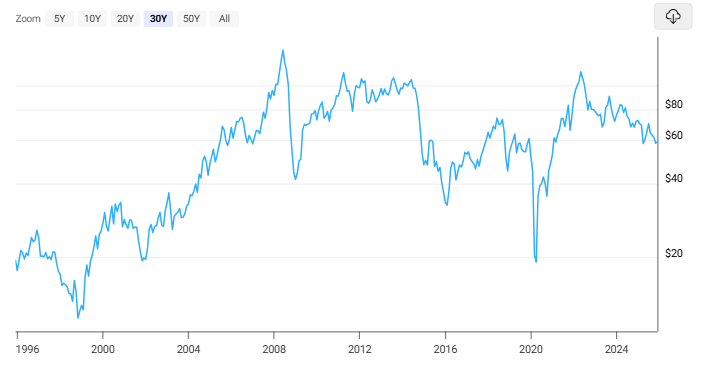
Impact – If the administration is successful, it will be a huge win and will probably further depress energy prices. If not, other than a loss of some credibility, the losses will probably be minor. (Perhaps the same calculus is being used by the administration.)
The war in Ukraine has dragged on for the better part of four years. It appears Putin is taking a cue from Peter the Great while NATO has seen the addition of two strategically significant and powerful states of Sweden and Finland. Meanwhile, Ukraine has fought courageously but has hurt itself via recent revelations of corruption. Seeking an off-ramp, Mr. Witkoff is proposing that Ukraine give up some territory in exchange for some security guarantees.
The rub is that security guarantees were provided in exchange for Ukraine’s giving up its nuclear weapons in the Budapest Memorandum negotiated in 1994. Perhaps Mr. Trump’s trump card is the ending of weapon, monetary, and intelligence support for Ukraine if Zelensky is not supportive. Yes, the EU can help, but to date that support has been a fraction of that provided by the US and will probably be insufficient to enable Ukraine to continue for long.
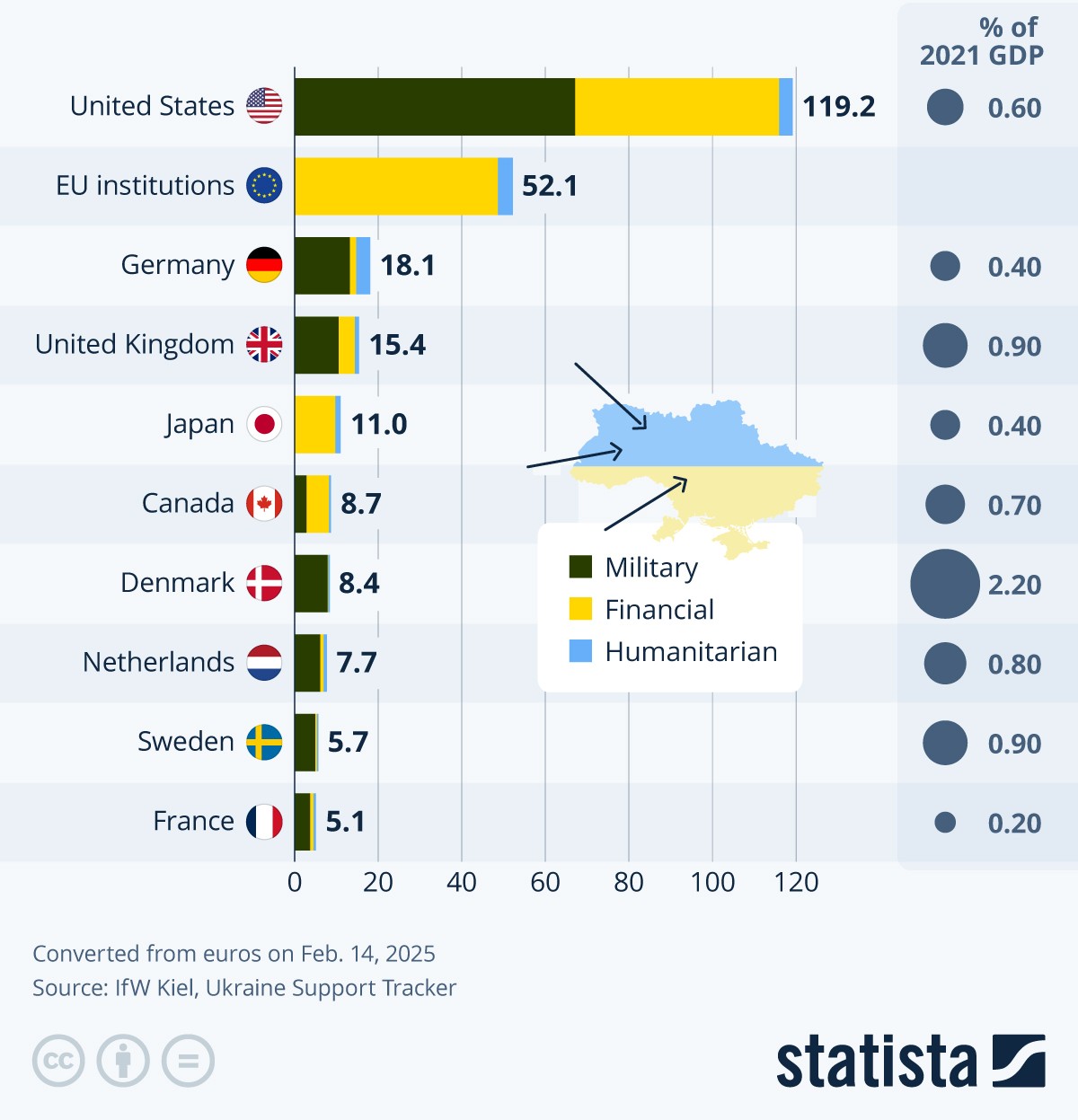
Impact – Wars are easy to start and hard to end. Perhaps the most vexing aspect has been Europe’s continued reliance on Russian energy, and India’s increased purchases of Russian oil. Perhaps THE question is whether the old metrics of land equating to power need to be revisited, although this is unlikely by traditional warriors like Putin. Look for a cease fire, a claim of victory by both sides, and a deferral of some of the larger questions. (By the way, there has never been a formal end of the hostilities between North and South Korea.) No one can get what they want, but hopefully what they need.
Over the past 500 to 1,000 years, Europe has generally been considered the seat of enlightened thinking. Prior to the First World War, Europe had been the location of the advanced sciences, technologies, and culture. After two world wars, the continent rightly saw that wars were becoming far more lethal, and a structural solution was needed. That structural solution came in the form of the European Communities (EC), which consisted of the European Coal and Steel Community (ECSC), the European Economic Community (EEC), and the European Atomic Energy Community (EAEC or Euratom).
These institutions bound the European nations into trading partners and over time facilitated the development of the European Union. While the EU solved one structural problem (i.e., a reduction in the probability of wars between and among European states), it created another problem, and that is the cumbersomeness of the structure, which necessitates the acquiescence of all states for major decisions.
Impact – Unfortunately, Europe has lost some of the vitality which made it a global leader. The continued war in Ukraine might be evidence of the problem. Europe should be at the forefront in addressing the attack on a major buffer state between it and Russia, but the response has been far more tepid than many wished. With the high sovereign indebtedness levels, the lack of national commercial champions, and an aging population, a reversal is difficult. Adding to the challenges is the fact that much of the economic growth has been stoked by the technology sector, which for the most part is located elsewhere. The counterargument is the success of ASML, Novartis, and Airbus.
The leading Ford truck, the F Series, has been and remains a killer, dominating all truck sales:
“King of the hill for 47 years running, the faithful Ford F-series trucks crush the competition with over 750,000 units sold last year, up 14.8 percent in 2023.”
Furthermore, the F Series accounts for a significant portion of Ford’s overall profitability. Yes, some of the foreign manufacturers have set up shop in the U.S. (to avoid import tariffs), but trucks are still dominated by the domestic manufacturers, with Ford in the lead.
The conundrum is that electric vehicles have become the fastest-growing segment of the vehicle industry, and if the stories of improvements in batteries and motors (i.e., cost and range) are to be believed, it appears that electric vehicles will become more competitive. For better or worse, Ford appears to be seriously considering abandoning production of its electric F-150. Furthermore, advancements in self-driving are continuing apace, and the domestic manufacturers do not appear to be focused.
Impact – To quote former Intel chief Andy Grove, “only the paranoid survive.” Perhaps firms run their natural lives and simply have difficulty managing major technology shifts. For the sake of many employees and customers, we hope that a solution is forthcoming.
There is often a large gap in aspirations and reality. For the sophisticated institutional investors and risk managers, it is often helpful to recognize and anticipate those gaps and adjust exposures accordingly.


.jpg)