.svg)

“I used to rule the world. Seas would rise when I gave the word.”
- Chris Martin, Viva La Vida (3.4 Billion Streams)
In its hit song, Coldplay describes a lament in the voice of a deposed ruler: a man who once commanded the world, remembering how quickly it stopped answering to him. Though poised to be powerful in the future, America’s unipolar moment is over.
Some strategic moats that enabled great powers to maintain and project power are less relevant than previously. The good news is that it’s difficult for rivals to expand their scope also so long as they choose to respect the taboo of nuclear weapons. Geopolitical tensions and conflicts provide massive disruption and opportunities for sophisticated institutional investors.
The Iran War has failed to meet its objectives with no immediate remediation in sight. For context, Washington has walked back each of the following goals:
•Regime change. The opening strike killed Supreme Leader Ali Khamenei; the United States now negotiates with his son and successor, Mojtaba.1
•Removing the nuclear material. The IAEA has been locked out of Natanz, Isfahan, and Fordow since February 28; the ask now is only that Iran declare its stocks.2
•Controlling the Strait of Hormuz. The memorandum (before it was effectively blown up) asks only that Iran allow safe passage, conceding that control was never on the table.1
•A permanent bar on a nuclear weapon. The memorandum had only a forward promise not to build one, unverified and unenforced.1
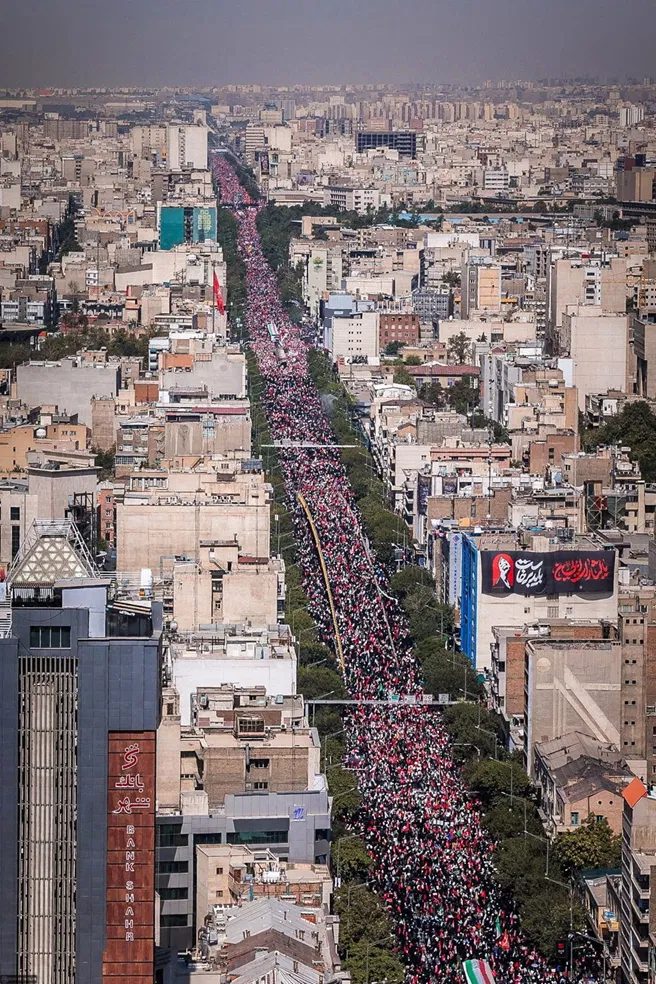
Further indication of America’s inability to exert power is Khamenei’s state funeral, which opened on July 4, the day the United States marked its 250th Independence Day.3 Massive crowds chanted “Death to America” and carried placards demanding the death of President Trump.
A few of the problems are listed below.
•Iran can’t be moved from its physical position on the map. It will remain relevant to shipping.
•America is unwilling to put more pressure on the regime by disrupting utilities or oil production, thus risking a recession. This is of particular concern given pressure on Russian oil production (see part II).
•America is unwilling to break the taboo of use of nuclear weapons.
•American assets (e.g., bases and aircraft carriers) are vulnerable to cheap drones and munitions.4,5
•America lacks the political will to transition its military to a similar cheap arms approach at a large scale.
•There is no clear pathway for an internal revolt.
Although the conflict recently became hot, it has been ongoing in a cold manner for more than three decades, since the 1990-91 war made the bases permanent, with the oil commitment dating to 1980.
“An attempt by any outside force to gain control of the Persian Gulf region will be regarded as an assault on the vital interests of the United States.”
- President Jimmy Carter, State of the Union, 1980
Today Washington keeps 40,000 to 50,000 troops across at least nineteen sites in about ten countries.6 The below items tie America to the region.
• Energy significance. America needs to protect key energy assets in the region.
• Transit significance. The Middle East is critical to global shipping lanes.
• Commitment to Israel. American military and political institutions are deeply tied to Israel, despite weakening polling results among Americans for Israeli support.7
• Sunk cost. Decades of transfer payments for bases and alliances are hard to write off, and leaving under fire is likely to yield a political cost that can exceed the cost of staying (e.g., Afghanistan).
• Committed money. A defense-industrial base, arms pipelines, and basing contracts pay out only while the commitment holds, with a wide set of firms and constituencies invested in continuation.
• Gulf expectations. The Arab monarchies have wired their economies to Washington and expect the security umbrella in return.
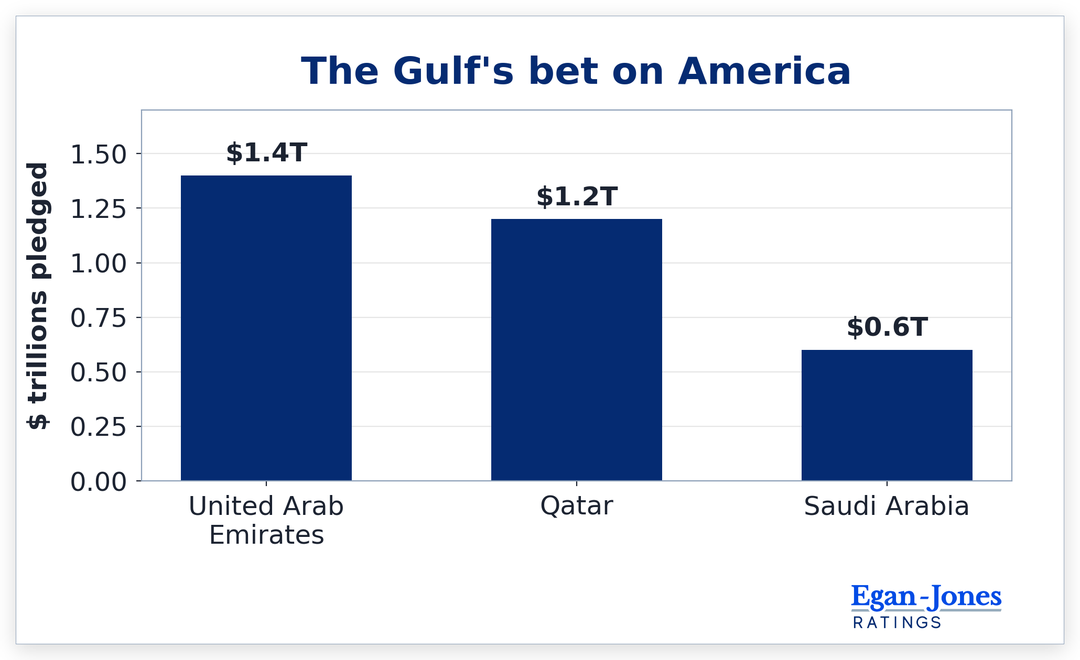
The wager runs both ways: Gulf sovereign funds hold about $2 trillion in US assets, over a third of their total, and invest 12 to 15 times more in the United States than the reverse. That capital buys a claim on American protection and means a war that turns unpopular at home still cannot end in a clean exit.
Impact: America will remain interested in the region and the war will likely have a de facto solution before it has a de jure solution.
The war is effectively a tax on trade. War-risk insurance, longer routes, and idle ships raise the cost of every barrel and box that transits, leading to deadweight loss for the world.9 Two questions must be answered by sophisticated institutional investors.
•Is the Iranian leadership a true believer in global intifada?
•Will Israel have the support it needs to protect itself? Suppressing threats through periodic strikes works only with American cover, which the war showed to be thinner than Israel assumed.
At home, the campaign has run past the War Powers Resolution’s 60-day limit without authorization. Both chambers voted to end it, the House 215 to 208 and the Senate 50 to 48 with four Republicans crossing, though the votes are symbolic against a veto.10
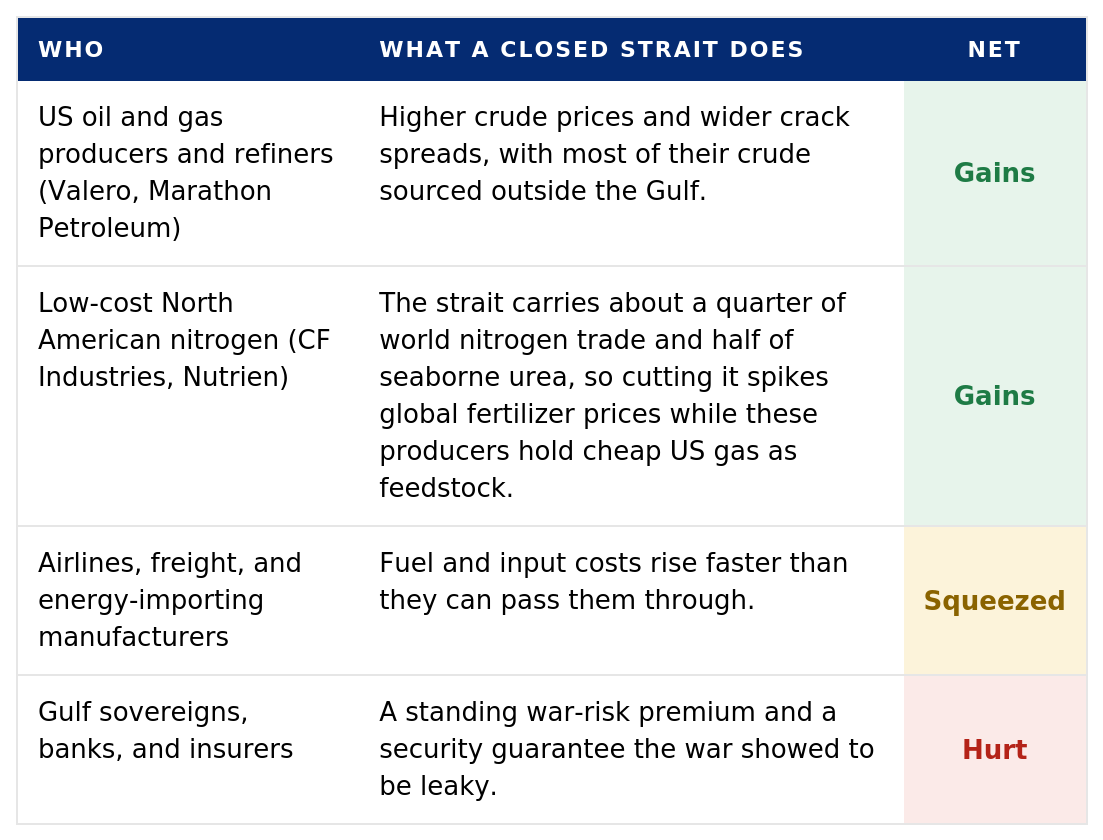
The shock does not fall evenly. A closed strait is a windfall for some balance sheets and a squeeze for others:
In late June, President Zelensky approved a 40-day campaign of deep strikes to press Moscow toward terms.11 Some targets are as follows: the Moscow Oil Refinery at Kapotnya, hit twice in a week from about 500 kilometers off; the port of St. Petersburg; and fuel and rail infrastructure across occupied Crimea, now under a state of emergency.12 Russia’s massive scale was once a defensive moat against Napoleon and Hitler, as it required attenuated supply lines that proved unsustainable, particularly in winter. For long-range drones, that is no longer an issue.
The question is whether the attacks risk a nuclear response. Doctrine reserves that for a threat to the state’s existence, a line left vague.13
Washington is in a version of the same bind. It can no more control Iran than Moscow can control Ukraine, and each is held back from the step its most aggressive hawks seek: a nuclear answer, in the American case to a state that chased its own bomb while chanting death to America, in the Russian case to the constant Ukrainian raids funded in Europe and Washington. We expect neither nation will break the taboo, and there is a symmetry in watching two great powers meet the limits of their reach at once.
Impact: Rearmament is a fiscal drag on German and French budgets even as it lifts Rheinmetall and the wider defense complex.
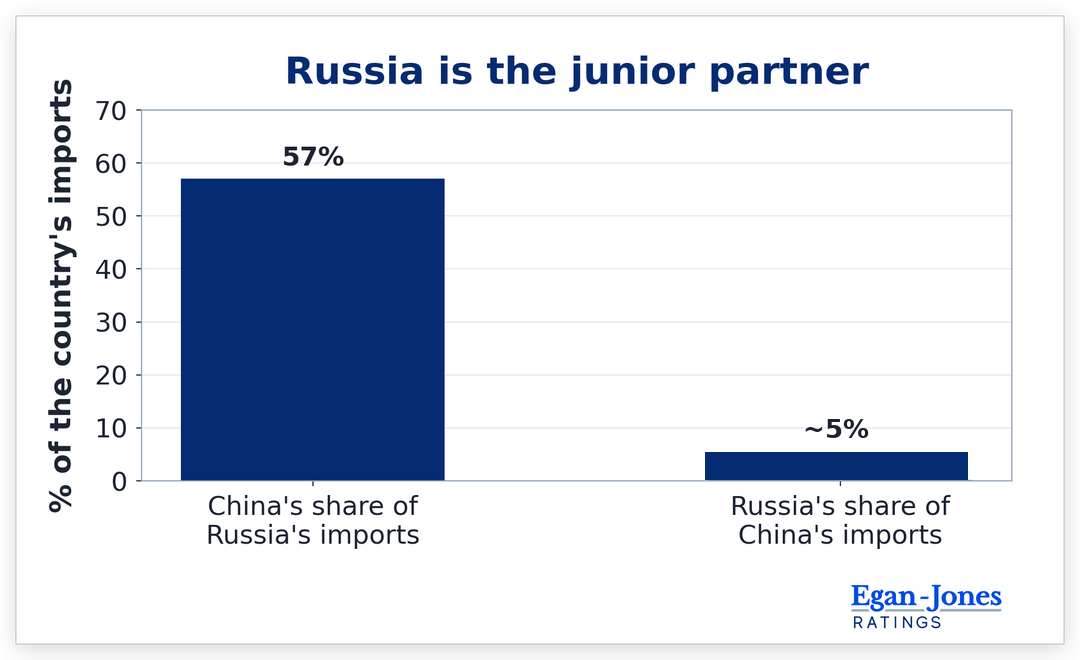
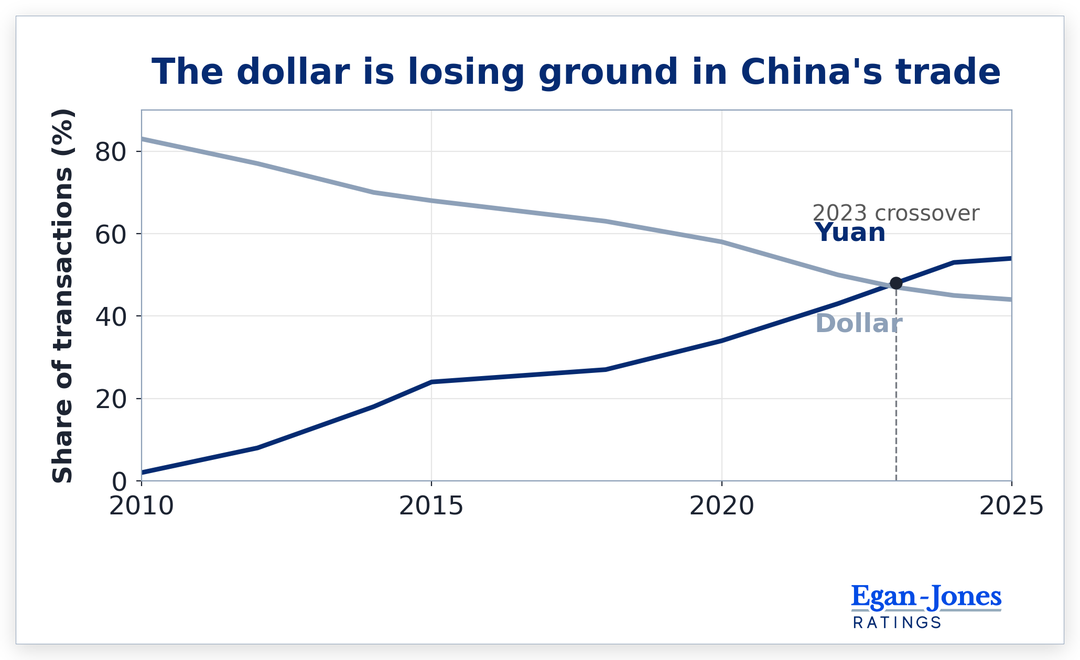
Russia’s war economy now runs through China, which takes more than half of Russia’s imports while Russia is a small share of China’s, which settles almost all the trade in yuan and rubles, and slow-walks Power of Siberia 2.
China is not without its issues for seeking broader control in its own region. China’s coast faces a picket of large islands against its seaboard: the Japanese home islands, the Ryukyus, Taiwan, the northern Philippines, Borneo, and Taiwan sits at the midpoint, about 100 miles off China’s coast, the position General MacArthur called an “unsinkable aircraft carrier.”16
This is the frame in which the American commitment to Taiwan is best understood. America can claim to support Taiwan to "protect democracy." However, the island is important strategically for the American empire, holding the island chain’s midpoint, and demonstrating to Japan, Korea, the Philippines, and Australia that America will protect them from Chinese expansion.
The United States does not have the same geographic chokehold. The nearest island of any strategic consequence west of California is Hawaii, some 2,400 miles out.
Impact: China benefits by far most from war profiteering, though not entering a war itself. It gains from a NATO-Russia collision that drains Western magazines and attention, pulls focus from the Pacific, and deepens Russia’s dependence on Beijing. The multipolar shift accelerates; watch the Taiwan timeline, Power of Siberia 2 pricing, and Chinese leverage over Russian energy.
Great powers would be well suited to recognize the limits of their power and play within those confines. However, even in defeat one can find success. Despite the defeat in Vietnam, America won the First Cold War some fourteen years later. Economics was the primary factor in that outcome and are likely to be the driver of outcomes in the future, though poor decisions may be made in the meantime. For sophisticated institutional investors and risk managers, the repricing is already underway.
1. Death of Ali Khamenei and succession by Mojtaba, the June 17 memorandum of understanding, and its safe-passage terms: 2026 Iran war (Encyclopaedia Britannica); House of Commons Library. britannica.com · commonslibrary.parliament.uk
2. War start (February 28), Iranian strikes on at least eleven US bases and the Fifth Fleet headquarters, the Al Udeid air operations center rendered inoperable, and the IAEA locked out of Natanz, Isfahan, and Fordow: 2026 Iran war (Encyclopaedia Britannica and Wikipedia); Breaking Defense; Air & Space Forces Magazine. en.wikipedia.org · breakingdefense.com
3. Khamenei’s state funeral opening July 4, 2026, timed to the 250th US Independence Day; chants of “Death to America”; red banners; placards calling for the deaths of President Trump and Prime Minister Netanyahu; and Mojtaba’s absence for his safety: Al Jazeera; State funeral of Ali Khamenei (Wikipedia). aljazeera.com · en.wikipedia.org
4. Gulf states expending the majority of their Patriot interceptors within a month and the assessment that the war permanently altered the Gulf’s security calculus: 2026 Iranian strikes on Arab countries (Wikipedia), citing the Jewish Institute for National Security of America. en.wikipedia.org
5. US interceptor stocks stretched thin and more than 150 THAAD interceptors fired defending Israel in 2025: Al Jazeera. aljazeera.com
6. US military presence in the Middle East for decades, permanent Gulf basing since the 1990-91 Gulf War (over three decades) and a commitment to defend the region’s oil dating to 1980; 40,000 to 50,000 troops across at least nineteen sites (eight permanent) in about ten countries; the Fifth Fleet in Bahrain and Central Command’s forward headquarters at Al Udeid in Qatar, which Qatar spent about $1 billion to build; and at least eleven US bases struck in the 2026 war, several left barely usable: Council on Foreign Relations; Middle East Institute; Al Jazeera; Defence Security Asia. cfr.org · mei.edu
7. Weakening US public sympathy for Israel, with Gallup finding Americans no longer more sympathetic toward Israelis than toward Palestinians in the Middle East: Gallup. news.gallup.com
8. US investment pledged by Gulf states in 2025 (UAE $1.4 trillion, Qatar $1.2 trillion, Saudi Arabia $600 billion), much of it multi-year and non-binding; and the six Gulf states’ sovereign wealth funds holding about $2 trillion in US assets, over a third of their total, investing roughly 12 to 15 times more in the US than the reverse: The White House; Euronews; Forbes. whitehouse.gov · forbes.com
9. Gasoline near $5 a gallon, diesel near $6, and a spike in fertilizer prices tied to the Hormuz disruption, with the strait carrying roughly a fifth of world oil and about a quarter of world nitrogen-fertilizer trade: CNN; Yahoo Finance; industry reporting on the 2026 nitrogen shock.
10. The campaign passing the 60-day War Powers Resolution mark without authorization, the House (215-208) and Senate (50-48) resolutions with four Republicans crossing over, and about a quarter of Americans calling the war worth the cost: NPR; Al Jazeera; TIME. npr.org · aljazeera.com · cnn.com
11. President Zelensky’s approval on June 25, 2026 of a 40-day Security Service operation of long-range and medium-range strikes to pressure Russia to end the war, announced after a meeting with acting SBU chief Major General Yevhenii Khmara: Euronews; Defence Matters. euronews.com · defencematters.eu
12. Ukrainian strikes on the Moscow Oil Refinery at Kapotnya (June 16 and 18), the port of St. Petersburg (June 3), ships and air defenses at the Kerch Strait, and fuel and rail infrastructure across occupied Crimea, enabled by an “open corridor” in Russian air defenses and forcing a redeployment of air defenses to Moscow and the Kerch bridge; Crimea declared a state of emergency: CNN; Euronews. cnn.com · euronews.com
13. Russian nuclear doctrine tied to a threat to the state’s existence, and 2026 signaling (a May ICBM test, a snap strategic-forces exercise, and a May 24 strike on Kyiv with nuclear-capable systems carrying conventional warheads) read as calibrated coercion that has already constrained Western involvement without a detonation: DGAP; ECFR. dgap.org · ecfr.eu
14. China at about 57% of Russia’s imports (2024) versus Russia at roughly 5% of China’s imports (about $130 billion of $2.59 trillion in 2024), more than 95% of bilateral trade settled in yuan and rubles, and Beijing’s leverage over pricing and Power of Siberia 2: EUISS; UN COMTRADE and China’s General Administration of Customs; Atlantic Council RMB brief; MERICS. iss.europa.eu · scowcroft.substack.com
15. The yuan overtaking the dollar in China’s cross-border transactions (48.4% to 46.7% in March 2023) and leading both inbound and outbound flows in 2024: China’s State Administration of Foreign Exchange via Reuters and Nikkei; FXC Intelligence; Bloomberg. tradingnews.com · fxcintel.com
16. The first island chain (Japanese home islands, Ryukyus, Taiwan, northern Philippines, Borneo), John Foster Dulles’s 1951 formulation, Taiwan at the midpoint roughly 100 miles off China’s coast, and General Douglas MacArthur’s “unsinkable aircraft carrier”: Wikipedia; South China Morning Post; Hoover Institution. en.wikipedia.org · scmp.com · hoover.org
• Ukrainian targeting time falling from 15 to 20 minutes of manual coordination to under a minute with GIS Arta and Delta: Booz Allen, in National Defense Magazine (July 2026); sensor-to-strike cycle under three minutes per New Geopolitics Research Network. nationaldefensemagazine.org · cepa.org
• Formula 1 pit-stop times: about 67 seconds average in the 1950s, roughly 6 to 12 seconds in the 1994-2009 refueling era, and a 1.80-second world record (McLaren, 2023 Qatar Grand Prix): Guinness World Records; Statathlon. guinnessworldrecords.com · statathlon.com
• Strategic Petroleum Reserve at roughly 326 million barrels in mid-2026, the lowest since 1983 and about 46% of the 714-million-barrel capacity; the 2022 release of 180 million barrels taking it from 579 million to a 347-million low by mid-2023; a partial refill to about 413 million by December 2025; the March 2026 draw of 172 million barrels as part of a coordinated 400-million-barrel release by 32 countries; record weekly drawdowns in May 2026; storage in four Gulf-Coast salt caverns, sour-crude skew, and a maximum withdrawal of about 4.4 million barrels a day: EIA; US Department of Energy; CNN; Yahoo Finance; RBN Energy; Congressional Research Service. eia.gov · cnn.com · finance.yahoo.com
• The Ukrainian front largely static and drones not proving decisive, with any concentration of force punished quickly: GIS Reports; New Geopolitics Research Network. gisreportsonline.com · newgeopolitics.org
• Ukraine’s dependence on Western cloud and models, and Russia’s push for sovereign compute with China, showing where the decisive inputs now sit: Atlantic Council, “The coming compute war in Ukraine.” atlanticcouncil.org
• North Korea’s 3.7% growth in 2024 (Bank of Korea, fastest in eight years), monthly trade with China at an eight-year high, about 10,000 new Pyongyang apartments last year (more than Los Angeles or Chicago), the country roughly three times brighter at night than five years ago, and billions of dollars from munitions sales and troop deployments to Russia (Institute for National Security Strategy): Dasl Yoon and Timothy W. Martin, “The World’s Most Surprising Economic Success Story Is...North Korea,” The Wall Street Journal (June 2026); Lowy Institute. Nighttime-light exhibit: Earth Observation Group data, graphic by Carl Churchill for the same Journal report. en.interaffairs.ru · kyivpost.com · lowyinstitute.org


.jpg)