.svg)

Governing is a difficult business. Niccolò Machiavelli is considered an expert, and his paramount rule as an advisor to Renaissance Florence rulers was, paraphrasing “never wound a prince.” Consider the full quote below.
“Men must either be caressed or else annihilated; they will revenge themselves for small injuries, but cannot do so for great ones” (Niccolò Machiavelli, The Prince)
The notion is that as king, often the princes were the greatest danger and simply wounding one would create lasting enmity sowing the seeds for future challenges. This installment aims to address the rapidly developing conditions in the Middle East and implications for sophisticated institutional investors and risk managers.
The assumption that Israel and the US could eliminate the threat posed by Iran via an air campaign is, in our opinion, fundamentally flawed. It is simply too easy for Iran to hide the weapons and keep the population at bay. No question that via the air, Iran’s defenses have been degraded. However, in our view, it will be extremely difficult to affect a regime change without a significant number of “boots on the ground.” Even with an attacking force, it is questionable whether the population will support the invaders.
Regarding finding and neutralizing the missiles and drones, it appears to be a fool’s errand. Perhaps the Gaza War can serve as a proxy. In contrast to Gaza, Iran is massive:
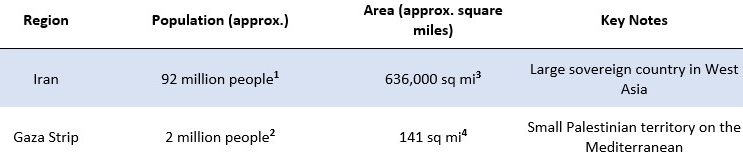
Furthermore, unlike the Gaza Strip, Iran has uncontrolled borders, and like Afghanistan, has a significant portion of mountainous regions. Our premise is that even if the US and Israel kill the next several chosen leaders of Iran, the regime might not change its stance.
The use of dangerous weapons in difficult conditions is almost a guarantee of some problems happening, despite the best efforts of all involved. To date, we have witnessed the apparent bombing of a girls’ school with over 100 casualties, the loss of several aircraft, the massive destruction of infrastructure, and a sobering spike in petroleum prices.
Given the massive cost and disruption emanating from this war, what if anything, has been accomplished? While we like to be optimistic, we remain concerned. Yes, the dangers of flying over Iran have improved.
Despite the above accomplishments, it is not clear that there will be lasting changes. If Iran still has nuclear capabilities (which it probably does), perhaps Iran cannot easily deliver those weapons via missiles. Stopping a dirty bomb appears far more difficult. Additionally, stopping cluster bomb missiles, directable hypersonic missiles, and a variety of drones is extremely difficult. (Even if a cluster bomb missile is hit, the bomblets will continue to do damage.)
Our main premises are: (i) there will not be a regime change without a massive number of troops rooting out the prior regime, (ii) neither the US nor Israel will be willing to commit the necessary troops to affect a regime change, (iii) it will be very difficult to eliminate Iran’s drone and missile capabilities, and (iv) Iran is highly likely to rebuild its capabilities. If our analysis is correct, then it appears that the US and Israel have committed THE fundamental error: they wounded (and did not kill) the prince.
If one finds oneself in a hole, the best action is to stop digging. Despite the braggadocio employed by the current administration, we expect that the futility of their efforts will soon be evident. As that becomes increasingly apparent, watch for claims of victory and a speedy withdrawal.
Regarding the non-negotiables, we expect that Iran will want to maintain its power and, if possible, have a pathway for becoming a nuclear power. The underlying assumption is that to date, no country with nuclear power has experienced a regime change.
From Israel’s and the US’s perspective, presumably, they do not want either of those developments to occur. The rub will be working out a meaningful agreement.
We hope that our analysis is wrong. However, if we are correct, the longer the combatants are engaged, the worse it will be for all.
[1] Iran Population - Wikipedia
[2] [3] Gaza Strip | Area | Britannica


.jpg)