.svg)

In early August, US Treasury Secretary Bessent intervened in the Japanese yen market to curtail plunging exchange rates and elevated yields.1 Simultaneously, yields on 30-year treasuries have reached recent highs.2 Adding to the mix is the shift in the political landscape whereby the DSA (Democratic Socialists of America) has become a real force in U.S. politics. For the benefit of sophisticated institutional investors and risk managers, this installment aims to provide a framework for understanding recent developments and more importantly, some future safe harbors. (The relevancy of the Tiangong Ultra’s beating Usain Bolt’s record is addressed below.)
After its finest hour, with the defeat of Nazi Germany, England shifted, removing Churchill as prime minister in favor of Attlee, an avowed socialist. The citizenry was apparently tired of years of fighting, rationing, losses, and the daily sacrifices and simply wanted to take a different path. Different it was with the result being in the next couple of decades the country lost leadership in numerous industries and some globe-leading companies.
Gone (or diminished) are a variety of stalwarts of English commerce:
.png)
The Wilson and Callaghan years prompted significant spending and a corresponding rise in debt to GDP:
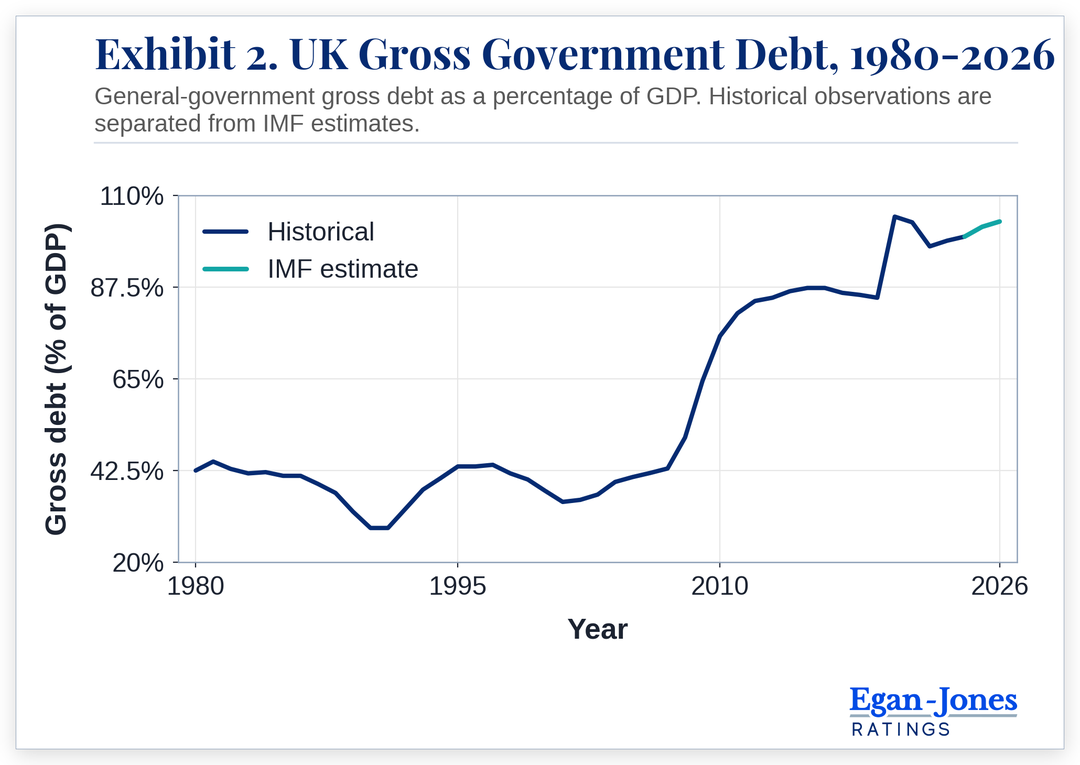
So, what happened? Why did other nations find ways to prosper while the UK did not? Perhaps the loss of several colonies4 and the burdens of socialism contributed to a massive increase in its debt to GDP. The irony is that while England had a major role in developing many technologies including computers, radar, and cell phones5, it lost leadership.
While the UK lost a number of industry leaders since World War II, it begs the question of which countries assumed the torch. Below is a summary6:
China’s greatest advantage is its ability to manufacture emerging technologies at enormous scale. Assuming Elon Musk is correct in his vision of robots being a critical industry prospectively, the achievements of Chinese robots are sobering.
The United States’ greatest advantage is its combination of frontier research, capital markets, software companies and entrepreneurship. Taiwan, South Korea, Japan and the Netherlands control critical portions of the semiconductor and advanced-manufacturing supply chain.
Our premise is:
THE issue is whether AI and related fields are going to accelerate growth to the extent that GDP overwhelms sovereign debt. (The short answer is that we do not know but historically, it has been very difficult to curtail social expenditures.)
Another item to consider is that in the short run, numerous jobs are likely to be eliminated such as truck and taxi/Uber/Lyft drivers which in turn, might increase social expenditures. The rise of the DSA probably reflects the frustrations of many college-educated citizens stuck in moderate or low-paying jobs.
Now for the tricky part. While there have been numerous sovereign defaults over time, typically a default is both embarrassing and highly disruptive. Hence, the preferred path is one that has been attempted (in many cases successfully) since the beginning of time.7 An extreme example of disruption was seen in the Weimar Republic, whereby the safest places for assets were the following:
This has been among the hardest Risk Commentaries to write because of the high level of uncertainty and the various cross currents. However, since it is such an important topic, we expect to revisit it, especially to check our assumptions, review the pros and cons of various safe harbors, and further develop safe harbor areas.
The ten most recent Egan-Jones CLO tranche ratings are shown below alongside the other NRSRO’s equivalent rating on the same tranche and the current collateral test cushions.
.png)
Diff is the gap in notches between the Egan-Jones rating and the other NRSRO’s equivalent rating on the same tranche, measured on a 22-step scale from AAA to D. Green is Egan-Jones higher; red is Egan-Jones lower; “=” is a match.
Cushion is the current test level divided by its trigger, so a figure below 1.00 means the test is failing. “n/a” appears where the report shows no test of that type for the class, and “—” where no comparison is available because the tranche is unrated by one of the two. Egan-Jones ratings shown here are not NRSRO ratings.
Additional Sources


.jpg)