
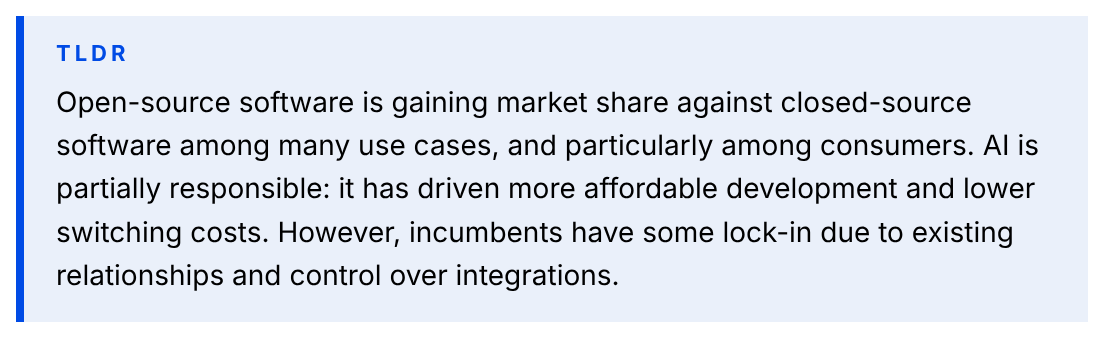
Investors often treat software incumbency as long-lasting. The record suggests it is less secure than some credit models assume.
Even if open-source solutions don’t dominate a market, free substitute software can limit the amount that an incumbent can charge before it takes significant market share.
This installment aims to provide a framework for sophisticated institutional investors and risk managers holding software and platform credit.
Key Definitions
Open-source application - software whose code anyone may view, use, change and redistribute, such as Linux, Android and PostgreSQL. This is the primary focus of this
piece.
Open standard - a published specification anyone may implement, such as HTML or MP3. Software built on an open standard can still be closed.
Many consumers are accustomed to paying for software (e.g., Windows, Adobe, Docusign, etc.) and therefore assume that this practice is widespread and will persist.
Over the past five years, Linux, an open-source operating system, has grown significantly on a proportional basis among personal computing operating systems.
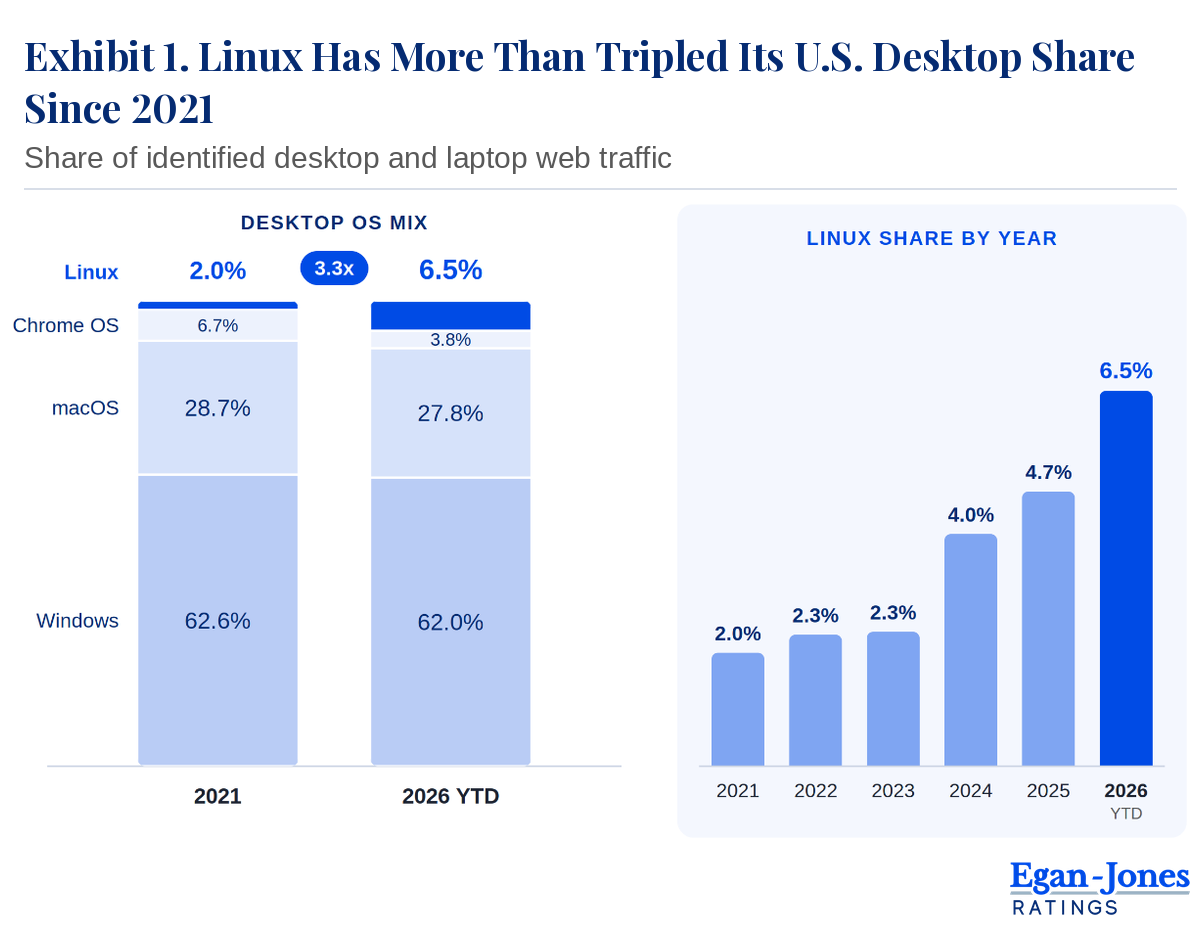
In fact, Linux’s growth understates the control that open-source software has over all applications.
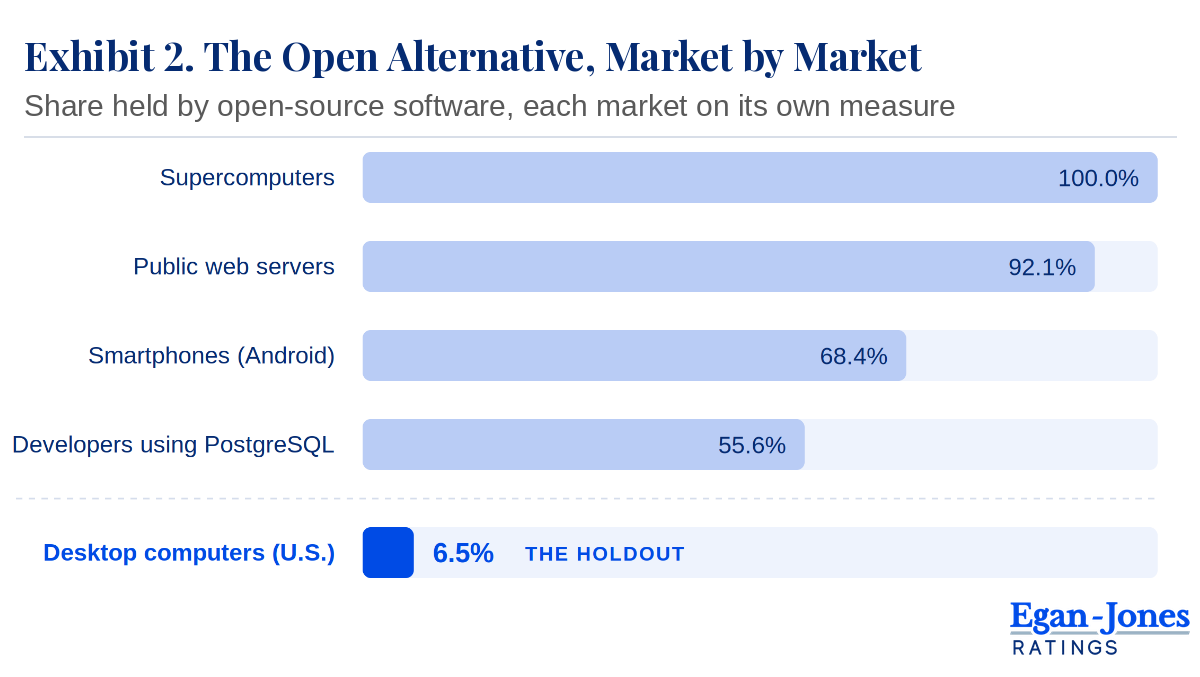
Each bar uses its own market’s measure, so levels are not strictly comparable.
It appears that adoption of open-source software must be considered on a sector-by-sector basis. As seen in the chart above, open-source software is ubiquitous in some enterprise sectors. Among enterprise supercomputers, open-source software holds virtually the whole market due to its stability and customizability, which were of particular importance.
Regarding desktop computer operating systems as well as SaaS products, affordability concerns may push consumers to transition to open-source software more quickly than enterprises.
Although open-source software eliminates the opportunity to charge directly for software, opportunities for related revenue streams persist (e.g., hosting, support, security, etc.). Consider how Valve has built its popular gaming SteamOS on top of Linux, an open-source operating system. This growth has been to the detriment of Microsoft and Sony's closed systems.
With AI, the cost of development is much lower. If a user wants a feature for an open-source application, it’s much easier for them now to build it. Thus, closed-source applications with few developers must compete against a much larger number of developers. This challenge is likely to only expand as always-on agents become more popular.
Thus, we expect software will become, in some cases, more commoditized.
Relative to enterprises, consumers have low switching costs and a higher propensity to switch, so open-source applications often gain ground with them first. The reasons are as follows:
Given the threat of consumers leaving, legacy software providers often must respond with lower prices.
Google’s choice to keep Android open source and provide software to handset makers at no cost led it to outsell every other phone platform, while BlackBerry, the corporate standard, fell to zero.
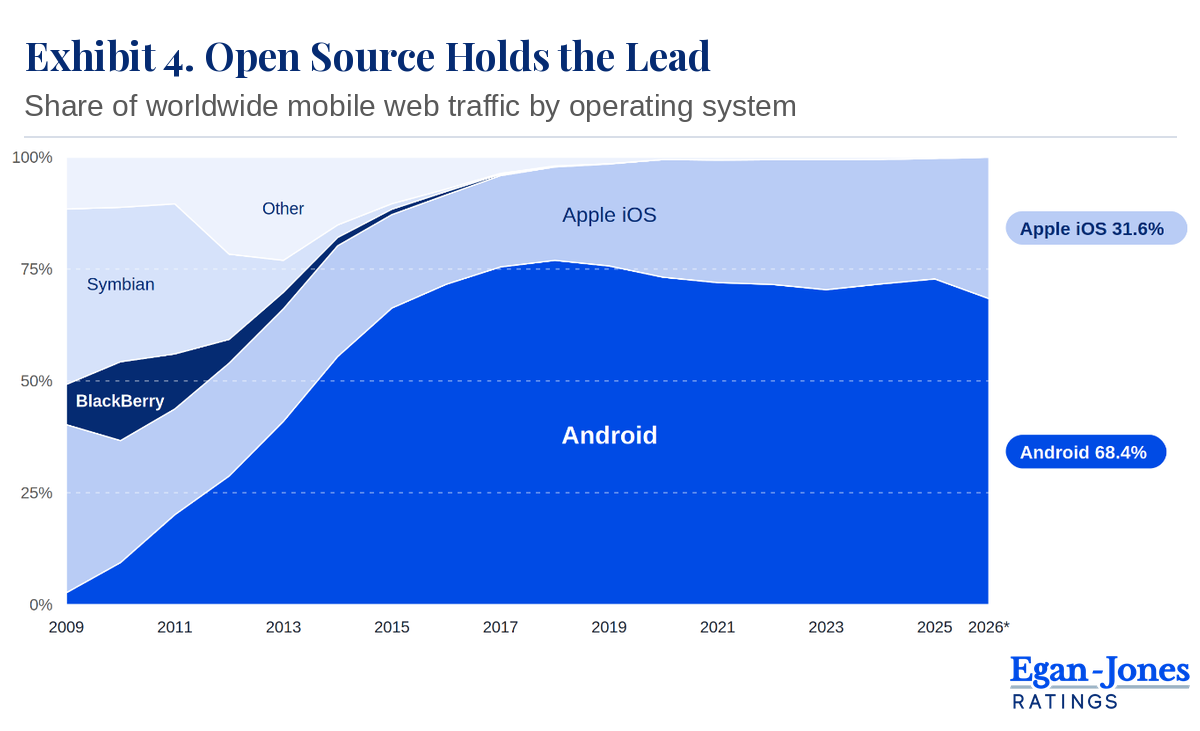
To be clear, the world isn’t so cleanly divided because, although Android is open source, it has benefited Google tremendously by pushing users to Google's other products. Further, Apple’s closed-source operating system has an increasing share of the smartphone market, though its share appears below its 2009 peak.
To understand how a firm can win given open-source alternatives, a sophisticated investor should consider what “hooks” keep consumers from switching.

Those firms which will continue to compete and win against open-source alternatives will maintain a number of hooks in the mouths of their clients.
Microsoft: Microsoft provides identity (Entra ID), mail (Exchange and Outlook), documentation (SharePoint and Office), and meeting (Teams) software, which requires some effort to switch off and train people on new platforms. Further, the software has already gone through extensive vendor review. The adage “no one gets fired for buying IBM” applies here.
Apple: The Apple ecosystem is often lauded: Apple software (Apple Pay, Apple Account, iMessage, FaceTime, iCal, etc.) and devices (iPhones, AirPods, iPads, MacBooks, Apple Watches, AirTags, etc.) all work together seamlessly. Notably, these products lack the seamless integration with products made by other vendors. These hooks keep customers in the Apple ecosystem.
Should a user seek to move out of either the Microsoft or Apple ecosystem, it will be a painful process of removing the hooks.
Porting code, moving data, and rewriting connectors were switching costs that held customers in place, and AI agents now do it quickly. The effect is likely to be much more pronounced for applications that have few connectors and are easy to retrain on.
Despite its higher price, people want to choose the easy and accepted option, which will often be the market leader, although similar alternatives exist.
Example: Consumers buy Coca-Cola although generic colas provide a similar taste.
Given the enormous sums being spent on AI, we ought to consider if this will be commoditized. It seems that the switching costs between AI models are low and brand loyalty is as well. Thus, AI companies have the more challenging task of providing value in one of the following areas: price, intelligence, or speed.
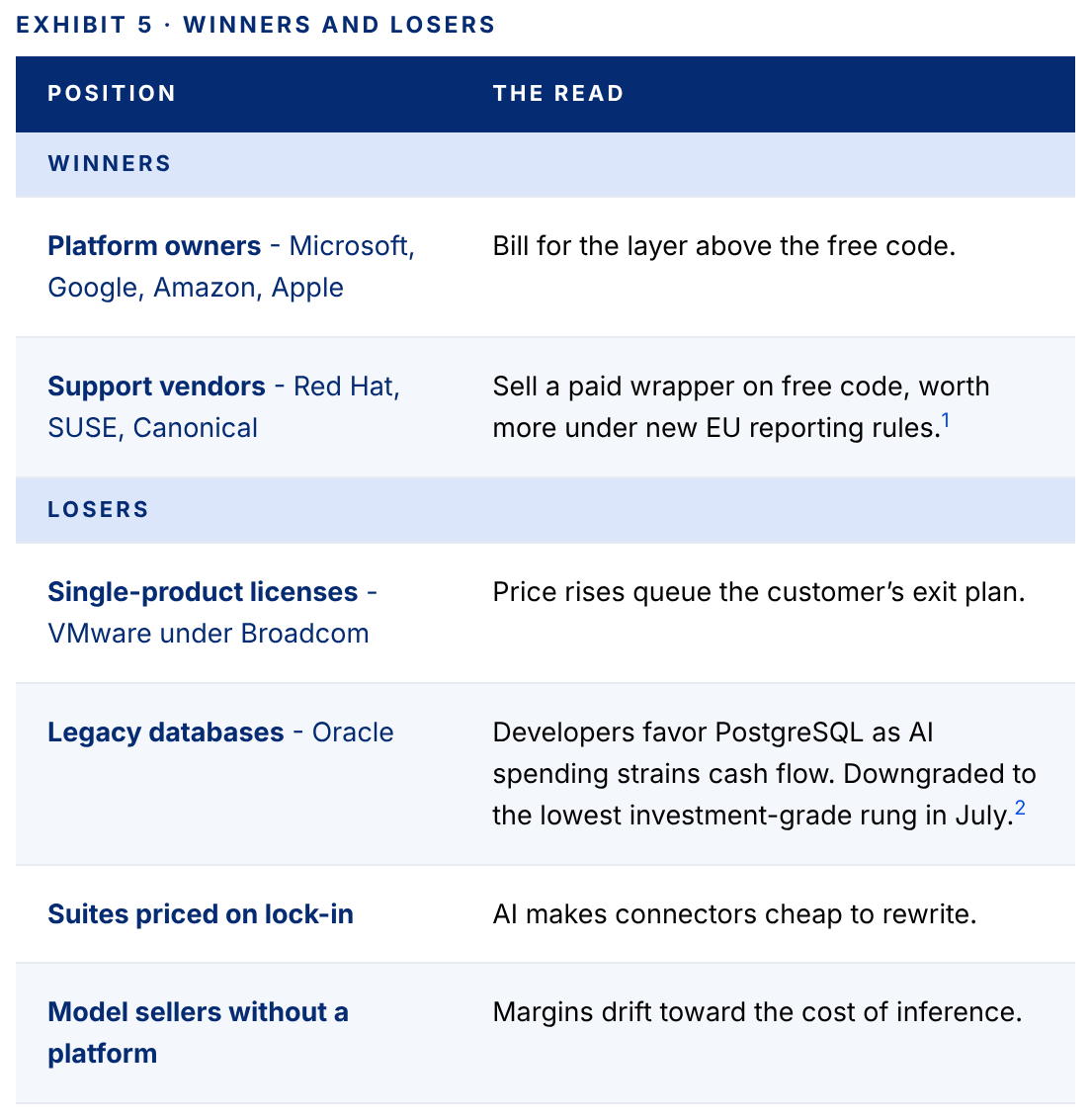
Software incumbency lasts only as long as leaving stays expensive. Open-source applications cap what incumbents can charge, consumers usually move first, and AI is lowering the cost of switching. The world is changing rapidly, and this installment is offered as a framework for sophisticated institutional investors and risk managers.