
Market commentary
10
 min read

MAD World; Private Assets and State-Level Risk

Cheap, long-range drones expose commercial assets, insurers, lenders and investors to rising strategic risk.
Published on
August 20, 2026

I. Overview

At her own wedding reception in Goodfellas, Karen Hill receives envelopes of cash from wedding guests. Later during a dance, Karen says to her new husband, "The bag. The bag." Henry: "What bag?" Karen: "The bag with the envelopes in it, all the money." Henry isn't concerned. "Don't worry. Nobody's going to steal that here."

Every guest at the reception understood what would happen to anyone who touched it.

American commercial assets have been sitting on the table the same way for seventy years. The shield has been, in large part, the US intelligence and military complex. Our premise is that investors should evaluate whether that calculus still holds, and whether private and entirely commercial assets face heightened vulnerability due to the declining cost of conflict. This installment aims to provide a framework for pricing the exposure, for the benefit of sophisticated institutional investors and risk managers.

II. A Few Givens

Perhaps the best place to start is with four points we treat as settled.

  • Mutually assured destruction still works. Second-strike capabilities continue to deter strategic nuclear exchange among nations.
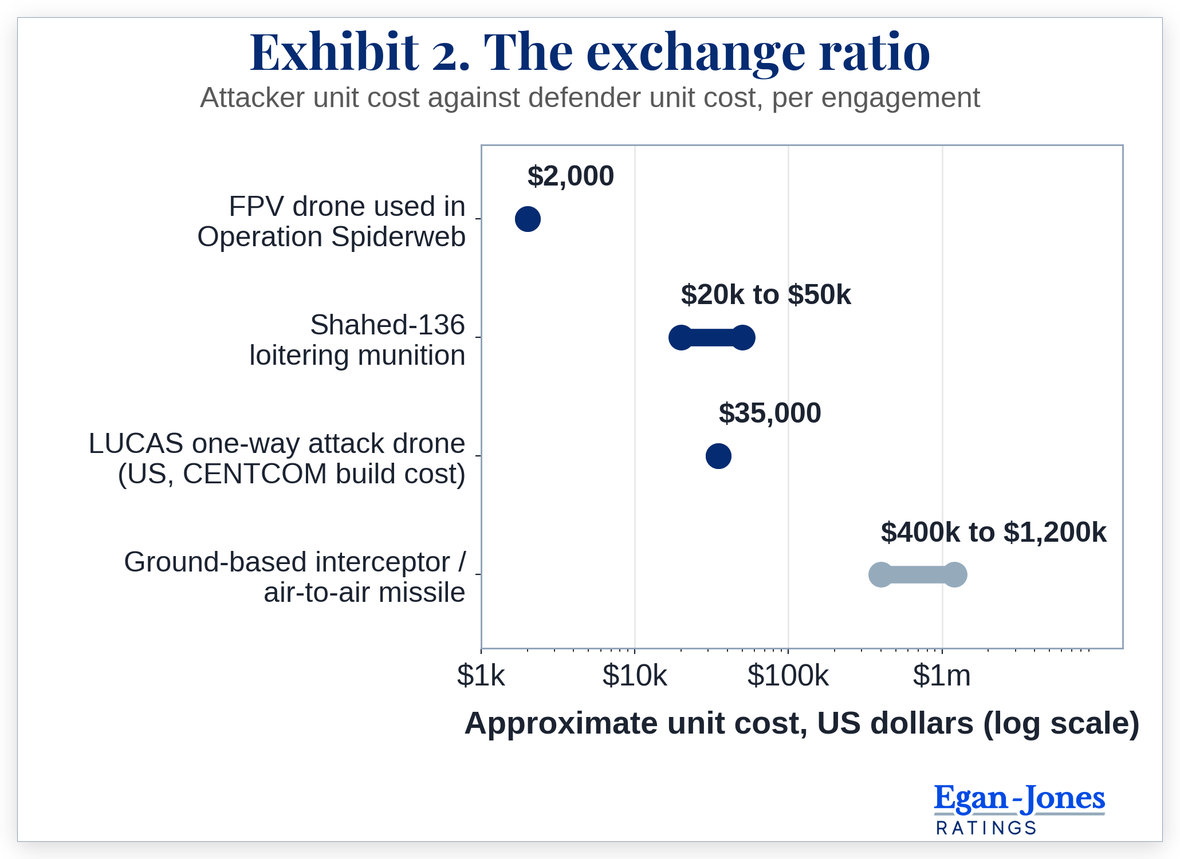
  • The cost of inflicting serious damage has collapsed. In Operation Spiderweb on June 1, 2025, Ukraine used first-person-view drones costing roughly $2,000 apiece to damage about a third of Russia's strategic cruise missile carriers, a fleet Ukrainian officials valued near $7 billion.1
  • Range has stopped being a constraint. The July 7, 2026 strike on the Omsk refinery, Russia's largest, was executed almost 2,500 kilometers from Ukrainian-held territory.2 That is roughly the distance from New York to Denver.
  • A target does not have to be military to be strategic. The remainder of this installment turns on that general point. As an example, a drone with explosives was recently found at Leipzig/Halle Airport.

III. Russia's Amazon

Wildberries accounts for about 45 percent of Russian online retail, ahead of Ozon at 32 percent, and in 2022 it was the largest taxpayer in the country. Ukraine's stated rationale for striking it is that its logistics centers move drone components, navigation equipment and other military hardware. Among many consumer products, the company lists drone components and body armor for sale on its own website.3

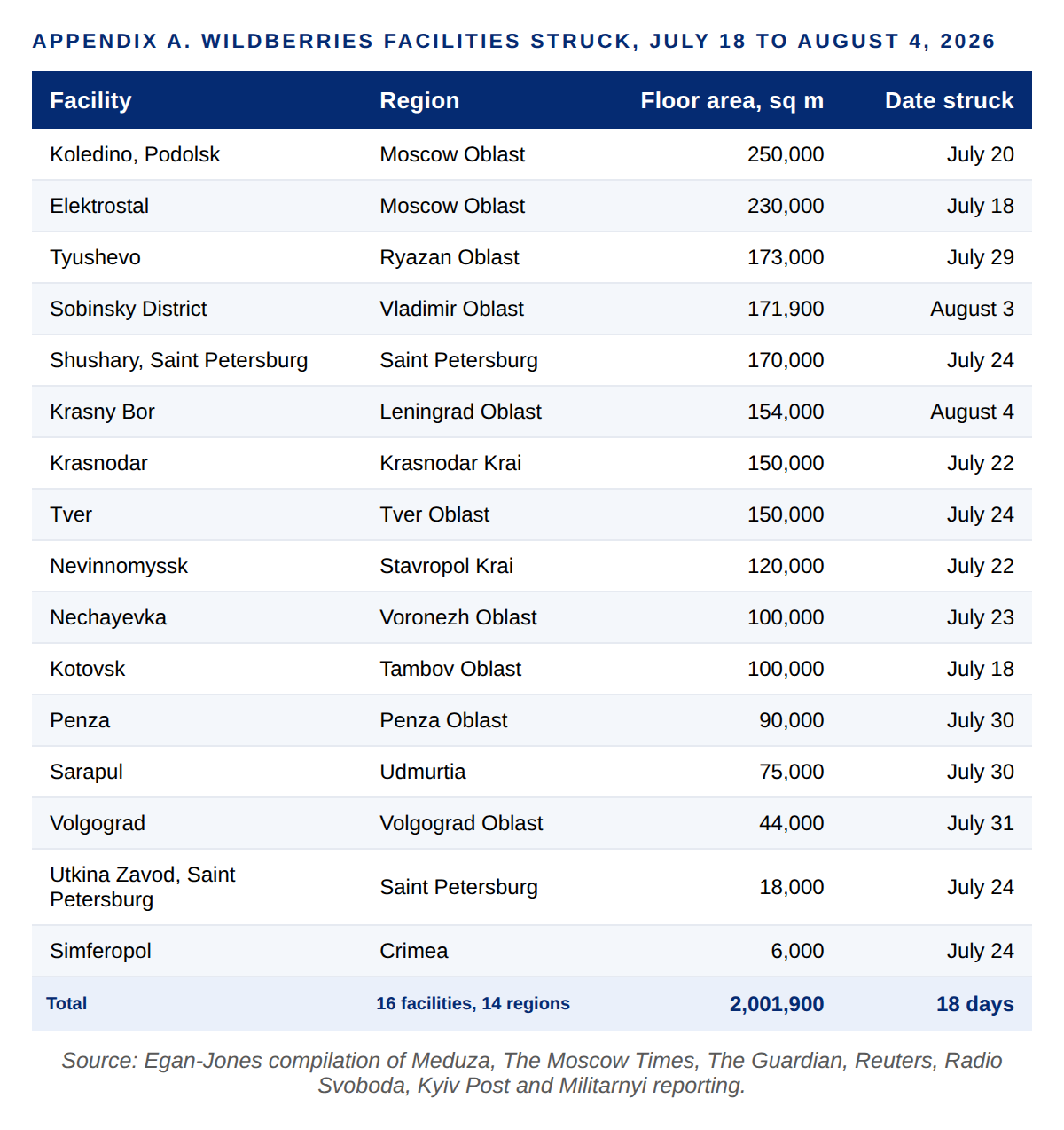
Between July 18 and August 4, 2026, drones struck at least sixteen Wildberries facilities across fourteen Russian regions, from Krasnodar in the south to Sarapul in Udmurtia. The published floor area comes to roughly 2.0 million square meters, about 21.5 million square feet, in eighteen days. Data Insight put lost merchandise alone at 170 billion rubles, near $2.2 billion, by July 24.4 Experts told Kommersant that restoring the Tambov and Elektrostal sites could run to 35.8 billion rubles, about $457 million, and that insurers would probably not cover it in full.5 The Elektrostal fire burned for four days.
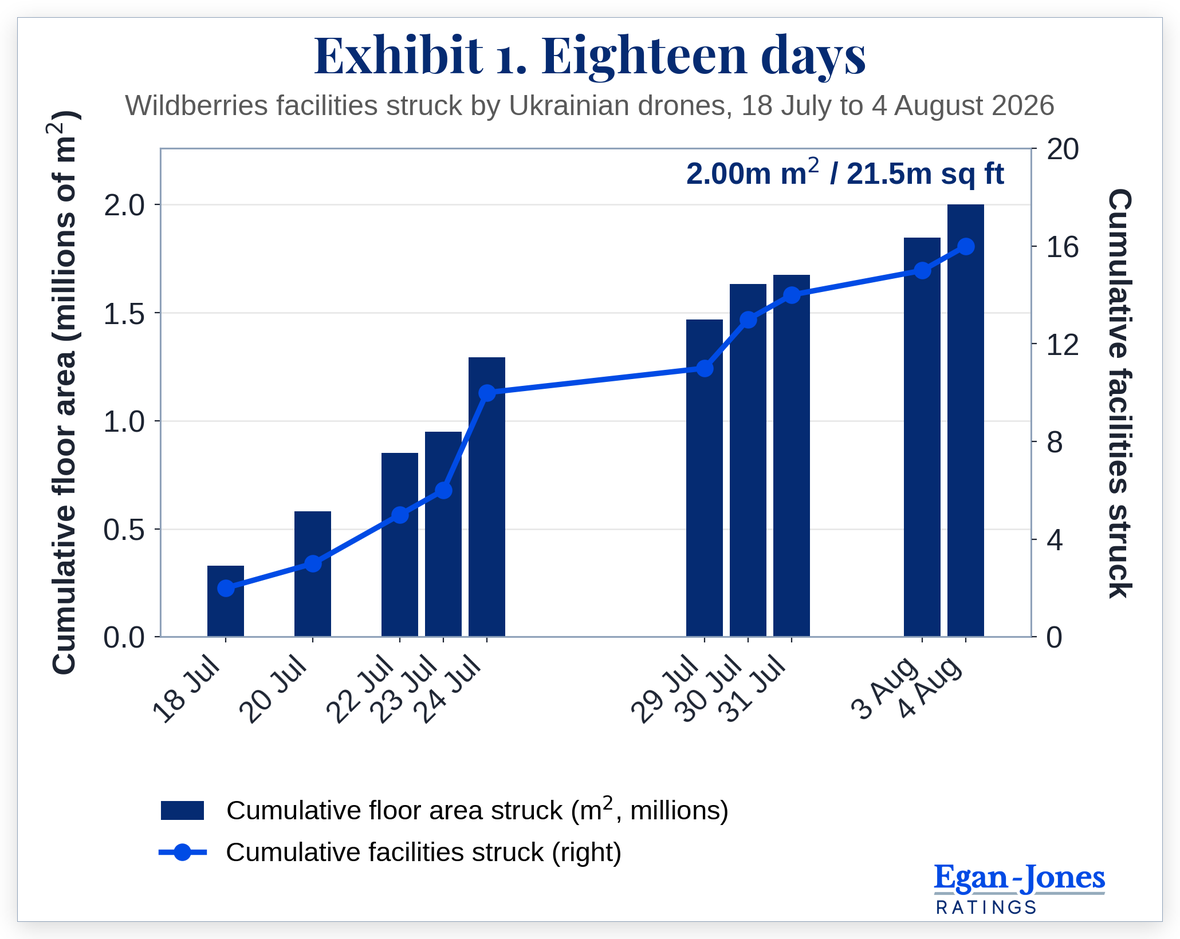
Exhibit 1. Eighteen days
Source: Egan-Jones compilation of Meduza, The Moscow Times, The Guardian, Reuters and Radio Svoboda reporting. Covers the sixteen struck facilities with published floor area; Meduza's running count reached twenty facilities by August 4, 2026.
A consumer retailer lost the equivalent of twenty-one large distribution centers in under three weeks. Appendix A lists the facilities.

IV. How to Protect Assets

Four responses are available to a state whose commercial base sits in range, and each of them has a ceiling.
  • Passive hardening. This includes using concrete shields, burial, or dispersal of inventory for protection. However, this is not economically viable at scale.
  • Active defense. Interceptors and counter-drone systems are much more expensive than attacking drones. Further, the success rate must be 100%.
  • Retaliation. This conventional approach requires a concentrated, known adversary holding assets it values. As was seen in Afghanistan, this can be a challenge to combat dispersed non-state actors. For retaliation to be effective, it requires the final approach, surveillance.
  • Surveillance. The United States operates the most capable monitoring apparatus in history, as Edward Snowden's 2013 disclosures about the National Security Agency established, and intelligent devices keep extending it. Surveillance narrows the planning window. Russia has the FSB, and Russia lost sixteen warehouses in eighteen days.
Exhibit 2. The exchange ratio
Sources: Ukrainian official estimates reported for Operation Spiderweb, June 1, 2025; published Shahed-136 unit-cost estimates and leaked Iranian procurement documents; US Central Command disclosed build cost for the LUCAS one-way attack drone, December 2025.
For active hardening, the defender pays between twenty and six hundred times the attacker's unit cost.

The durable answer has usually been commercial. The Soviet Union failed primarily due to economics. Economic weight and the value of repeat business provide a unique type of protection, and that observation is the reason American commercial strength deserves more analytical weight.

V. Where the Loss Lands

On July 7, 2026, eleven days before the first strike, Wildberries revised its terms and conditions to disclaim liability for goods destroyed in force majeure events, drone strikes among them.4 Sellers whose inventory burned were compensated for none of it. A contract amendment moved the loss from the largest platform in Russian e-commerce onto thousands of small merchants with no capacity to absorb it. Insurance took a share and declined the balance.

The lending channel is where a credit analyst should look hardest. On July 27, Denys Shtilerman of the Ukrainian firm Fire Point described Wildberries' relationship with state-controlled VTB Bank as part of the strategic case for the target, called Wildberries the largest borrower in Russia, and argued that its failure would carry several banks down with it.6 Whatever one makes of that claim, the structure it describes is ordinary. A physical loss at a dispersed borrower resolves into a capital question at a lender whose own assets were never subject to attack.
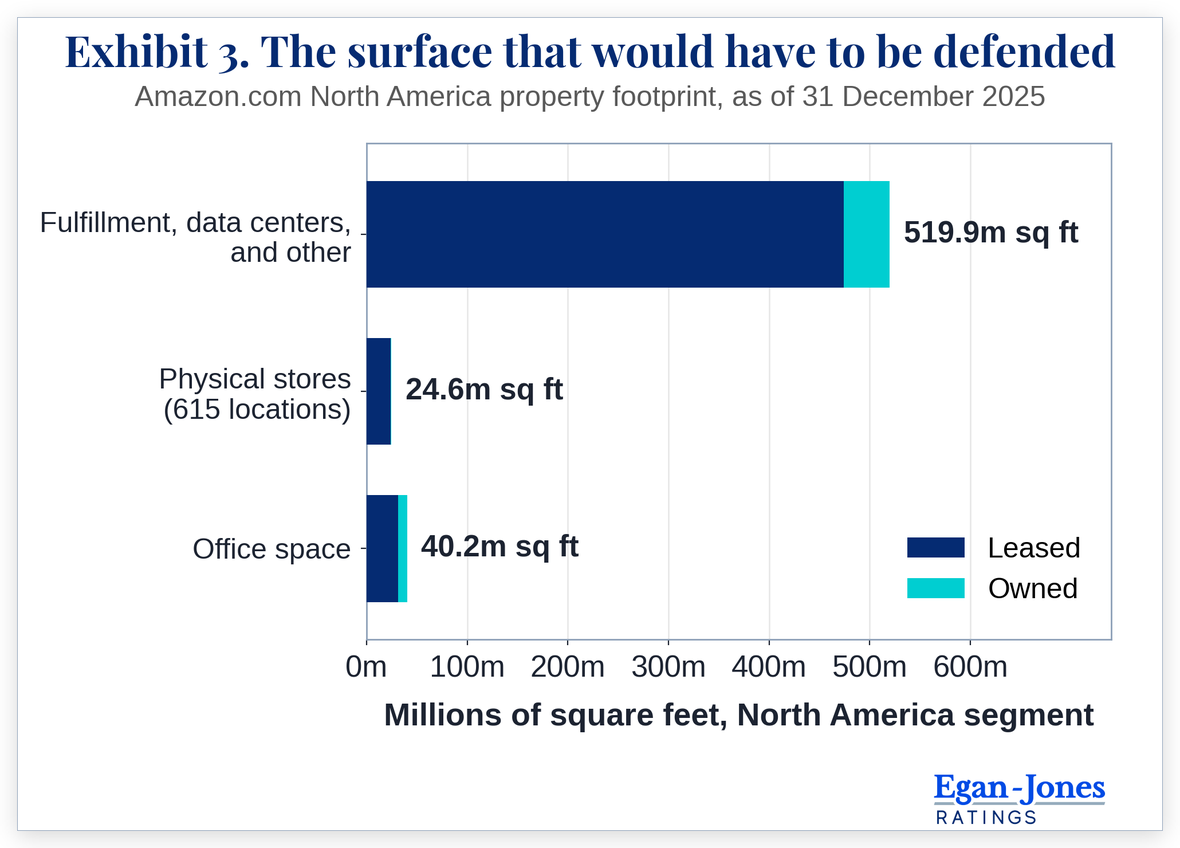
Exhibit 3. The surface that would have to be defended
Source: Amazon.com, Inc. Form 10-K for the fiscal year ended December 31, 2025, Item 2, Properties (filed February 6, 2026).

Amazon's most recent Form 10-K reports 519.9 million square feet of fulfillment, data center and other space in North America alone.7 The Wildberries floor area burned in eighteen days equals about 4 percent of that single figure.
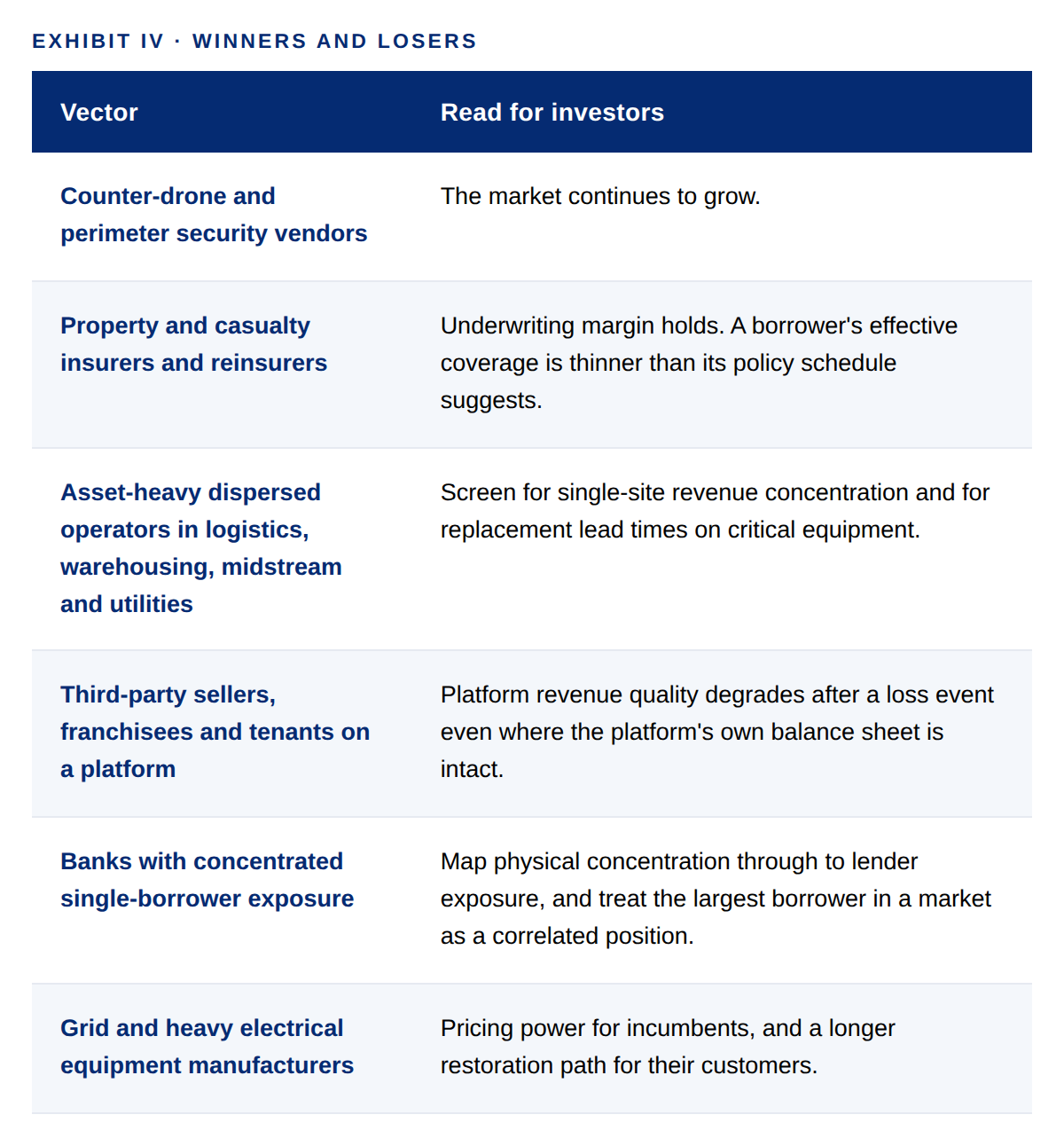
VI. Underwriting It

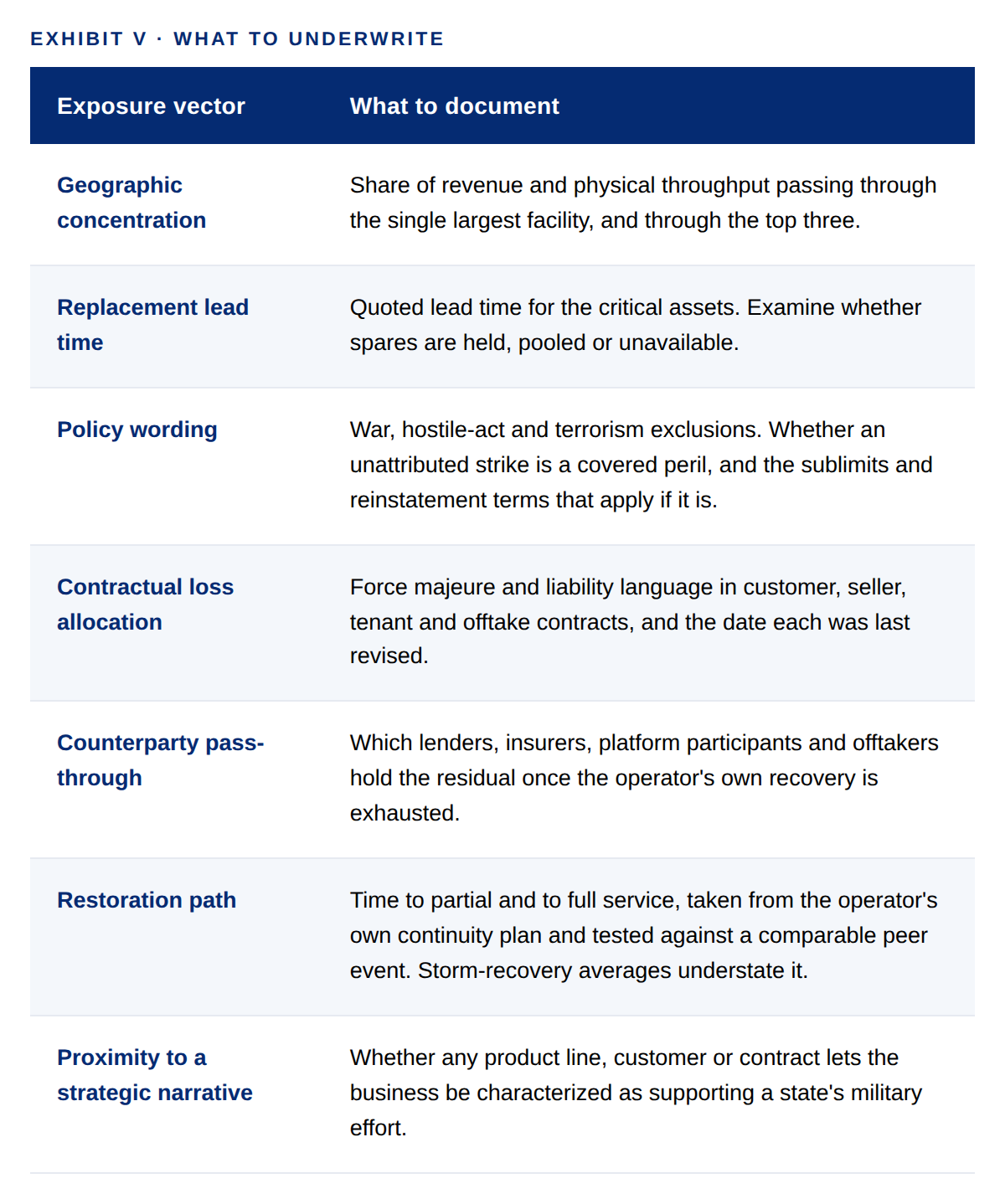
An institutional investor holding asset-heavy private positions should determine whether exposure to state-level risk was examined at all. Exhibit V outlines dimensions one can examine.
VII. Conclusion

Mutually assured destruction has not failed for state actors. However, non-state and particularly solo actors aided by AI have exposed massive vulnerabilities in American assets. Losses can be inherited by those who were not struck directly. The world is changing rapidly. This installment aims to provide a framework of possible major shifts for the benefit of sophisticated institutional investors and risk managers, and here the framework is a short list of questions.

Appendix A

Wildberries Facilities Struck, July 18 to August 4, 2026

The sixteen facilities below are those with published floor area. Meduza's running count reached twenty facilities by August 4, 2026.8 The July 25 strike at Yekaterinburg is excluded, as footage indicated the adjacent parking area was hit and operations resumed within four hours.
Sources & Footnotes

  1. Ukrainian official damage estimates for Operation Spiderweb, June 1, 2025. Approximately one third of Russia's strategic cruise missile carriers, valued near $7 billion, struck with drones costing about $2,000 each.
  2. Ukrainian deep strike campaign against Russian refining, including the July 7, 2026 strike on the Omsk refinery at a range of almost 2,500 kilometers, and the International Energy Agency's assessment that more than 20 percent of Russian refining capacity was offline as of July 2026.
  3. Wildberries market share, tax standing, sanctions status and product listings: Ukrainian strikes on Wildberries warehouses, with underlying reporting from Radio Free Europe/Radio Liberty and Reuters.
  4. Pjotr Sauer, "Ukraine strikes on Russia's 'Amazon' warehouses bring war closer to ordinary people", The Guardian, July 24, 2026. Source of the Data Insight loss estimate, the July 7 terms and conditions revision, and the quoted assessment of the protection problem.
  5. "What We Know About the Aftermath of Ukraine's Wildberries Drone Strikes", The Moscow Times, July 20, 2026, reporting expert estimates carried by Kommersant.
  6. Warren Murray, "Ukraine war briefing: Wildberries attacks shake Russian economy and banking", The Guardian, July 29, 2026, reporting remarks by Denys Shtilerman of Fire Point.
  7. Amazon.com, Inc., Form 10-K for the fiscal year ended December 31, 2025, Item 2, Properties, filed February 6, 2026. North America segment: 474,128 thousand square feet leased and 45,803 thousand owned in fulfillment, data centers and other.
  8. "Ukraine has hit 20 Wildberries warehouses since mid-July", Meduza, August 4, 2026, and "Ukraine keeps striking Wildberries warehouses. Here's the toll so far.", Meduza, July 24, 2026. Running facility count and per-site casualty and fire-duration detail.

Additional Sources

  • Exhibit 1 and Appendix A: Egan-Jones compilation of Meduza, The Moscow Times, The Guardian, Reuters, Radio Svoboda, Kyiv Post and Militarnyi reporting.
  • Exhibit 2: Published unit-cost estimates for Operation Spiderweb, the Shahed-136 and the US Central Command LUCAS one-way attack drone.
  • Exhibit 3: Amazon.com, Inc. Form 10-K for the fiscal year ended December 31, 2025, Item 2, Properties.
Egan-Jones Insight
Receive the latest insights on the proxy market.
Read about our privacy policy.
Thank you! Your submission has been received!
Oops! Something went wrong while submitting the form.