Both parties’ mainstreams look set to keep backing the AI buildout, as they did pharma; the pushback comes from populists and the states.
Published on
November 5, 2026
Overview
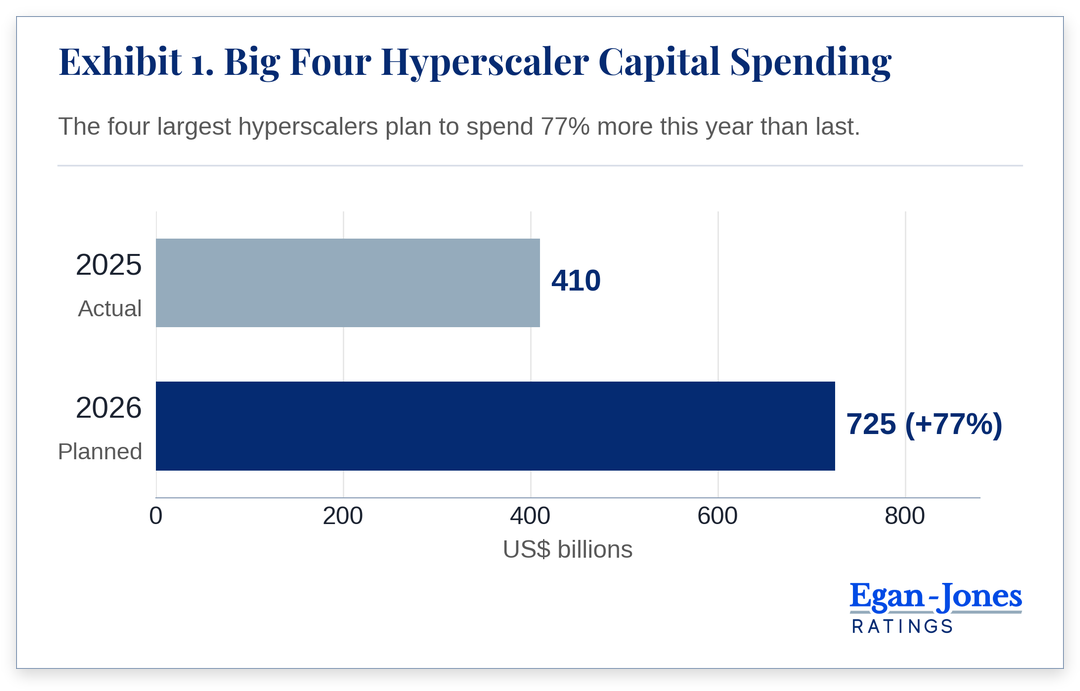
The four largest hyperscalers plan over $700 billion of capital spending this year;1 the pro-AI super PAC network Leading the Future has raised $140 million for the midterms.2
Alphabet, Amazon, Meta and Microsoft. Source: Yahoo Finance, June 3, 2026.
Our premise is that the mainstreams of both parties will keep backing AI in effect if not in rhetoric, as they have backed drug makers through years of public anger over prices. The populist wings will be the primary push to halt the buildout or spread the wealth. This installment offers sophisticated institutional investors and risk managers a framework for the political risk associated with the unprecedented AI buildout.
I. The Pharma Playbook
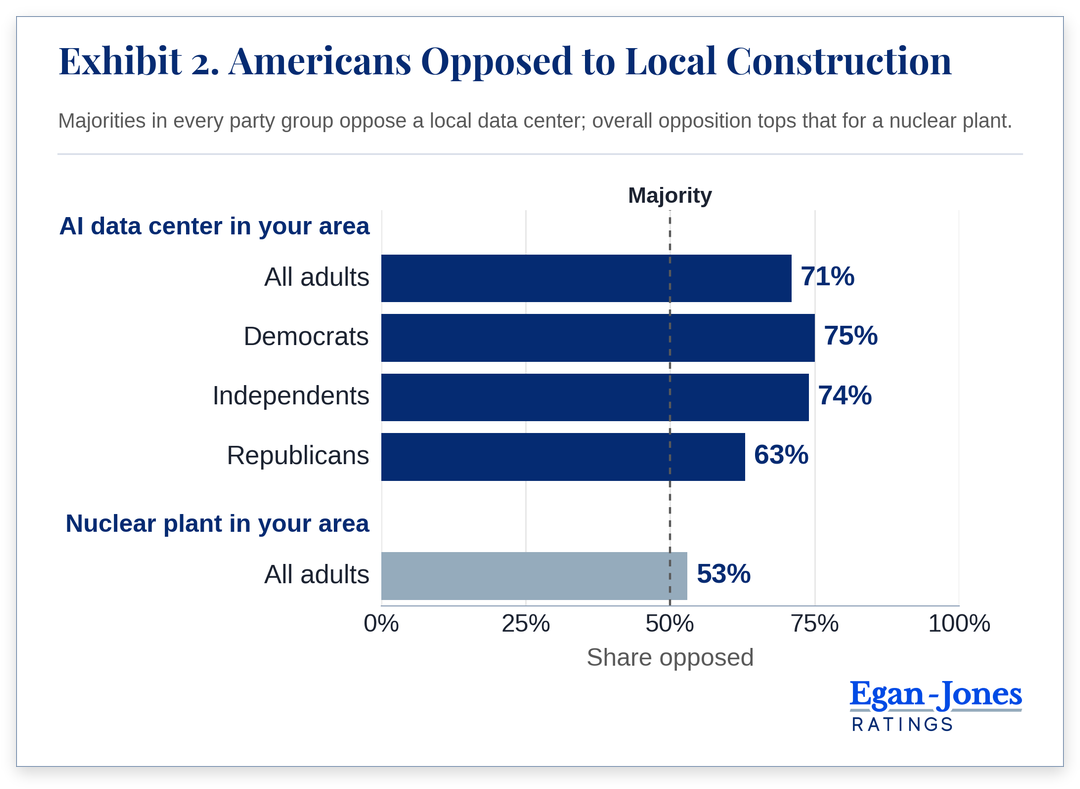
Gallup finds 71% of Americans oppose a local AI data center, versus 53% for a nuclear plant.3
Source: Gallup, survey of 1,000 adults, March 2-18, 2026.
Similarly, drug makers have remained unpopular for years,4 yet pharma has outspent every other industry on federal lobbying in all but one quarter since 2010,5 and both parties keep backing it. Public anger over prices was concentrated toward profit-seeking fall men such as Martin Shkreli, though no new laws have been sufficient to halt growth in the lucrative industry.
Credit cards and sports betting show the same pattern. A 10% cap on card interest rates, backed at different times by President Trump, Bernie Sanders and Josh Hawley, has sat in committee since February 2025.6 Sports betting is now legal in much of the country, though 43% of Americans call that bad for society and 7% call it good,7 and betting companies had put $45.6 million into this year’s midterms by the end of the first quarter.8
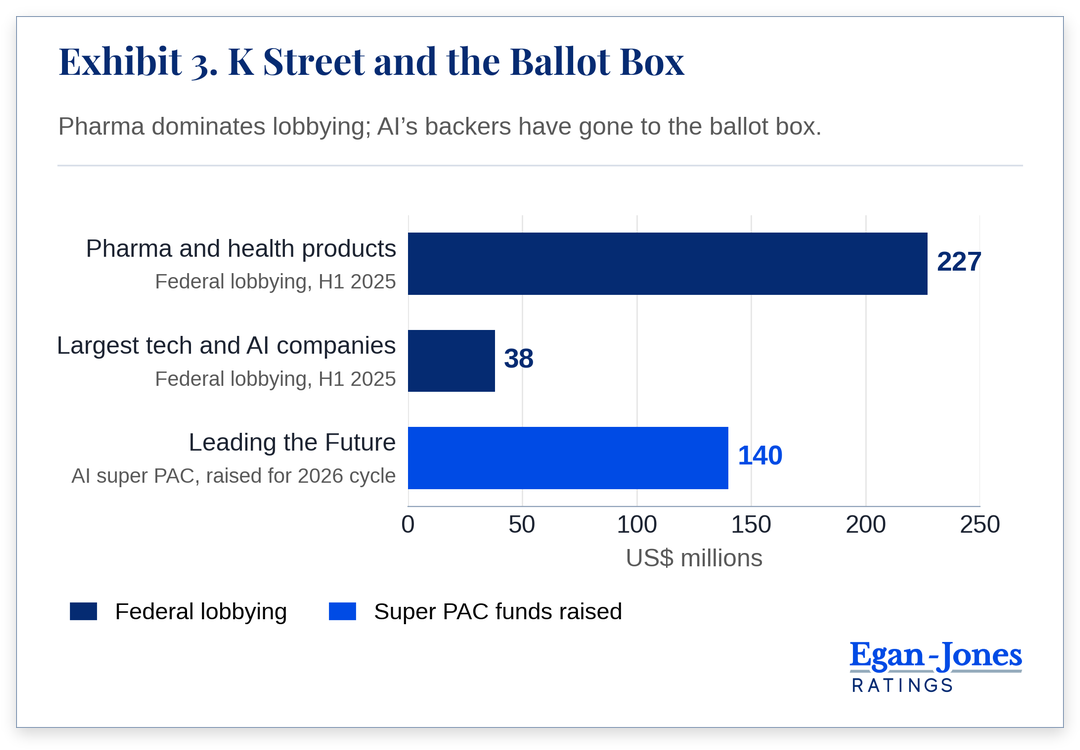
We expect AI to follow the same path, perhaps further. Big Tech and AI spend about a sixth of pharma’s lobbying total9 but have made up ground at the ballot box: Leading the Future spent some $8 million against Alex Bores, author of New York’s AI safety law, who narrowly lost his June primary.2
Sources: OpenSecrets analysis via The Fulcrum; Issue One (the 11 largest tech, social media and AI companies plus their trade groups); Pluribus News via Arizona Capitol Times. Lobbying and super PAC figures measure different activities over different periods.
II. 417 to 3
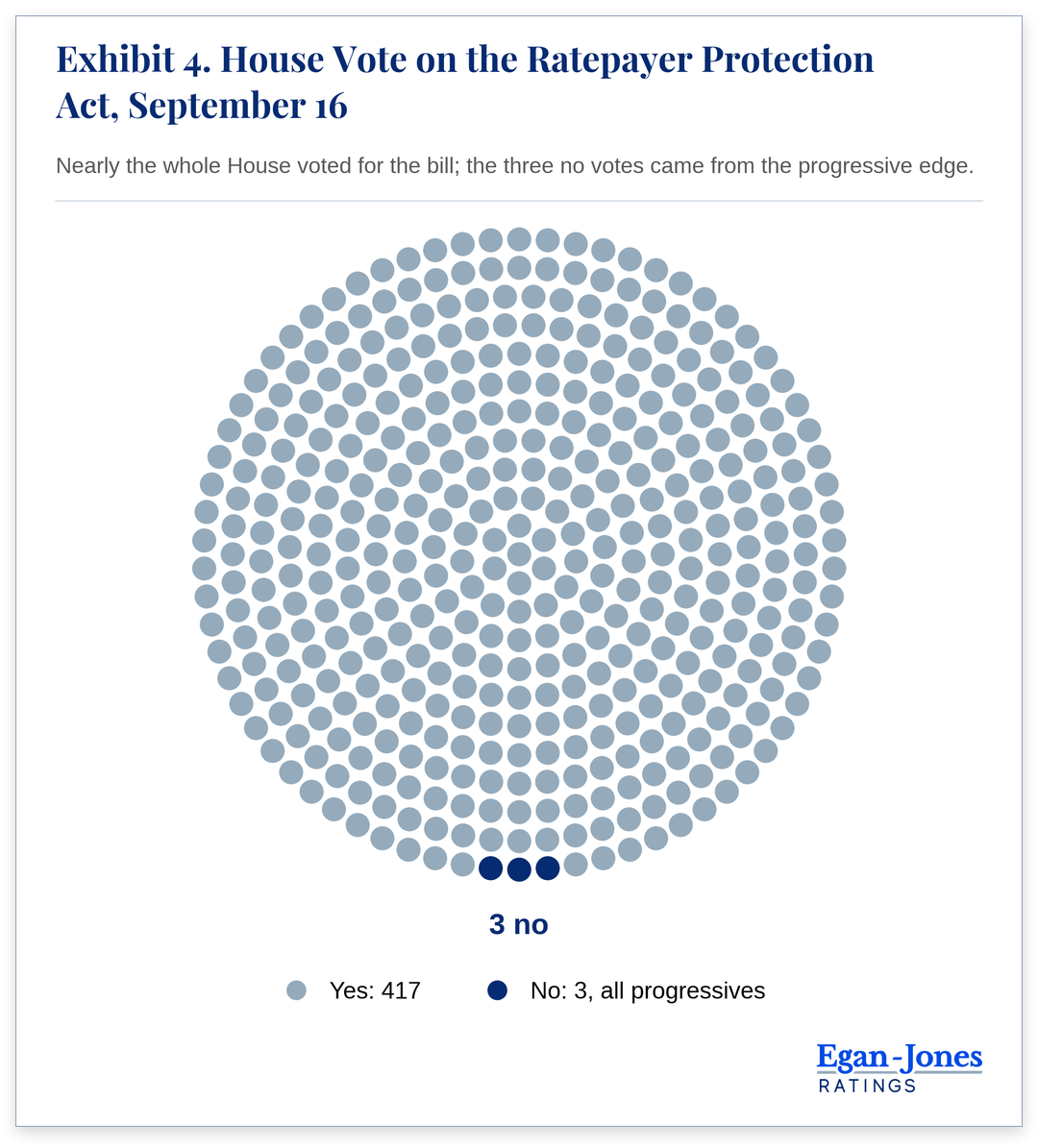
The House vote on September 16 shows how that works. By 417 to 3, members passed a bill pushing states to make large data centers pay for the power lines and plants built to serve them.10 It answers one of the public’s main complaints, higher power bills, and puts no limit on how many data centers get built. All three no votes came from progressives, and one of them, Rashida Tlaib, called for a national moratorium.
One dot per vote cast. Source: NBC News, September 16, 2026.
That is the mainstream approach by both parties: act to show the public that some action was taken, though do not halt growth.
III. The States Push Back
Governors face pushback for infrastructure projects more directly, and several have turned on the industry. Greg Abbott, who once billed Texas as the “epicenter” of AI, has frozen new data center grid approvals and permits ahead of his reelection bid.11 Gavin Newsom, who vetoed a water disclosure bill last year, signed a seven-bill package on September 21 that shifts grid costs onto operators.12 Ron DeSantis, a Republican wary of AI, signed a law in May so that Floridians would not pay “one more red cent” for data centers’ power;13 talks with the White House softened the final bill.14
China has been supportive of forestalling U.S. AI development. In June OpenAI shut down ChatGPT accounts likely run by a private Chinese technology firm working for Chinese provincial government clients; they produced posts and cartoons blaming data centers for higher power bills.15 In August X disclosed about 200 accounts from a suspected Chinese bot farm pushing the same message, accounts it had already suspended earlier in the year.16
IV. Incumbent Advantage
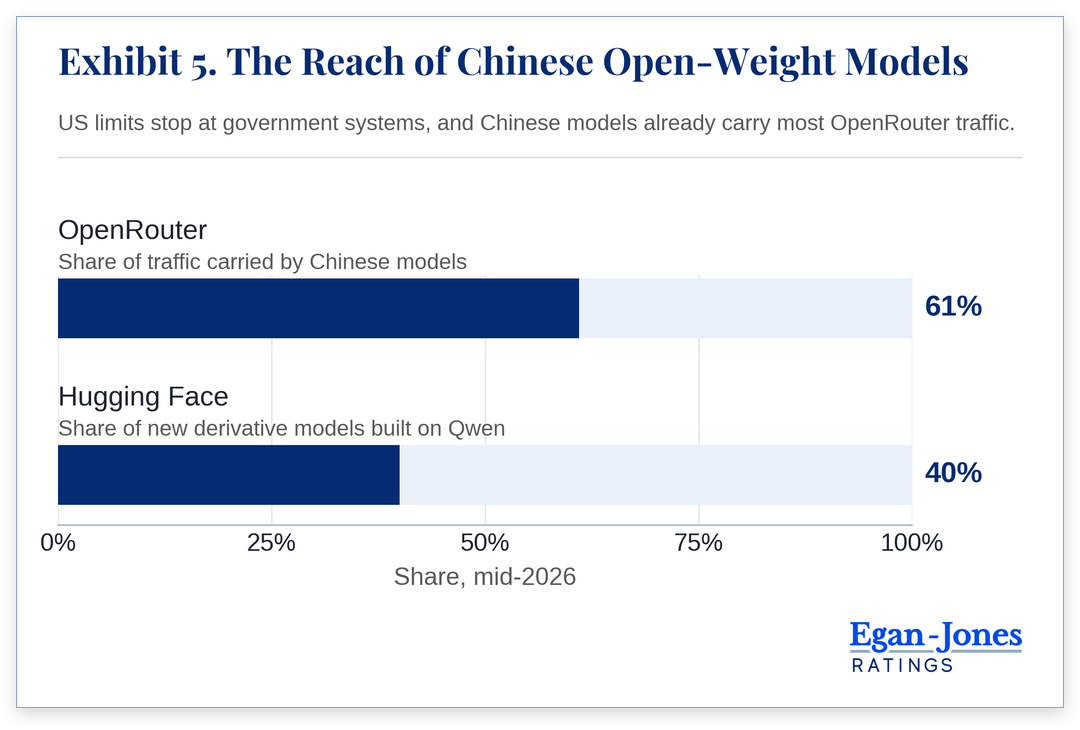
An important question is federal regulation on AI. No clear path forward is underway as the current White House seems opposed to federal regulation in order to avoid stymying AI growth. However, incumbents often seek regulatory capture: rules that end up serving the firms they regulate by dissuading newcomers.
Source: Sheppard Mullin, July 23, 2026, citing OpenRouter and Hugging Face data.
V. Credit Impacts
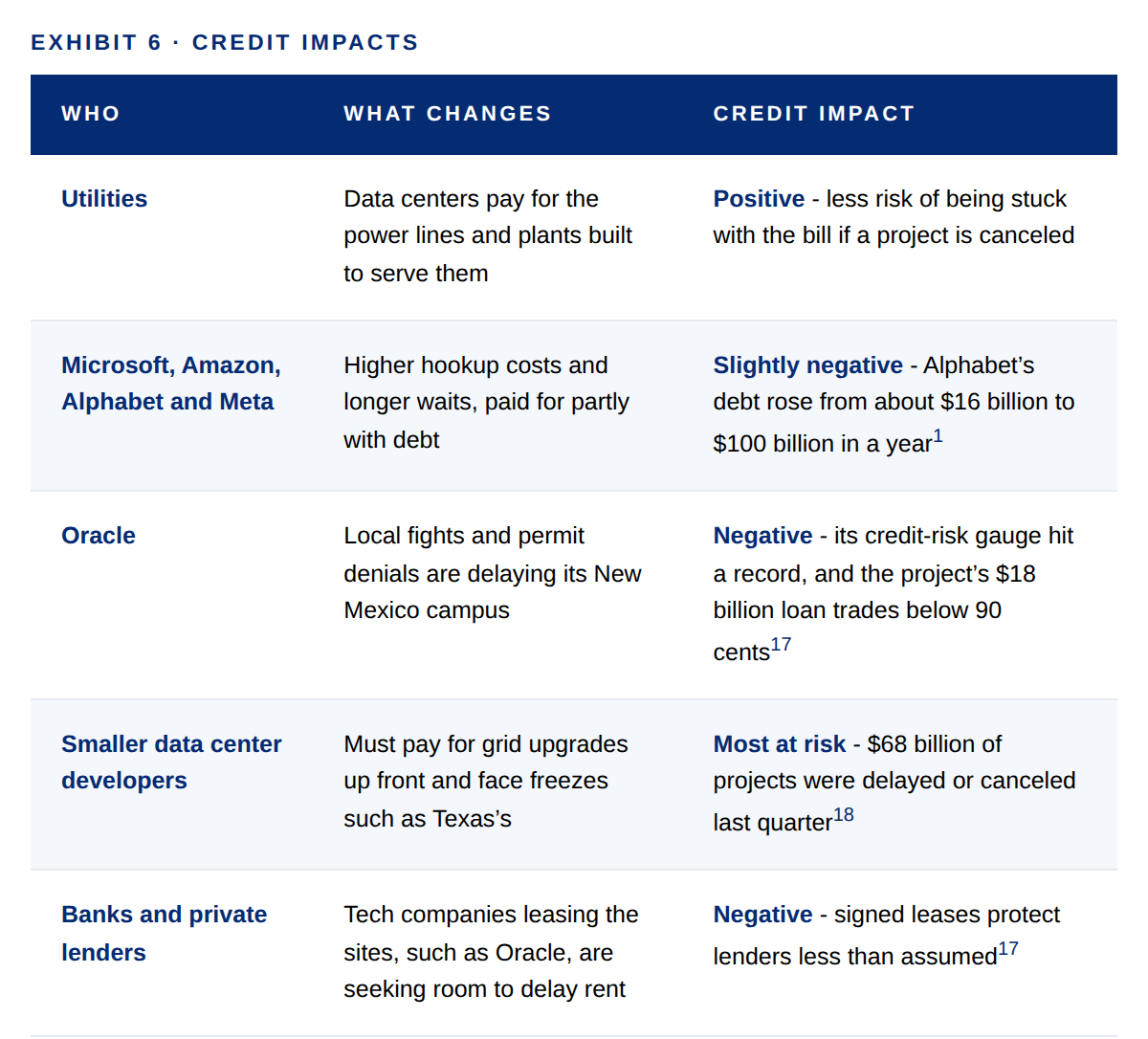
The fight over who pays for power, and who waits for permits, lands on credit as follows.
Egan-Jones assessment; sources in notes 1, 17 and 18.
VI. Conclusion
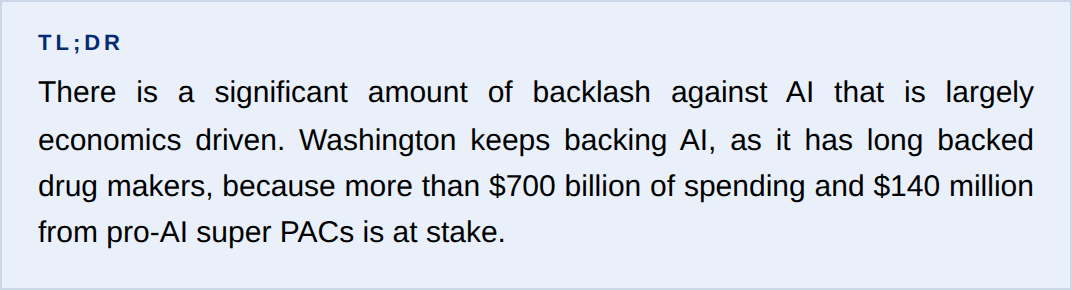
It is reasonable to expect higher costs and slower permits for the industry. The money keeps both parties’ mainstream on board with AI growth. This is perhaps the fastest industrial buildout in world history. Sophisticated institutional investors must pay attention.
Sources & Footnotes
TMT Finance, “2026 hyperscaler capex tops US$700bn - analysis”, August 18, 2026, covering Microsoft, Alphabet, Amazon and Meta guidance after second-quarter results. The same analysis reports Alphabet’s debt rising from about $16 billion a year earlier to roughly $100 billion.
Pluribus News via Arizona Capitol Times, “AI super PACs flood money into state elections”, August 16, 2026. Leading the Future is a $140 million pro-AI super PAC network whose key funders include Andreessen Horowitz and OpenAI president Greg Brockman. It mounted an $8 million campaign against New York Assemblymember Alex Bores, sponsor of the RAISE Act, who came in a close second in the June primary in New York’s 12th District.
NBC News, “House passes bill to shield consumers from data center price hikes on energy”, September 16, 2026. The only opposition came from progressive Reps. Summer Lee, Delia Ramirez and Rashida Tlaib; Tlaib called for a national moratorium. The bill requires states to consider standards for large loads to cover the cost of serving them (Utility Dive); it awaits Senate action.
CalMatters, “What to know about 7 new data center laws Gavin Newsom signed”, September 2026. Three of the laws shift electric infrastructure costs toward data center operators, three require disclosure of water and other resource use, and one removes environmental review exemptions.
Florida Phoenix via Route Fifty, “Florida has a new law regulating AI data centers”, May 8, 2026: the House rewrote the bill after conversations with the White House, and the final law was less expansive than DeSantis sought.
Bloomberg via Insurance Journal, “Oracle Cites ‘Force Majeure’ on Controversial New Mexico Data Center”, September 25, 2026. Oracle sent Blue Owl’s Stack Infrastructure a force majeure notice; about 20 banks provided the $18 billion construction loan; an Energy Transfer gas pipeline for the site slipped to February 1, 2027 after repeated permit denials; and the report notes the questions the notice raises about the resilience of data center leases.
Bannon’s backing of the Sanders and Ocasio-Cortez proposal, as reported by the Wall Street Journal and summarized by the Jerusalem Post. Hawley’s questioning of the buildout per Mother Jones, March 25, 2026.
Harvard Salata Institute, “On data centers, local vibes matter more than electricity prices - poll”, April 21, 2026. Average answers on a scale from 0 (strongly oppose) to 1 (strongly support), with 0.5 neutral: e-commerce warehouse 0.61, auto factory 0.57, data center 0.51, petrochemical plant 0.37. The survey also found that perceived quality of life weighed nearly three times as much as any other factor, power bills included.
Coverage by a Chinese state broadcaster and a Communist Party newspaper blaming AI data centers for higher US energy prices, cited in a May 2026 Bitcoin Policy Institute report, as described by PolitiFact, September 23, 2026.
Opening image: still from the film Margin Call (2011).
Exhibit 1: Yahoo Finance, June 3, 2026: Alphabet, Amazon, Meta and Microsoft plan $725 billion of capital spending in 2026, up 77% from $410 billion in 2025.
Exhibit 2: Gallup (note 3). Party figures add the somewhat and strongly opposed shares in Gallup’s tables.
Exhibit 3: pharmaceutical and health products federal lobbying, first half of 2025 (note 5); the 11 largest tech, social media and AI companies plus their trade groups, first half of 2025 (note 9); Leading the Future funds raised for the 2026 cycle (note 2). Pharma’s $226.8 million is shown rounded to $227 million.
Exhibit 4: NBC News (note 10).
Exhibit 5: Sheppard Mullin, “Choosing Between U.S. and Chinese AI Models: The Export Control Risks on Both Sides”, July 23, 2026: Chinese models accounted for roughly 61% of tokens processed on OpenRouter in mid-2026, and the FY2026 NDAA bars the Defense Department and its contractors from using DeepSeek; also the source for Qwen’s share of new derivative models on Hugging Face.
Exhibit 6: Egan-Jones assessment drawing on notes 1, 17 and 18.
Egan-Jones Insight
Receive the latest insights on the proxy market.
Thank you! Your submission has been received!
Oops! Something went wrong while submitting the form.