.svg)
Over just the past two years, Jack in the Box (NASDAQ: JACK) has yielded a -76% return for investors, significantly under performing peers and the total market (see Figure I).
Accordingly, Egan-Jones recommends shareholders withhold votes from Chairman David Goebels as well as Guillermo Diaz, Jr., Madeleine Kleiner, Michael Murphy, James Myers, and Vivien Yeung, whose tenures have coincided with severe and sustained value destruction at the Company.
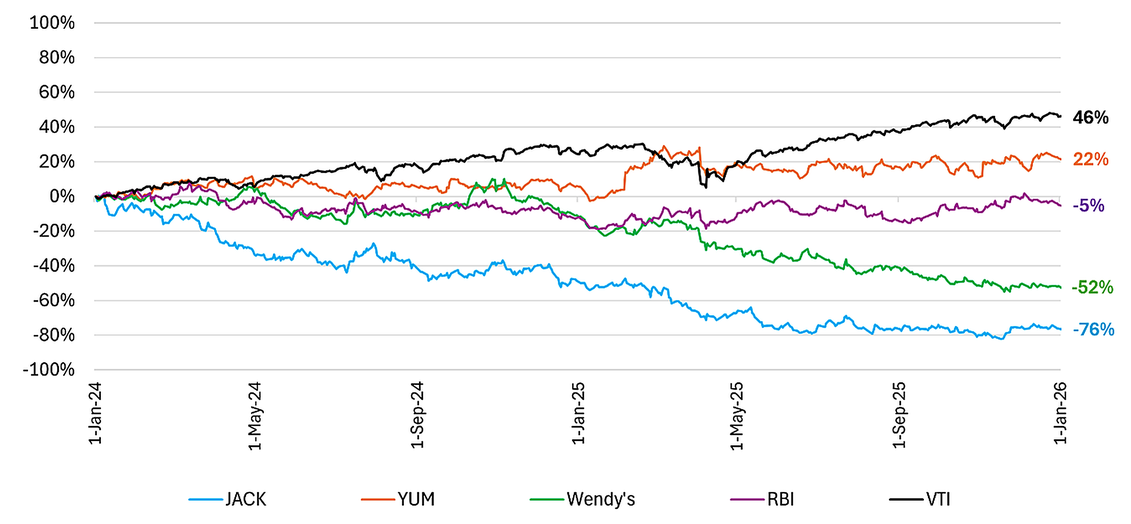
Yum! Brands include Taco Bell, KFC, Pizza Hut, and Habit Burger & Grill. Restaurant Brands International (RBI) includes Burger King, Tim Hortons, Popeyes, and Firehouse Subs. McDonald’s is excluded from our peer comparison because its market capitalization is more than 100 times larger than that of Jack in the Box, making it an unsuitable benchmark for our analysis.
Jack in the Box’s challenges stem primarily from declining customer traffic over the past several years. While multiple factors have contributed to this trend, a lack of consistent and focused branding appears to be a central issue. Compounding these challenges, the Company has experienced significant executive turnover in recent years and recently sold Del Taco at a significant loss.
In April 2025, management launched the JACK on Track strategic plan to address these issues. However, the plan has yet to demonstrate meaningful results. Same-store sales continued to deteriorate following the plan’s introduction, declining to -7.4% year-over-year in Q4 of FY 2025.
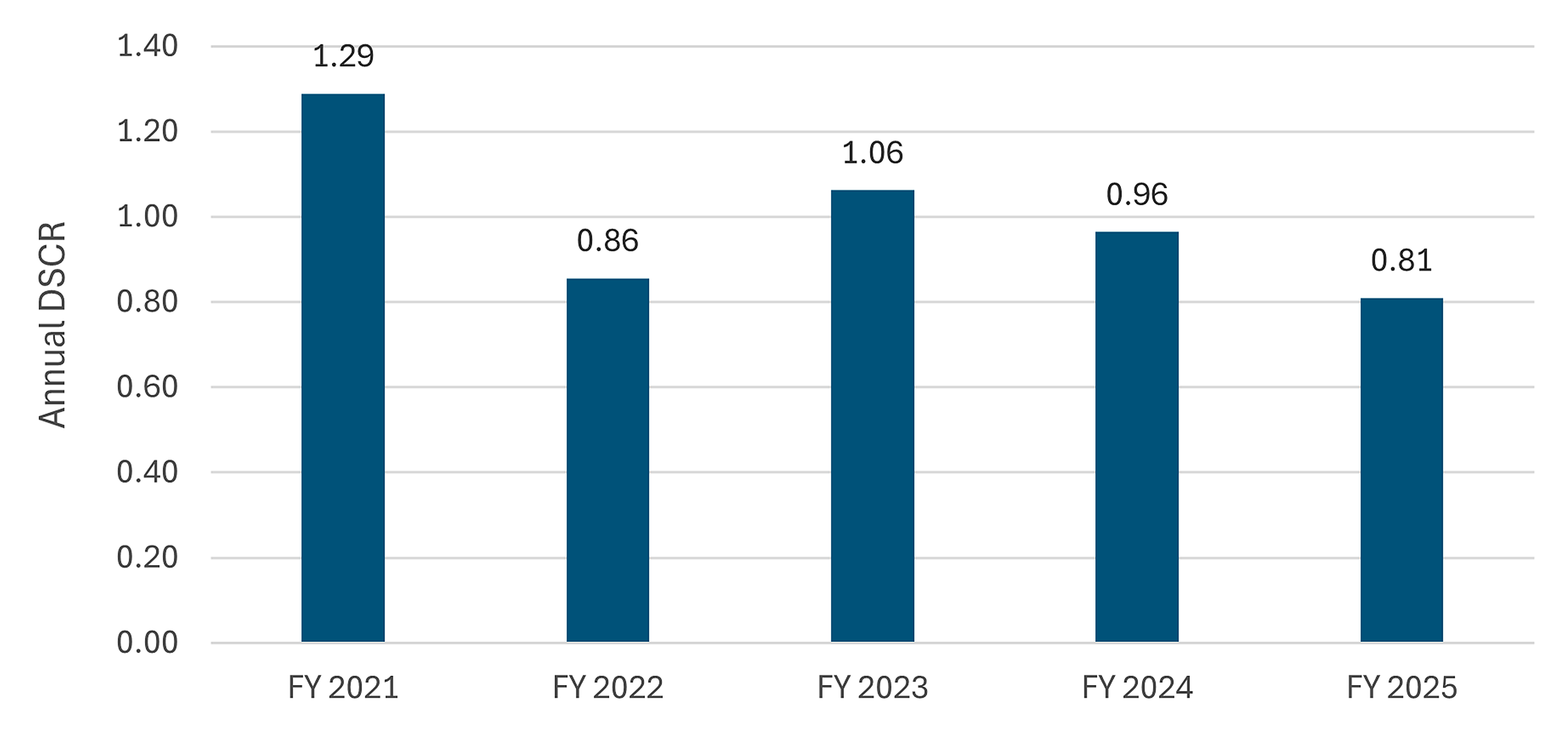
The Company is also highly leveraged, with a debt service coverage ratio (DSCR) of less than one in the last two fiscal years. Unless Jack in the Box can execute its planned debt reduction of approximately $300 million over the next 12-18 months while simultaneously improving store traffic and earnings, it may struggle to meet its debt obligations.
Founded in 1951 in San Diego by Robert O. Peterson, Jack in the Box was an early innovator in fast food, pioneering the modern drive-through with two-way intercom ordering. Its early branding leaned heavily on a clown mascot and novelty appeal. As the chain expanded through the 1960s and 1970s, it began repositioning toward a broader, more adult audience.
A major inflection point occurred in the 1980s, when the Company famously “blew up” its clown imagery in advertising and adopted a more irreverent, tongue-in-cheek tone. This period also saw menu diversification beyond burgers and a brief, unsuccessful attempt to rebrand as Monterey Jack’s. Following a highly publicized E. coli outbreak in the mid-1990s, Jack in the Box focused on rebuilding trust through food-safety reforms and reintroduced “Jack” as a satirical, corporate-style mascot.
The Company developed a reputation for an eclectic menu featuring tacos, breakfast items, and unconventional limited-time offerings, paired with humor-driven marketing rather than family-oriented nostalgia.
In April 2025, just weeks after Lance Tucker began his tenure as CEO of Jack in the Box, the Company introduced its JACK on Track strategic plan. Management characterizes the plan as an effort to simplify the business and transition toward a more asset-light operating model.
According to the Company, the strategy focuses on three primary initiatives:
With falling earnings and cash flow, Jack in the Box is poorly positioned to address its debt service each year, as evidenced by a DSCR of less than one in the past two years. Under the JACK on Track plan, the Company has indicated its intention to reduce debt by approximately $300 million over a 12-18 month period. However, achieving this target alone may be insufficient.
Additionally, the Company does not seem on track to make that goal as of its February 5, 2025, press release. The Company will also need to materially improve earnings and cash flow generation to meet its debt obligations.
To date, management’s strategy has failed to deliver results. Same-store sales growth was modest in Q1 2025 at 0.4% year-over-year (prior to the plan announcement) but declined to -7.4% year-over-year in Q4 of FY 2025, marking some of the weakest performance reported in years. This sustained deterioration suggests that consumer sentiment has not improved, while the continued weakness in the Company’s share price indicates that investor confidence remains impaired.
Under all its policies, Egan-Jones therefore recommends withholding votes from several directors who have overseen this value destruction.


.jpg)