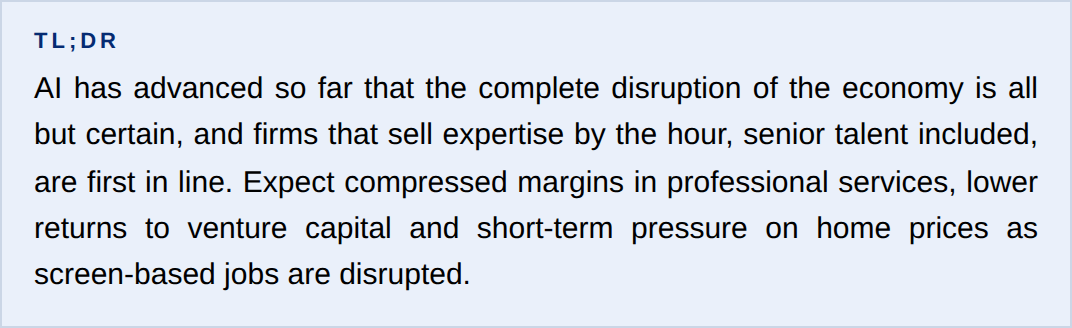
AI disruption is all but certain; professional services, venture capital and housing feel the first pressure.
Published on
November 5, 2026
Note that this piece is not written by credit analysts and the image above is not intended to be interpreted as a view on credit quality but rather as structural pressure to business.
I. Overview
AI has advanced so far that we regard the complete disruption of the economy as a near certainty. It is already in charge of much knowledge work. Human input and ingenuity are of decreasing importance in the process of production.
The reason why we are making more definitive statements now is that the capabilities of the latest models appear to have surpassed a threshold of quality in their output and speed for widespread adoption.
This installment aims to provide a framework for sophisticated institutional investors and risk managers as the disruption spreads.
II. A Faster Horse
Henry Ford is often credited with saying that customers, asked what they wanted, would have asked for a faster horse.
False premise Most companies are seeking to use AI to run their existing operations more quickly. The bigger shift is an entirely new paradigm in which firms with very few people are far more successful, and some may have no people at all.
Around the clock Businesses of the past kept operating hours. Businesses of the future will not. The internet already made fulfillment a 24/7 affair, and AI now does the same for productive work. SpaceXAI's Grok Bot, launched in August, gives each agent its own computer and keeps it working 24/7;1 Anthropic's Claude has run scheduled tasks in the cloud, laptop closed, since July;2 and OpenAI has followed their lead.3
Goodbye, GUI Software-as-a-service firms often pride themselves on an intelligent user interface. The Model Context Protocol (MCP), an open standard Anthropic introduced in 2024, lets an AI model plug into outside software and data through one common interface.4 With MCP, the data source's graphical user interface (GUI - pronounced gooey) matters less. The cutting edge mode of interaction has become a conversation with an AI platform, which reaches into those other platforms and builds a unique GUI interface on the fly only if the user needs it. - Goodbye, GUI. It's been nice. Hope you find your paradise.
Less make-work Much of what filled the grueling hours was make-work; the pitch books and models that consumed bankers' weekends take AI minutes. Work gets easier for the people who remain.
III. Just Business
So-called professional services These firms sell intellectual capital by the hour. When a handful of people with AI can do a floor's work, professional services price will decline significantly.
Audit - KPMG pressed its own auditor, Grant Thornton UK, to pass on AI savings and won a 14% fee cut.5 Every audit client will expect the same and this is only going to accelerate.
Investment banking - Ties to regulators, clients and counterparties will likely give incumbents significant moats. However, the ultimate work product is information and this can be replicated by artificial intelligence.
Consulting - The prototypical output for a consultant is a deck, and AI now assembles one, fully sourced, in minutes. Thus, justifying many billable hours is much more difficult. Further, implementation needs a fraction of the staff. When Anthropic said Claude Code could take on the analysis behind modernizing old COBOL systems, IBM lost 13% of its share price in a day, its worst session since 2000.6
Law firms - Reviewing and drafting contracts or assessing legal risk becomes far easier with artificial intelligence. It's difficult to see how long billable hours working on a case will continue to be justified.
Engineering firms - Drafting, modeling and code fill much of the billable engineering day, and AI handles a growing share of each.
As pressure mounts to adopt AI, there are a few important notes:
Many customers will care much about reducing legal and cyber risk. These are temporary, relatively shallow moats for incumbents. Notably, AI can help address these as well.
A large workforce may have negative value to a company as it costs more time and effort for implementation of new systems.
Many of the systems that have been set up for working are human-centric (e.g., order verification). Soon they will become more AI-centric, making firms more efficient and adoption faster.
2. The hand-knit sweater
While work done by a person may offer aesthetic value to some customers, like a hand-knit sweater, the vast majority of people don't much care about the source of the product. They care more about its price, quality, and availability.
3. Far lower barriers to entry
A small team with AI can already match the output of a large practice. New entrants can win work on price and quality, and grow without years of hiring, and incumbent scale matters less.
4. Seniority is no shield
Senior staff may be hit harder than juniors. They sell expertise, and expertise is now readily available through artificial intelligence. What protects them today is leverage inside the firm, since they decide where the cuts fall. That leverage buys time but not a guarantee of future employment.
IV. Cheaper Money
Startups now reach scale faster and on less capital. Venture money used to offer the means to acquire talent, the engineers and salespeople needed to build and sell a product. AI now does much of that work, so capital matters less to the companies that once depended on it. The result is a quiet deflation in the value of money: venture firms lose leverage, and their returns compress. We suspect few limited partners have priced this in.
V. Scaling
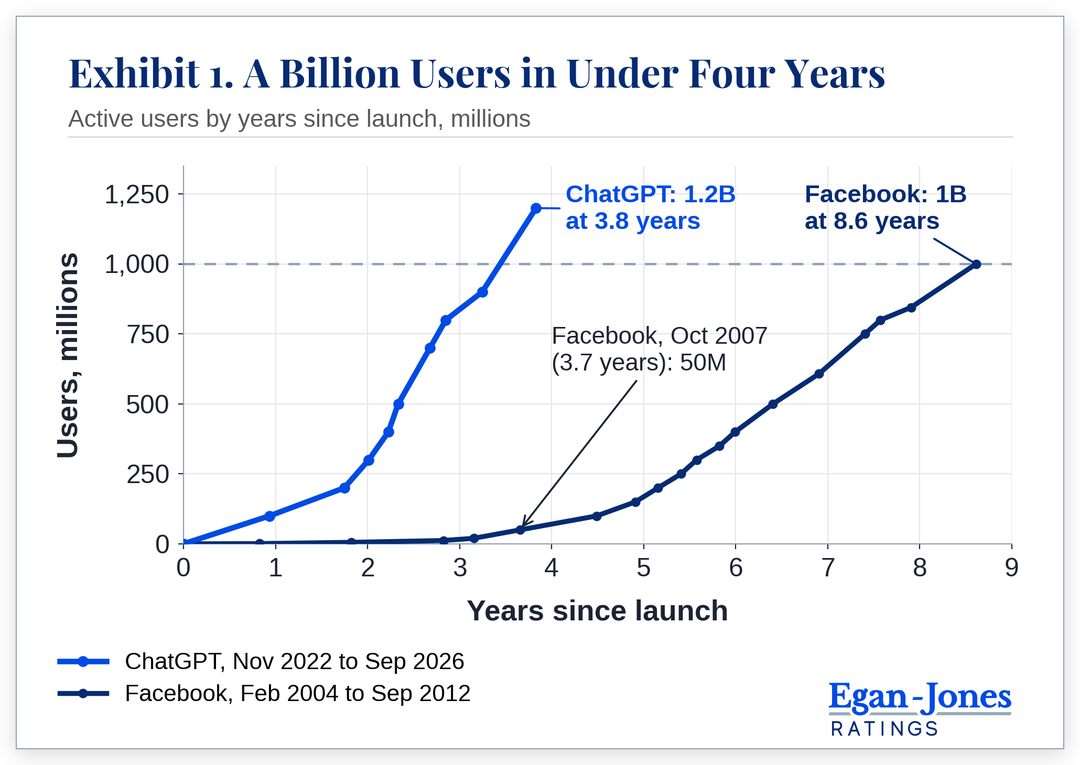
Just as AI companies scaled incredibly quickly, expect startups to scale more rapidly in the future, especially as discoverability via AI increases dramatically rather than reliance upon inefficient advertising. This also does not bode well for those vendors who rely highly on advertising.
Source: OpenAI, weekly active users as announced; Facebook, monthly active users from company milestones and its 2012 Form S-1.
ChatGPT reports weekly active users; Facebook reported monthly active users. Both lines start at zero on launch day.
VI. Bricks and Mortar
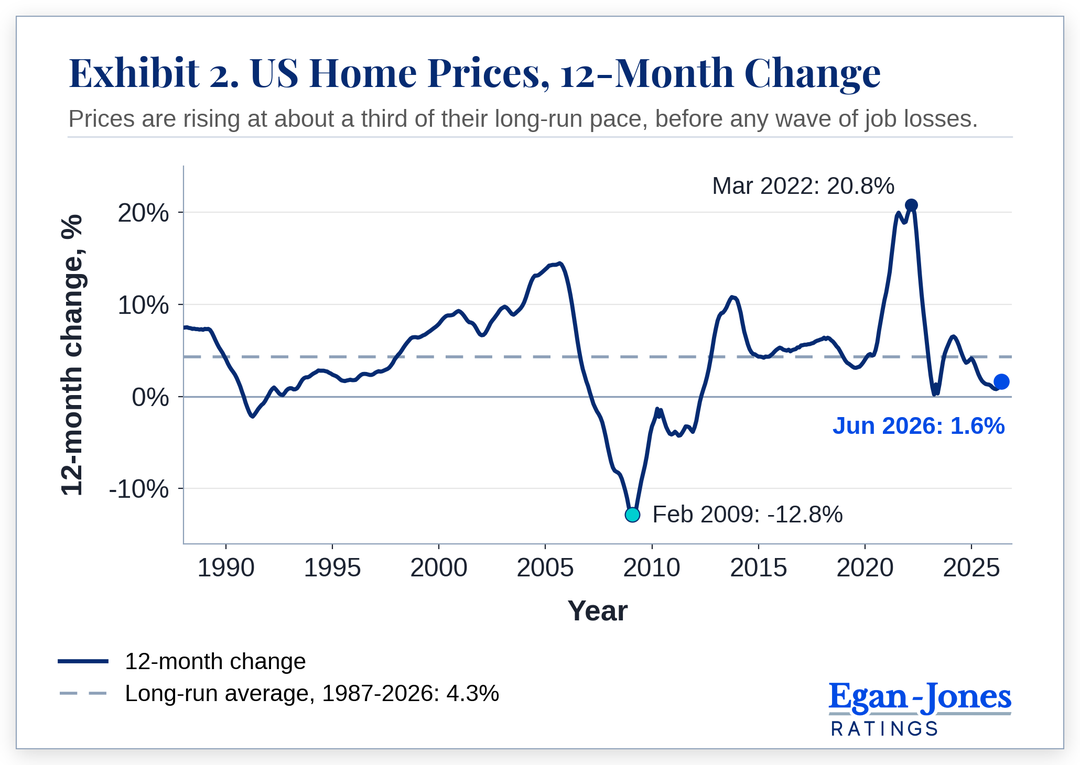
Job losses are the channel to watch. Anyone who works behind a screen is exposed, and the pressure would land on a market that has already stalled: home prices rose 1.6% in the year to June, below inflation of 3.5% and the 4.3% long-run average.7
Source: S&P Cotality Case-Shiller U.S. National Home Price Index, not seasonally adjusted (CSUSHPINSA), via FRED. Average is compound annual growth, January 1987 to June 2026.
Two incomes, two risks Many mortgages rest on two incomes. A lost job, a spouse's lost job can induce a sale over a 6-12 month period.
A thin cushion Housing has grown more expensive relative to pay: the median new home cost 3.6 times median household income in 1984 and 4.7 times in 2025.8 Buyers stretched that far have little room to absorb a lost paycheck.
Land endures People want to live near people, and city land is scarce, so the long-run case for urban land holds. Our view is short-term downward pressure, driven by that thin cushion faced by some homes (note that roughly 60% of owner-occupied US homes have a mortgage).
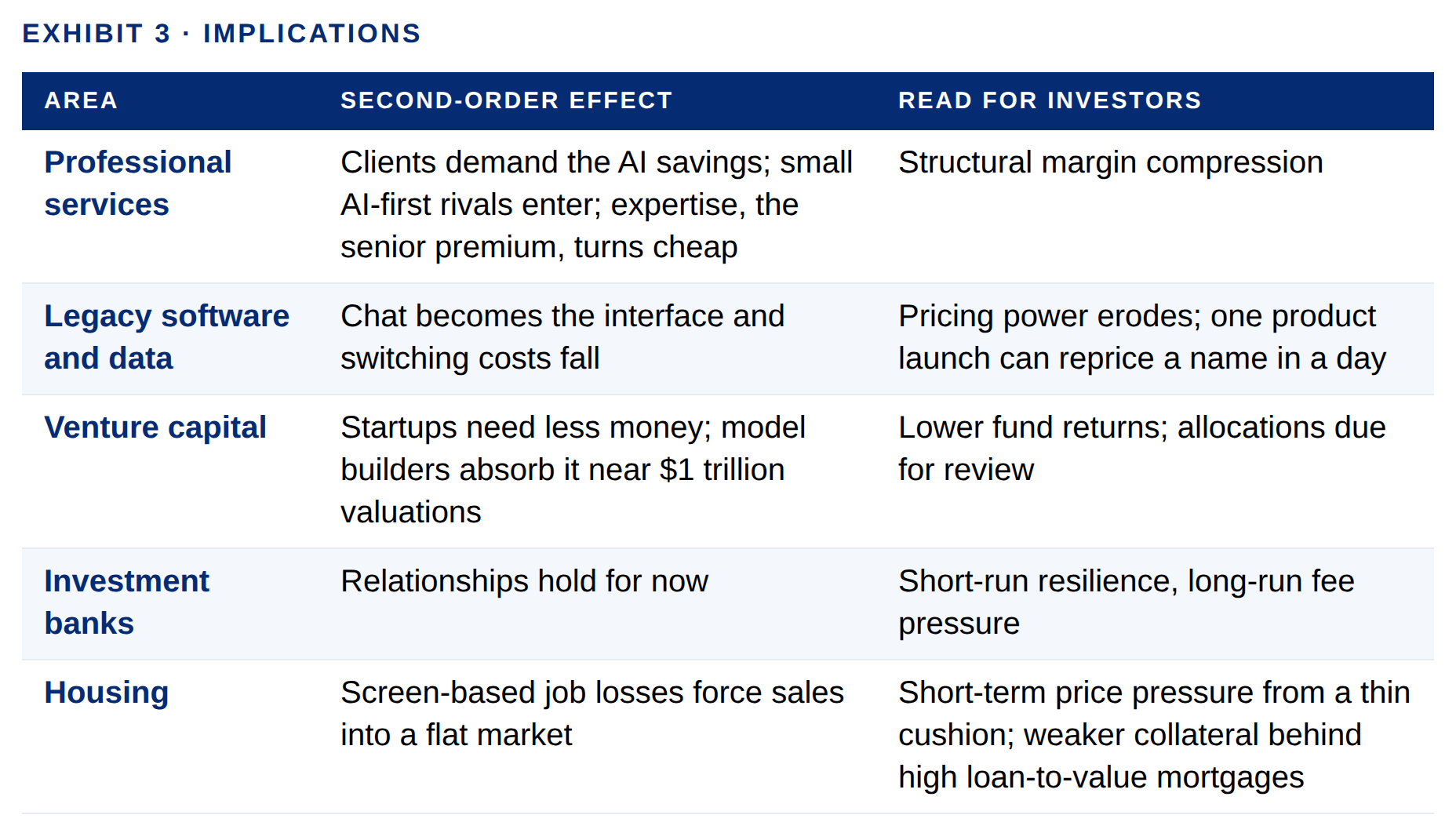
VII. Implications
VIII. Conclusion
The world is changing rapidly. This installment aims to provide a framework of possible major shifts for the benefit of sophisticated institutional investors and risk managers.
Anthropic, Series H announcement ($65 billion at $965 billion post-money), May 28, 2026; Sacra, Anthropic funding history (Series F, $13 billion at $183 billion, September 2025; Series G, $30 billion at $380 billion, February 2026).
Photo, Section III - ExTrance, "Cowichan Sweater," a sweater hand-knit by Cowichan artisan Dora Wilson, Wikimedia Commons, CC BY-SA 4.0, cropped.