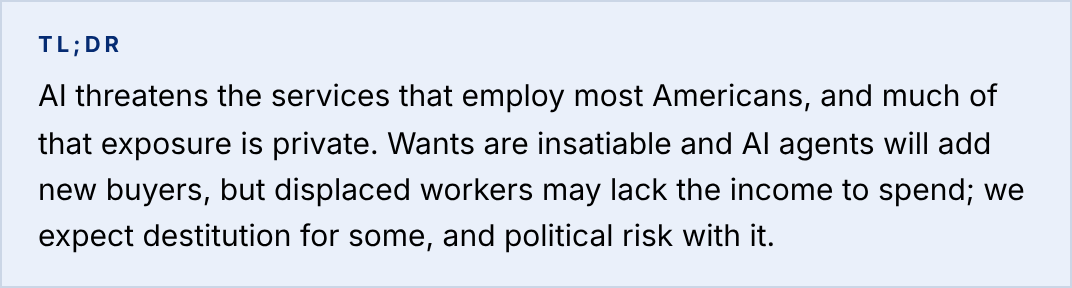
Today’s fear that AI will wipe out jobs does not fully consider the elasticity of demand and the insatiable nature of man’s appetites.
The harder question is how people will obtain capital to act on those demands if they cease to be economically useful in a world where intelligence is no longer scarce. This installment aims to provide a framework for sophisticated institutional investors and risk managers.
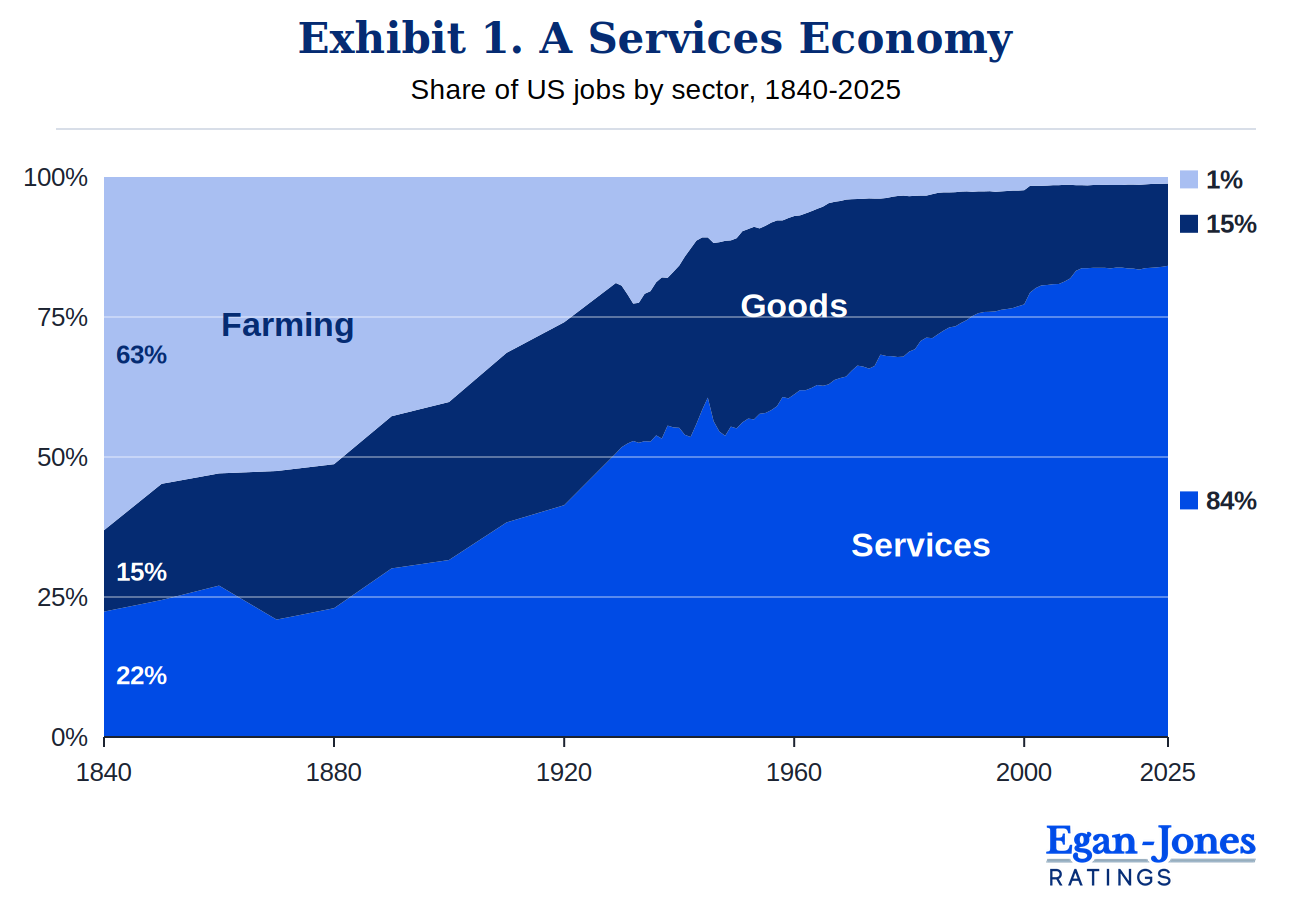
As we’ve discussed previously, professional services (e.g., accounting, audit, legal, consulting, etc.) and software face the most immediate impacts of artificial intelligence. Services in general happen to be the largest part of the economy (Exhibit 1).
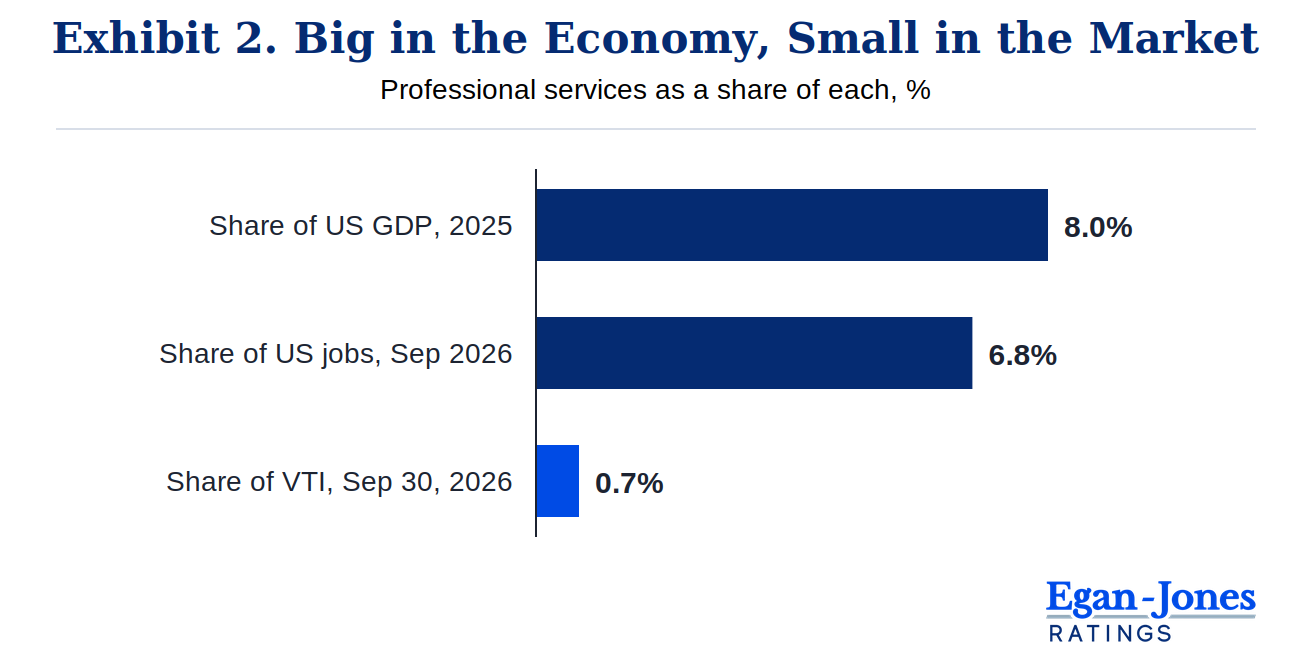
Much of the exposure to software and professional services is private. Professional services are a meaningful share of output, though they are a sliver of VTI (Exhibit 2). The largest law, accounting and consulting firms are partnerships, and ten of the 20 largest US accounting firms are backed by private equity.1
As AI reprices billable work, disruption risk falls on partners and private equity sponsors, who hold the equity, and on the private credit funds that hold much of the debt.
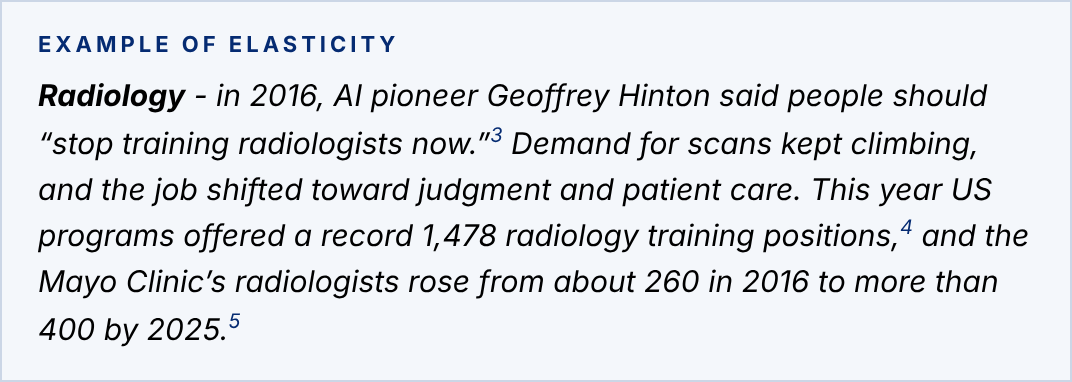
Although investors and professional services have reason to be concerned over decreasing costs, it’s clear that demand is highly elastic. Stated otherwise, people will buy more and demand higher quality as prices decline.
To understand consumption habits of the masses, one ought to consider the consumption habits of wealthier individuals, who are often early adopters of goods and services. Individuals of higher means tend to consume more goods and services, e.g., grocery delivery, home energy use, personal trainers, designer goods, live experiences, etc.6
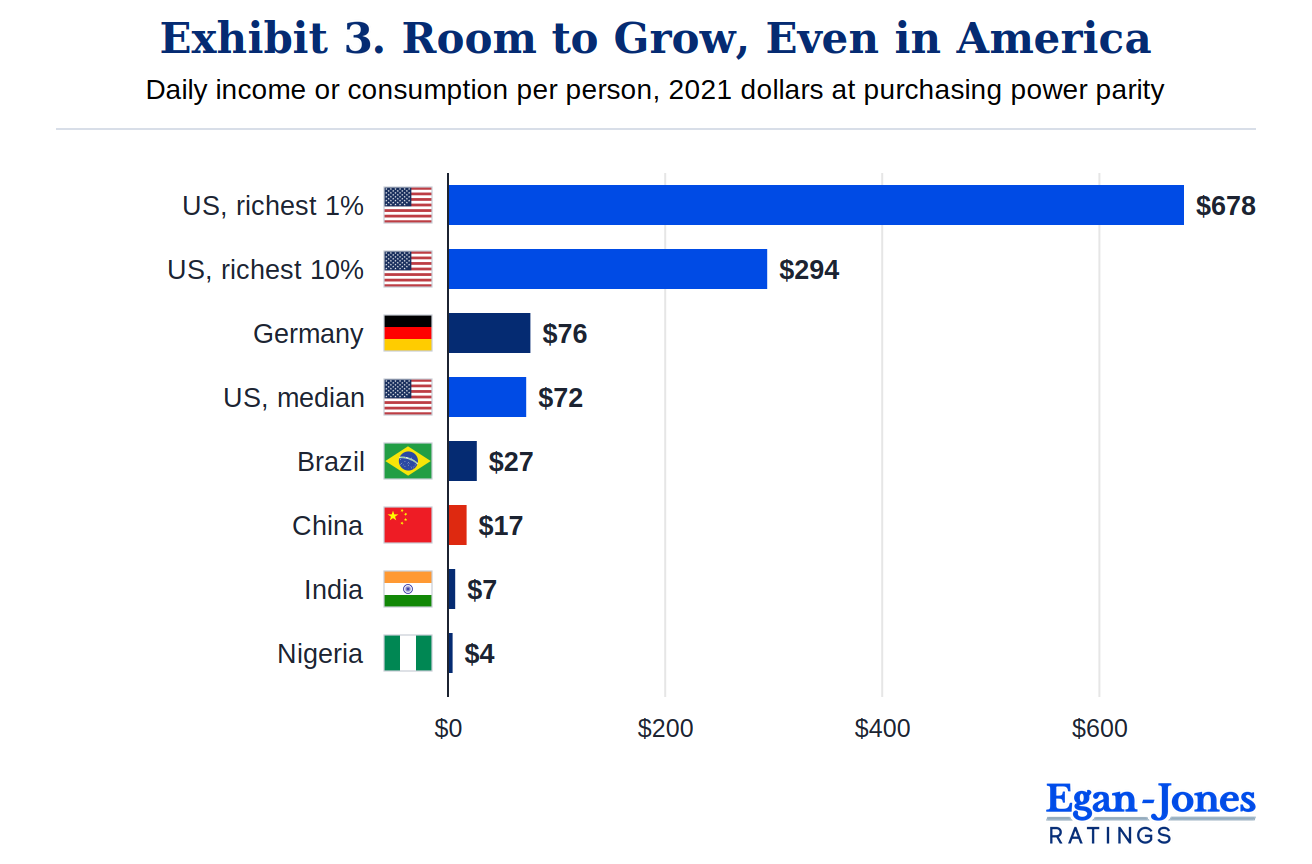
The growth in demand of individuals may vastly understate how the economy may grow, given the advent of always-on agents. Effectively the number of consumers in the economy has drastically increased.
We expect AI to work alongside humans in both personal and business settings. However, as mentioned previously, we also expect autonomous organizations run largely by AI agents to become a significant share of the economy.
Those autonomous organizations already have a model to build off of: open-source projects such as Linux, built by communities with no single owner. They need not resemble corporate organizations, which have strict hierarchies and accountability to shareholders. A poor argument would be that autonomous organizations need to be funded by people to survive. This reminds us of the Iran-Contra scandal, whereby after Congress cut off funding for the Nicaraguan Contras, National Security Council staff, with help from CIA officials, sold arms to Iran and diverted the proceeds to the Contras.8
An open question is how wealth will be distributed within the economy. Despite elastic demand of consumers, it appears that some workers will fail to adapt to this new economy. Thus, they may lack the funds to participate in the economy. The AI revolution seems to have two effects simultaneously.
Distributing Wealth - As we mentioned in our prior piece, AI makes entrepreneurship far easier, particularly among professional services and software providers. Thus, market share and wealth can be removed from legacy firms.
Concentrating Wealth - Many employed people have their current role threatened by artificial intelligence. However, they lack the capital, skillset, or desire for entrepreneurship. Thus, they cannot benefit as equity holders from the force described earlier. Further, it appears that many ventures will fail due to the ease of scaling operations with AI. Stated otherwise, although many entrepreneurs can create an audit firm, only a few may succeed. Prior moats such as regionality are less effective than they were pre-AI.
Therefore, there’s the open question of whether the old model of distribution of wealth will continue to work. A wealth tax, whereby the government takes partial ownership of assets without liquidating them, appears more viable. To gain liquidity, the government could borrow against these assets.
That is where the political risk lies. Governments ought to be particularly careful navigating this transition as we recall that prior economic transitions, such as the Industrial Revolution, contributed to mass revolutions and suffering in France, German states, Austria, Hungary, Italy, Mexico, and Russia. Watch for regulation and tax restructuring.
This month PewDiePie, the YouTuber Felix Kjellberg, unveiled Ajax, an “uncensored” AI model that runs on a home computer and will fulfill requests on topics that are typically refused by other models, though it is unclear whether that includes creating biological and chemical weapons.9

Given the massive risks and availability of “uncensored” AI models, we expect governments to respond. The most effective means of response appears to be the surveillance state: tracking people and their electronic activity. The technology here is highly sophisticated. Even Wi-Fi signals are used to track people’s movements within their homes.
Artificial intelligence makes analyzing this multi-modal mass surveillance data much easier. Washington and Beijing have a rare opportunity for collaboration despite their economic and military rivalry.10

Appetite alone pays no bills: AI will hit software and services businesses, many of them in private hands, and displaced workers may lack the income to spend. Navigating this economic transition must be done cautiously.
The world is changing rapidly. This installment aims to provide a framework of possible major shifts for the benefit of sophisticated institutional investors and risk managers.