.svg)
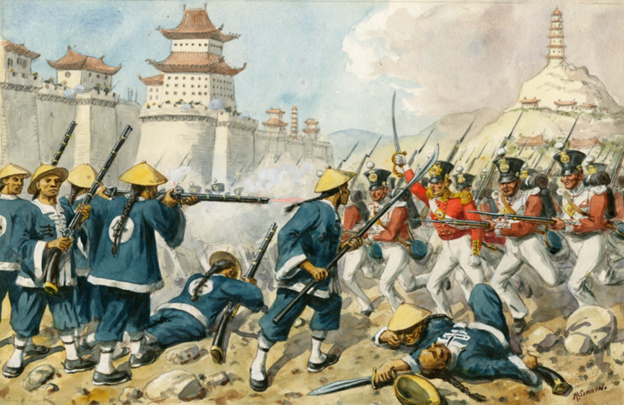
In military terms, a rollup occurs when an enemy successfully attacks one’s flank and proceeds to “rollup” defensive lines from the side. (The “holy grail” for many military men is out-flanking one’s opponent as demonstrated by the successes of the Alexander the Great, Hannibal, the Huns, Caesar, Rommel, Patton, and many others). Given the fact that the sides are typically undefended, the strategy can be highly successful in a short period of time. Our premise is that China has and is continuing to rollup various industries resulting in massive shifts in the environment for sophisticated institutional investors and risk managers.
The First Opium War occurred during the mid-1800s when England used its technological prowess to force China to open its ports to facilitate trading. Trade it did, with England flooding the Chinese market with highly addictive opium, thereby, in the view of many, weakening China and marking the beginning of the Century of Humiliation.
After the fall of the Qing dynasty in 1912, the country was enmeshed in a civil war. After years of fighting between the nationalists, communists, and Japan, the country barely had the resources to feed its population, and many times, it did not. The Communist regime became the inheritors of a long history of Chinese dynasties, and it is its most notable to date.
Something massive is afoot, and most do not recognize it. Our view is that step by step, China might be hollowing out major industries.
China has promised firms access to local markets provided there is partial local (i.e., government) ownership, a transfer of technologies, hiring of local talent in key roles, the establishment of competing enterprises, and, via a massive dose of government subsidies, the ability to offer similar products but at a massive discount.
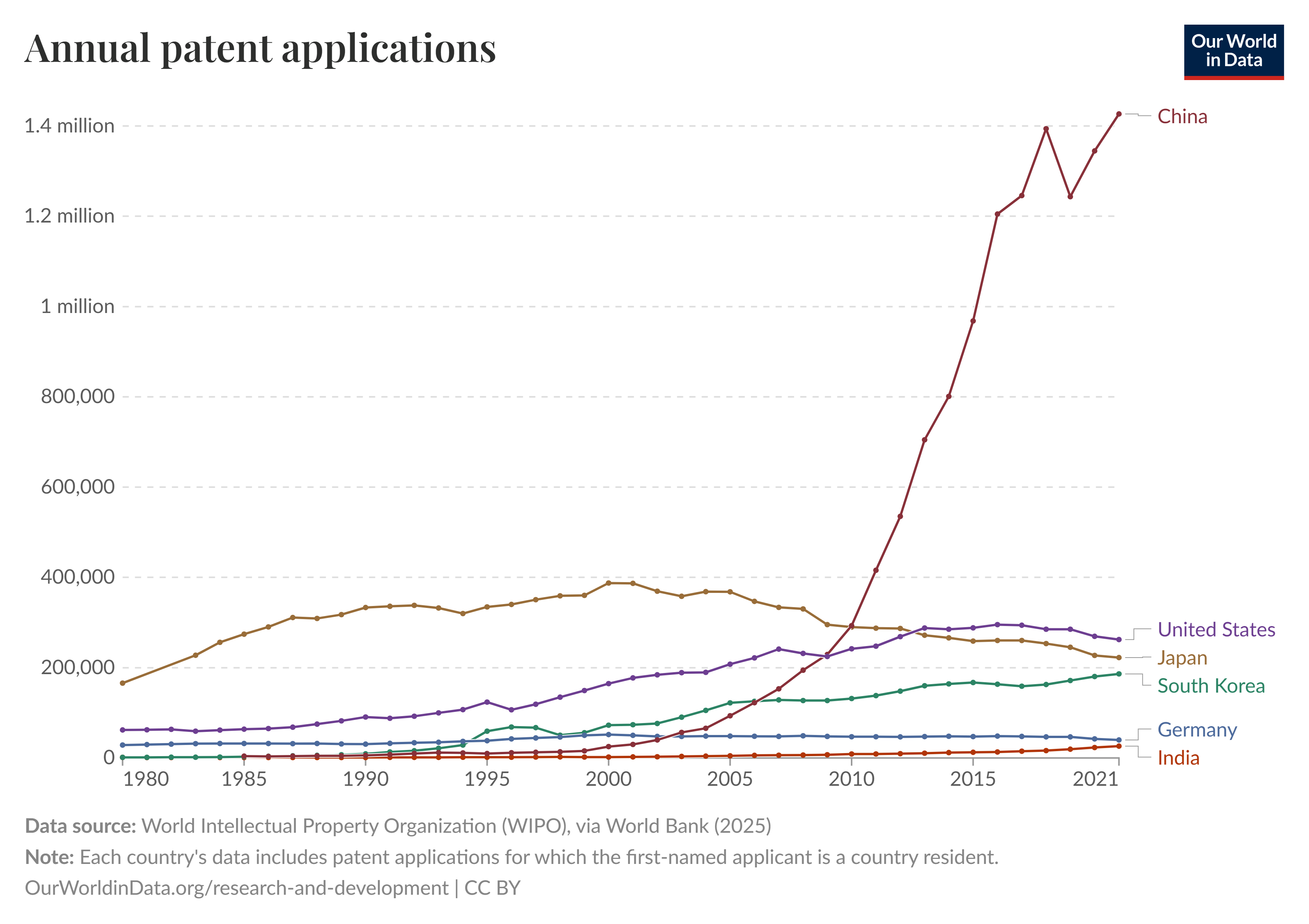
Lower-cost labor and a favorable regulatory regime have facilitated the rapid growth of newly competitive global businesses. However, it has morphed beyond that; with the massive cadre of engineering talent, the companies are able to innovate beyond what most had thought possible. The chart below indicates China’s dominance in patent applications, which is normally an indication of levels of innovation. For those paying attention, the country is a clear leader in the following areas (and competitive in many others): solar, autos, electronics, batteries, telecommunications, drones, etc.
It is not supposed to work this way. That is under a communist regime, there is central planning, and the inept bureaucrats devote government resources to ineffective but political projects. Think of the USSR whereby massive sums were devoted to steel making, ship building and other industries which soon became money-losers because of outmoded technologies and internal corruption. Perhaps, China is suffering some of these diseases with the overbuilding of housing, little used bullet train lines, and roads to nowhere. However, sophisticated managers would be remiss to ignore China’s “liberalizing” of markets and, in turn, enabling massive progress.
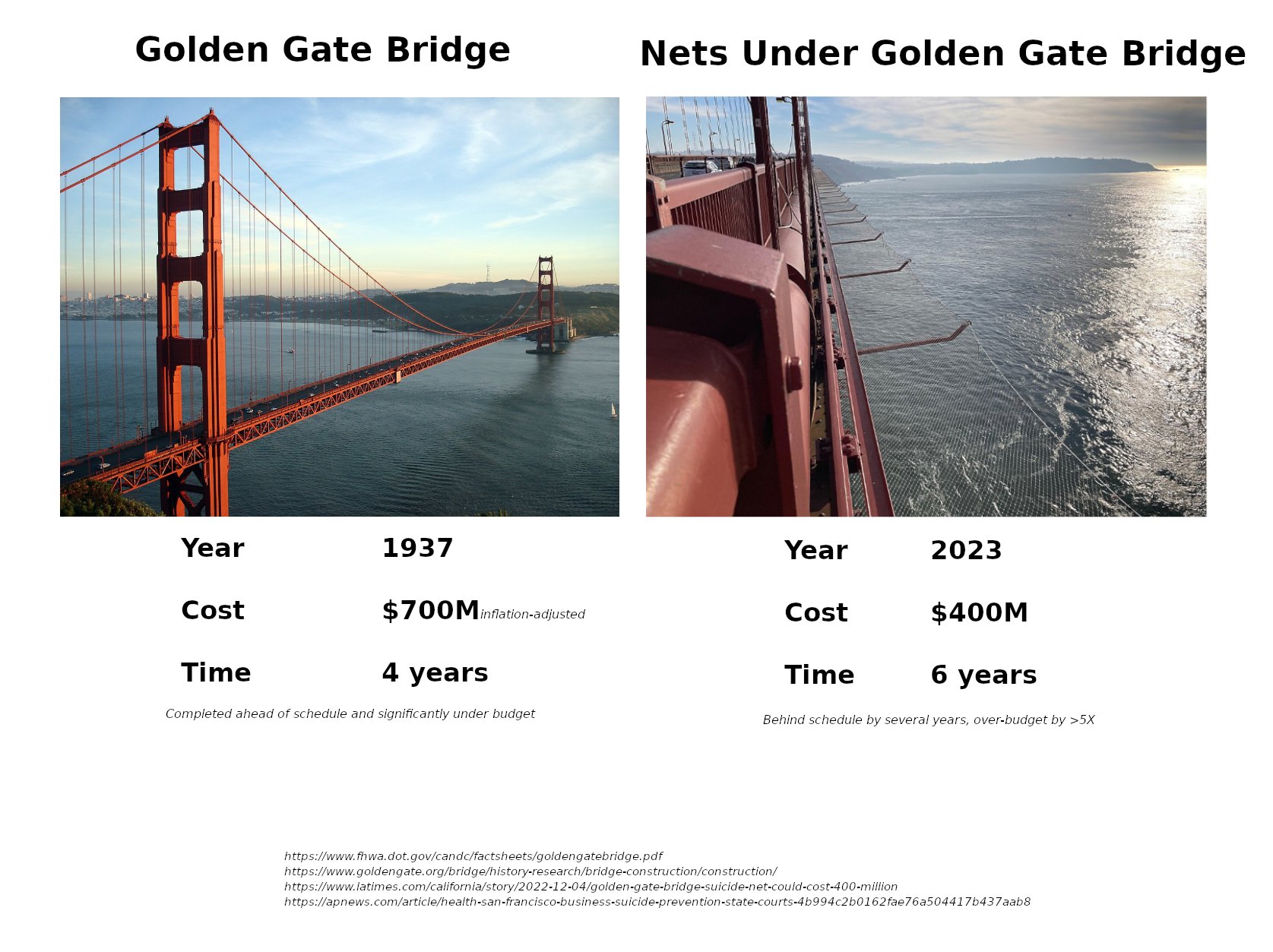
China’s centrally controlled government has the clear advantage of moving fast to provide businesses with the elements necessary to build and scale. Compare that to Western governments, which appear hostile to development. Consider the example of the Golden Gate Bridge below.
While the advantages of the Chinese system are clear, there are also numerous disadvantages. There is that pesky aspect of state control. With control, the government can and will force changes (including divestments) with little recourse.
Further, there is concern of re-nationalization. Foreigners who invest in Chinese equities may find their investments seized in one way or another.
Western manufacturers initially benefited from the opening of massive markets in China. However, over time they probably felt as though they created monsters who were able to replicate and improve their products but at a lower cost. Per the November 22, 2025, Economist, page 18 quote from a German manufacturer:
“In my sector they look at the price-point of the market leader and sell for roughly half of that…Europe is not prepared for this hyper-competition.”
Anti-dumping laws exist in most nations, but by the time firms obtain relief, they are often hollowed out. Furthermore, collecting from firms in other countries often with state support is problematic. Hence, the West is facing massive trade deficits.
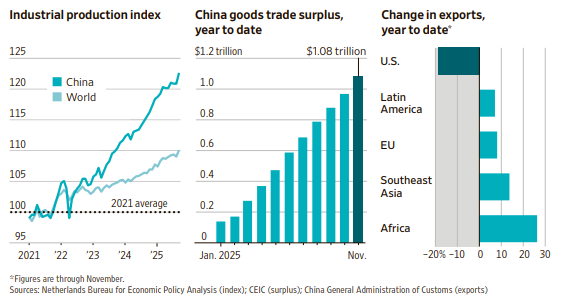
From the start, the current administration has emphasized the need to respond to what it believes are unequal trade relations. Unfortunately, in the case of China, the nation isn’t highly reliant on U.S. trade and therefore tariffs have limited impact.
To a large degree, we have been down this path before with Japan’s protecting its auto industry and the rapid re-industrialization of the country post WWII. Japan was hitting on all cylinders in the late 1970s and early 1980s and then it wasn’t. A massive asset bubble ensued, which, upon bursting in the 1990’s, left banks burdened with bad loans and triggered a credit crunch. The resulting deflation and weak demand led to prolonged economic stagnation.
Although to some degree we are in the business of predicting, we, and probably many others, need a better understanding before making any guesses with a fair degree of certainty. On the one hand are the massive achievements of the country over the past couple of decades. On the other hand, is the inefficiency of most communist regimes and the high levels of debt particularly among regional municipal governments.
Adding to the “noise” is the regular claim that the country is on the verge of collapsing, which has not proven accurate and is unlikely, at least anytime soon.
The trends outlined in this installment are massive and the implications are equally massive. We expect to revisit the topic as conditions progress. Perhaps in the next installment or two we will address those areas which might be the most vulnerable.


.jpg)