A leading candidate for France’s presidency, Jean-Luc Mélenchon is proposing that France cancel its debt1: that is an effective default. While some might view it as mere campaign rhetoric, given the high level of indebtedness, meager growth, and continued federal deficits, prudence suggests some caution. Our installments aim to address those developments which have the greatest impact on sophisticated institutional investors and risk managers.

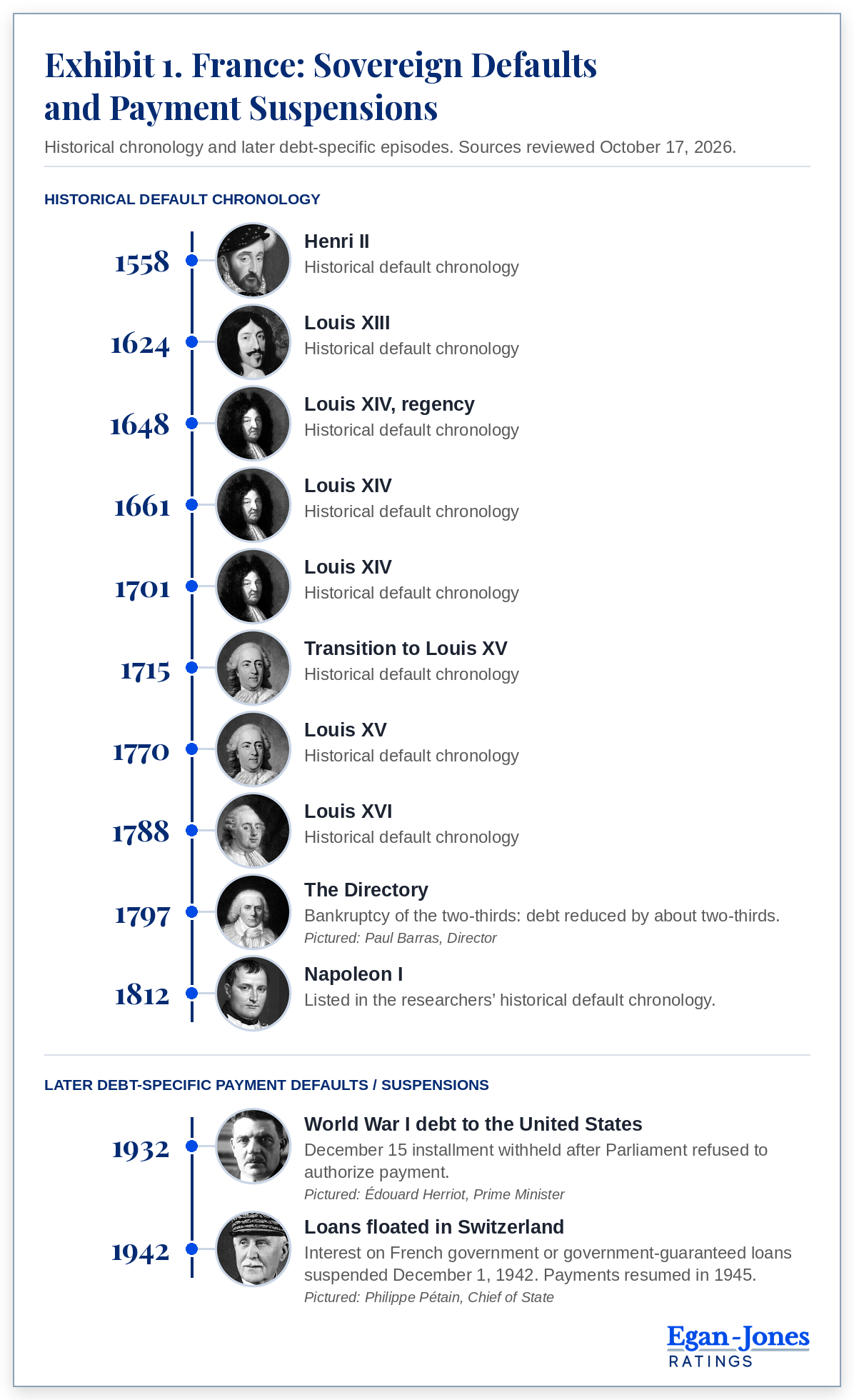
While sovereign defaults, particularly among developed nations, are rare, they have happened. As indicated in the below table, France has had hiccups numerous times:
Like the quote from Hemingway’s The Sun Also Rises, France appears to be following a similar path:
“How did you go bankrupt?” Bill asked.
“Two ways,” Mike said. “Gradually and then suddenly.”
- Ernest Hemingway, The Sun Also Rises (1926), Chapter 13.
Sovereigns have numerous tools to raise funds to forestall bankruptcy. The typical ones are obviously raising taxes, cutting expenditures, and tapping the IMF for Special Drawing Rights or a loan. Additionally, in 2012, for Spain and Italy, ECB head Mario Draghi provided support by purchasing their sovereign securities to reduce spreads. Speaking in London as ECB president, he declared:
“Within our mandate, the ECB is ready to do whatever it takes to preserve the euro.”2
From a metric perspective, France is not in terrible shape, particularly relative to a country such as Italy (see the attachment). However, there is this niggling issue of the claims of a leading candidate and the protestors (mainly students and some union members), who basically are protesting against any cuts in benefits. Per the recent WSJ article:
“Mélenchon has called for an economic overhaul of France. He wants to increase the minimum wage, cap prices on fuel and essential goods, lower the age of retirement to 60, and adopt a wealth tax on the assets of people with net wealth of at least 100 million euros, equivalent to $112 million. He proposes deep investments in green technologies to implement what he describes as an ‘ecological bifurcation.’”- Source: WSJ, Oct 14, 2026
Regarding France’s debt:
“One of Mélenchon’s most controversial ideas has been his proposal to freeze or wipe away the French bondholdings of the Bank of France, a sum worth €488 billion. Coquerel said the measure would considerably reduce France’s debt-to-GDP ratio and ease some of the pressure on its finances.”
- Source: WSJ, Oct 14, 2026
On the positive side, the rise of Mélenchon has aided the far-right candidate, Marine Le Pen, who is likely to have her own challenges in unifying the country.
If Mélenchon wins the election and proceeds with cancelling the Bank of France’s €488 billion holdings, the cashflow impact will be minor, but it is likely that any such measure will be challenged by the ECB. From an institutional investor perspective, the more relevant issue is whether this might be the first step in a broader effort.
We have prided ourselves on providing advance warning to sophisticated institutional investors and risk managers of pending developments. We hope we are wrong about conditions but typically it is best to understand underlying conditions and adjust rather than ignore emerging threats.