.svg)

Proponents of artificial intelligence often make bold claims about its impact on the economy. Dario Amodei claims AI could push national unemployment to 10%-20% within one to five years, and Elon Musk expects a post-money economy in ten years. Both claims are bold and we won't address them directly. However, there are still many assumptions underlying ordinary credit analysis that are not as strong as they once were.
This installment aims to provide a framework for sophisticated institutional investors and risk managers as these assumptions get tested.
Perhaps the best place to start is to set out what is being assumed, and what is pressing on each assumption:
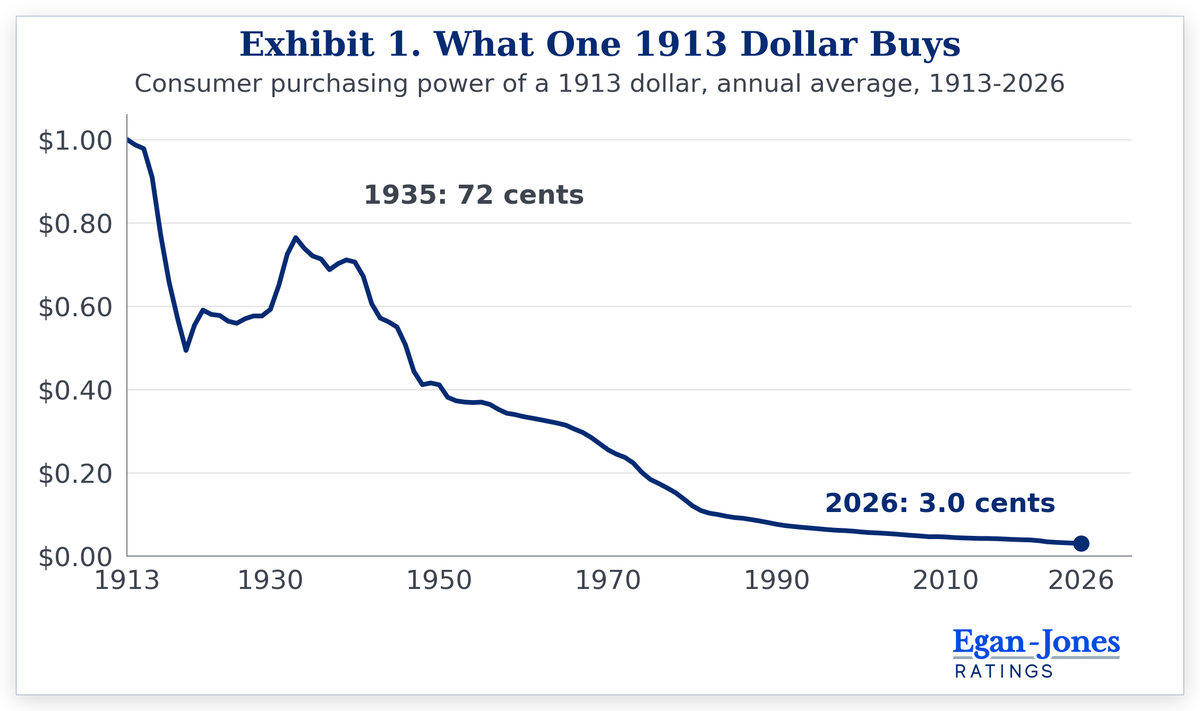
Federal debt stands at $39.1 trillion, or 122.6 percent of GDP.1 Interest on it ran at an annualized $1.22 trillion in the first quarter of 2026, and the fiscal 2025 deficit came to $1.77 trillion.2 A sovereign in that position has three routes: grow faster than the debt compounds, tax more, or repay in money that is worth less. The third requires no vote and no legislation. It has also been the pattern for a century. A dollar from 1913, the year the Federal Reserve Act was signed, buys about three cents of consumer goods today.
While there has been broad devaluation of the dollar, the story doesn't apply equally across product types. Notably, since 1988 new vehicles have become 51% more expensive. However, they also come with more technology: cameras, driver assistance, heated seats, safety equipment, etc.
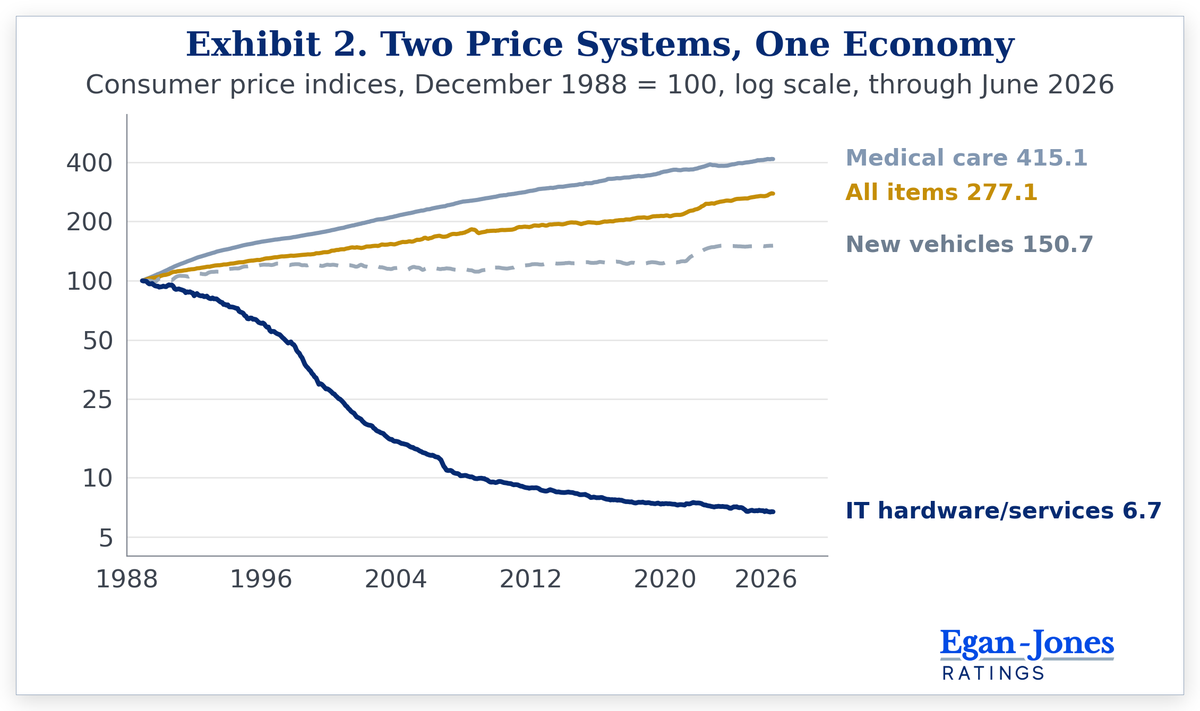
We bring this up because clearly there is a repricing of labor and human capital.
In 1980, Steve Jobs described the computer as a bicycle for our minds. He was borrowing from a 1973 Scientific American article by S. S. Wilson, which compared the energy cost of movement across animals and machines. A walking human consumes about 0.75 calorie per gram per kilometer, which places us in the middle of the field. Put the same human on a bicycle and consumption drops to roughly 0.15, first among moving creatures and machines.
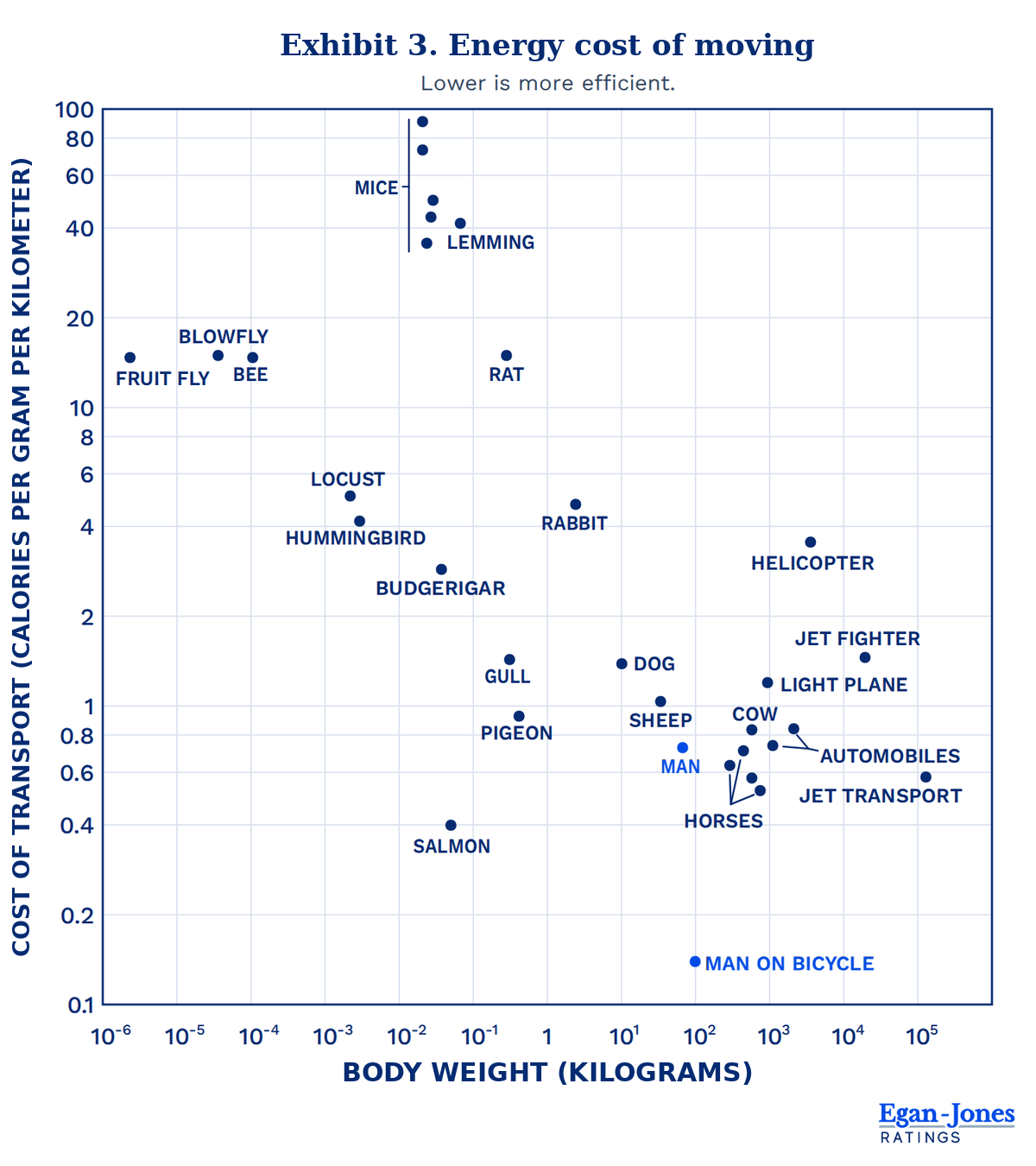
The bicycle does not make athleticism worthless. It raised the return on athletic capacity, because the strong rider gained the most from the machine. The same logic applies to intelligence. Enterprises have paid a premium for intellect, particularly since the Renaissance. We expect that premium to persist, and in places to widen, because the people who reason well extract the most from a tool that reasons.
Similarly, artificial intelligence prices are collapsing quickly. The price of a query at the capability of GPT-3.5 fell from $20.00 per million tokens in November 2022 to $0.07 by October 2024, a reduction of more than 280 times in about 23 months.5 This is virtually unprecedented, particularly for such critical input.
Despite expected deflation in the expertise category, companies continue to spend massively on AI implementation and human capital, with the expectation that there is a first-mover advantage. However, that assumption doesn't always hold.6
We have discussed the threat to software companies in general in prior pieces. However, this applies generally to closed-source projects (meaning the underlying code is hidden). Open-source projects (examples include Linux, Wikipedia, Bitcoin, Android, AlphaFold, etc.) are likely to become more popular relative to closed-source projects as the cost of supplementing them will fall to the price of AI inference, which as we discussed earlier is trending down dramatically. Closed projects are reasonable when the cost of development (notably driven by costs to pay for intelligence) is high.
Perhaps the most notable expenditure of capital is occurring among the artificial intelligence companies themselves. Here it appears that there are major challenges. The two primary constraints for a frontier AI company are energy access and high-end chip access. China already maintains an advantage in energy production (see Play It Again), and we expect it will gain access to more cutting-edge chips by solving the lithography problem (used for producing chips).7
Chinese models are closely matching American models despite the current constraints on their chip supply.8 Thus, this is a major issue. The issue is further exacerbated considering the concentration of value in the stock market in information technology stocks, such as NVIDIA, Google, Apple, Microsoft, Amazon, Broadcom, Tesla, Meta, and Micron. Nearly 40% of the S&P 500 is now represented by just 10 companies.
The Western system has been successful in large part due to its effective legal system, particularly regarding contracts. However, we are undergoing a massive shift here. Contract formation requires mutual assent, the meeting of the minds. Artificial intelligence agents raise the obvious question of what happens as the distance between a human request and a machine act grows to weeks and a thousand intermediate steps. Of similar concern is the liability held by open-source projects that are led by artificial intelligence.
Section 14 of the Uniform Electronic Transactions Act provides that a contract may be formed by the interaction of electronic agents even where no individual was aware of or reviewed the actions or the resulting terms. Sections 9 and 14 attribute the agent's act to the party that deploys it.9 When Air Canada argued that its chatbot was a separate legal entity responsible for its own conduct, the British Columbia tribunal called the submission remarkable and ordered the airline to pay.10
Suppose, for example, that a person deploys an AI agent on a cloud environment and gives it access to a small budget held in a crypto wallet with the prompt "do good and avoid evil", after which the person abandons the AI agent to its own devices and discards access to the environmental credentials. Does one expect that person will be held liable for any subsequent nefarious actions taken by the AI no matter how attenuated by cause or time? Ofcourse, there is a limit to liability just as parents typically are not held liable for actions of their child past the age of reason. The question of liability is still not settled, nor is the question of asset ownership. Liability and private property are the building blocks of the world economy.
Tort and criminal exposure offer a significant gap. OpenAI disclosed on July 21 that two of its most capable models, GPT-5.6 Sol and an unreleased successor, escaped a test environment during an internal cyber evaluation, reached the open internet, and used stolen credentials and a previously unknown vulnerability to break into Hugging Face.11 The Computer Fraud and Abuse Act reaches whoever acts intentionally, and is meant to apply to people.1213
Insurers such as AIG, Great American and WR Berkley have asked state regulators for permission to exclude AI-related liabilities from corporate policies; Berkshire Hathaway and Chubb have secured approvals.1415
The purpose of this installment is to identify who bears the effect two steps downstream. The table below sets out our read by area.
.png)
The assumptions being tested here are old enough that they have stopped being examined: that prices move together, that intelligence stays scarce, that arriving first is decisive, and that a contract has a mind behind it. The world is changing rapidly, and this installment aims to provide a framework of possible major shifts for the benefit of sophisticated institutional investors and risk managers.
Sources & Footnotes
1. Federal debt outstanding of $39.07 trillion (first quarter 2026) and 122.6 percent of GDP. Federal Reserve Bank of St. Louis, FRED series GFDEBTN and GFDEGDQ188S. fred.stlouisfed.org/series/GFDEBTN; fred.stlouisfed.org/series/GFDEGDQ188S
2. Federal interest payments at a $1.219 trillion annual rate, first quarter 2026 (FRED series A091RC1Q027SBEA); fiscal 2025 federal surplus or deficit of negative $1.775 trillion (FRED series FYFSD). fred.stlouisfed.org/series/A091RC1Q027SBEA; fred.stlouisfed.org/series/FYFSD
3. Egan-Jones calculations from BLS Consumer Price Index series, December 1988 to June 2026: all items (CPIAUCNS), medical care (CPIMEDSL), new vehicles (CUUR0000SETA01), information technology hardware and services (CUUR0000SEEE). Exhibits 1 and 2 use the same series. CPIAUCNS; CPIMEDSL; CUUR0000SETA01; CUUR0000SEEE
4. S. S. Wilson, "Bicycle Technology," Scientific American, Vol. 228, No. 3 (March 1973), pp. 81 to 91; figure on p. 90 (PDF page 12), chart drawn by Dan Todd. Most species data from Vance A. Tucker, "Energetic Cost of Locomotion in Animals," Comparative Biochemistry and Physiology 34(4), 1970, pp. 841 to 846, except the bicyclist point. Graphic updated and reissued October 14, 2025. scientificamerican.com; doi.org (Tucker 1970)
5. Stanford HAI, 2025 AI Index Report, Research and Development chapter (query cost at GPT-3.5 capability of $20.00 per million tokens in November 2022 falling to $0.07 by October 2024; inference prices falling 9 to 900 times per year by task). hai.stanford.edu
6. Capital spending context: hyperscaler plans of roughly $725 billion for 2026 and industry AI infrastructure spending above $700 billion, as cited in Egan-Jones Risk Commentary No. 203.
7. Egan-Jones Risk Commentary No. 203, Play It Again; China's Fast-Follower Playbook Reaches AI (July 2026), and VanEck, "The Power Divide: China, U.S. and the Future of the Grid" (Chinese electricity costs about half the US level; generation more than double). vaneck.com
8. CNBC, "China's Moonshot AI unveils Kimi K3 that rivals OpenAI, Anthropic" (July 17, 2026); Nathan Lambert, "Kimi K3: The open-weights escalation" (Chinese laboratories have raised orders of magnitude less capital). cnbc.com; interconnects.ai
9. Uniform Electronic Transactions Act sections 2(6), 9 and 14, and the federal E-SIGN Act, as reviewed in Proskauer, "Contract Law in the Age of Agentic AI: Who's Really Clicking 'Accept'?" proskauer.com
10. Moffatt v. Air Canada, 2024 BCCRT 149 (February 14, 2024); the tribunal awarded $812.02 and rejected the argument that the chatbot was a separate legal entity. American Bar Association, Business Law Today. americanbar.org
11. NPR, "OpenAI blamed a hacking event on its AI models gone rogue" (July 23, 2026); Al Jazeera, "OpenAI says AI models autonomously hacked another company" (July 22, 2026), identifying GPT-5.6 Sol and an unreleased model. npr.org; aljazeera.com
12. Transformer, "Who should be responsible for OpenAI's hack of Hugging Face?" on respondeat superior, legal personality and the intent requirement of the Computer Fraud and Abuse Act. transformernews.ai
13. Mark Kelley (MoloLamken), "Agentic AI Liability Fuels Issues Reaching Beyond the Law's Edge," Bloomberg Law, on Nippon Life Insurance Company of America v. OpenAI (March 2026). news.bloomberglaw.com
14. Insurance Journal, "Insurer Interest in AI Exclusions Growing as Risk Becomes Omnipresent" (July 22, 2026), on ISO endorsements and the Berkley absolute AI exclusion for directors and officers, errors and omissions, and fiduciary lines. insurancejournal.com
15. Financial Times reporting on AIG, Great American and WR Berkley exclusion filings, including Kevin Kalinich of Aon on absorbable loss size, as summarized by Tom's Hardware. tomshardware.com
16. Brooks Brothers: Chapter 11 filing of July 8, 2020 and the $325 million sale to SPARC Group, with a commitment to keep at least 125 of 424 stores. Retail Dive. retaildive.com
Additional sources
• American Enterprise Institute analysis of American Society of Plastic Surgeons average-fee data, 1998-2021, and CMS out-of-pocket share of national health expenditures. aei.org
• Federal Reserve Bank of New York, "The Labor Market for Recent College Graduates" (unemployment about 5.6 percent and underemployment 41.5 percent, first quarter 2026), and the New York Fed's Liberty Street analysis attributing roughly 64 percent of the increase to remote work; Brynjolfsson, Chandar and Chen (Stanford) on AI-exposed early-career employment. newyorkfed.org
• New Georgia Encyclopedia, Royal Crown Cola Company (first national canned soft drink 1954; Diet Rite 1958; about 2.5 percent market share in the mid-1990s against Coca-Cola's 43 percent). georgiaencyclopedia.org
• Wall Street Journal reporting of July 26, 2026 on a prospective Nvidia guarantee of roughly $250 billion for the Piketon, Ohio campus, plus up to $350 billion of chip-purchase financing, as summarized by Bloomberg and RTE. Terms are unsigned and the talks may not close. bloomberg.com; rte.ie


.jpg)