.svg)

Sophisticated Institutional Investors and Risk Managers are trained to find superior firms and entrust their beneficiaries' hard-earned assets with those stellar firms. While this is a terrific path inmost cases, at times, it can be disastrous.

Many consider Warren Buffett to be the paradigm of a superb investor. Time after time, cycle after cycle, he has built wealth for his clients, turning little-known Berkshire Hathaway into a powerhouse in the investment community. Among the many stellar investments unearthed by Mr.Buffett was Apple, a shining star which over the past couple of decades has built a money machine for itself via the excellent products, vast consumer acceptance, and a huge competitive moat. As can be seen below, Berkshire had a terrific run from an entry price near $25 to a partial exit near $200+:1
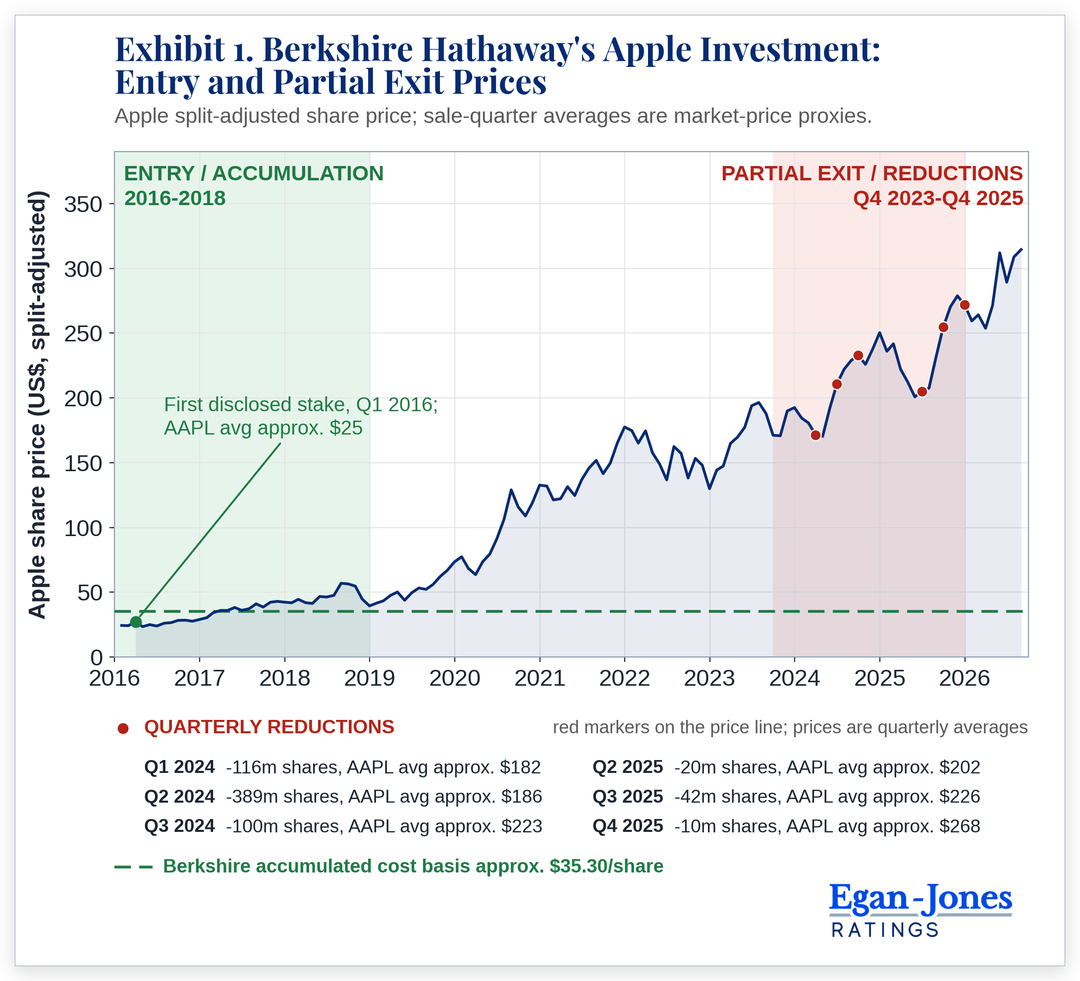
Berkshire has NOT fully exited: 227.9m shares were still held at June 30, 2026.
Given the fact that it is often best to imitate successful people, let’s consider a normal thought process for a sincere, studious fixed income investor (let’s call him “Earnest Eddie” or Ernestine if you prefer; regardless, “Eddie” for short). Apple checks all the boxes: sound management, strong cashflow, impressive product line. There is little debate that the firm will cause surprise or embarrassment for our erstwhile Eddie. Not only is Apple a stellar firm, but it is also likely to be a strong performer for the foreseeable future.
After performing significant due diligence and becoming comfortable with the future prospects of Apple, our erstwhile portfolio manager acts on his research and invests. Given the fact that Apple is likely to be solid for the foreseeable future, he sees no problem in making a multi-year bet. The terms appear to be reasonable: the interest offered is comparable to other AA+ rated instruments.
Reminiscent of the character in the popular sit-com (“Gomer Pyle, U.S.M.C.”) of ages ago are the words of a key character, Gomer Pyle with his tagline “Surprise, surprise, surprise”. (See photo above.) Unfortunately, that stellar investment at $1.00 is now trading at 50 cents courtesy of the rise in longer term interest rates, the deluge of AI-related paper, and investment jitters. The irony here is that Apple might still be a true strong investment grade risk, but the combination of being priced to perfection at issuance, the rise in rates, and sector concerns, our erstwhile portfolio manager might have inadvertently made a career-ending move. As can be seen below, the value of the Apple 2.55% 2060 bonds has supposedly been halved.2
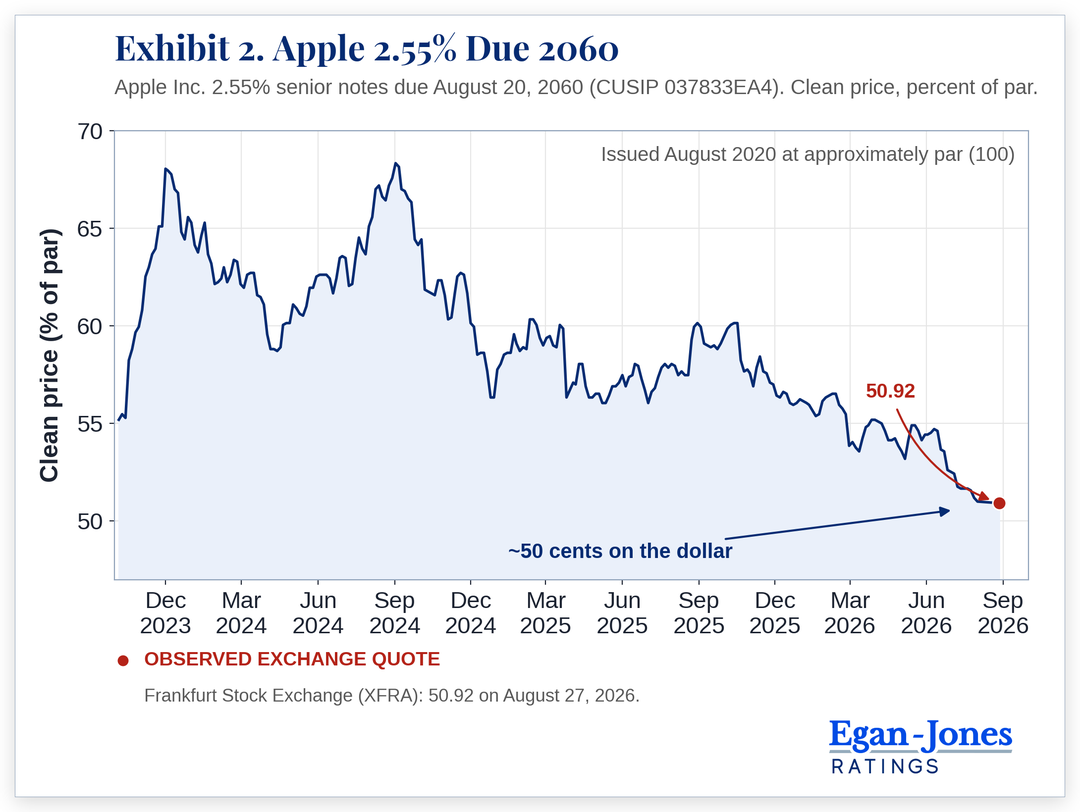
Hopefully Eddie maintained a diversified portfolio, but even that would not have helped if the characteristics of the other holdings were similar to Apple. The irony is that if the holdings were comprised of assets like the typical BDC with approximately 2.5% of loans marked as non-accruing, and an average interest rate near 8%, the interest on the non-defaulted holdings would have more than offset any credit losses. Perhaps this is another case of the headlines being polar opposite to the reality. Just to be clear, we are NOT suggesting that investment grade is riskier than speculative grade credits, but rather that the totality of risks should be considered.
A clear understanding of ALL the risks for various investments is usually the best path forward. Furthermore, some of the most damning risks are not always readily apparent.
The ten most recent Egan-Jones CLO tranche ratings are shown below alongside the other NRSRO’s equivalent rating on the same tranche and the current collateral test cushions.
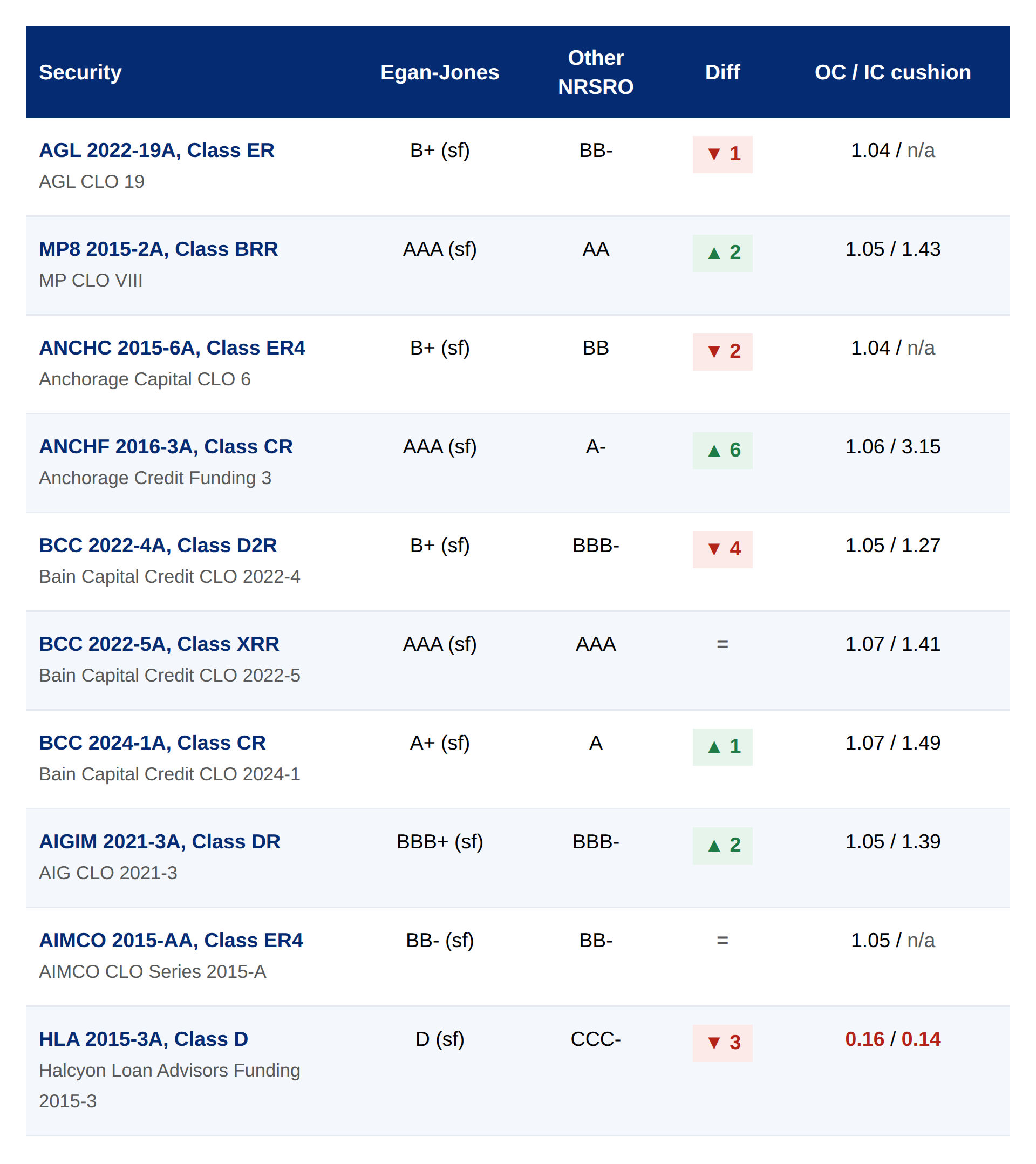
Diff is the gap in notches between the Egan-Jones rating and the other NRSRO’s equivalent rating on the same tranche. Green is Egan-Jones higher; red is Egan-Jones lower. Cushion is the current test level divided by its trigger, so a figure below 1.00 means the test is failing. “n/a” appears where the report shows no interest coverage test for that class. Egan-Jones ratings shown here are not NRSRO ratings.


.jpg)