Chokepoint Chokehold; Risk to Middle East Sovereigns
Middle East sovereigns face concentrated risks in oil routes, water, food, demographics, stability, and escalation.
Published on
August 11, 2026
I. Overview
For two decades the Gulf monarchies have been viewed as the settled part of a turbulent region supported by deep reserves and a security guarantee from Washington. The war that began on February 28 has tested that view. Nearly all the countries in the region face significant military threats and some political threats. This installment aims to provide a framework for evaluating concentration risk in the Middle East for sophisticated institutional investors and risk managers.
II. Oil Distribution Vulnerability
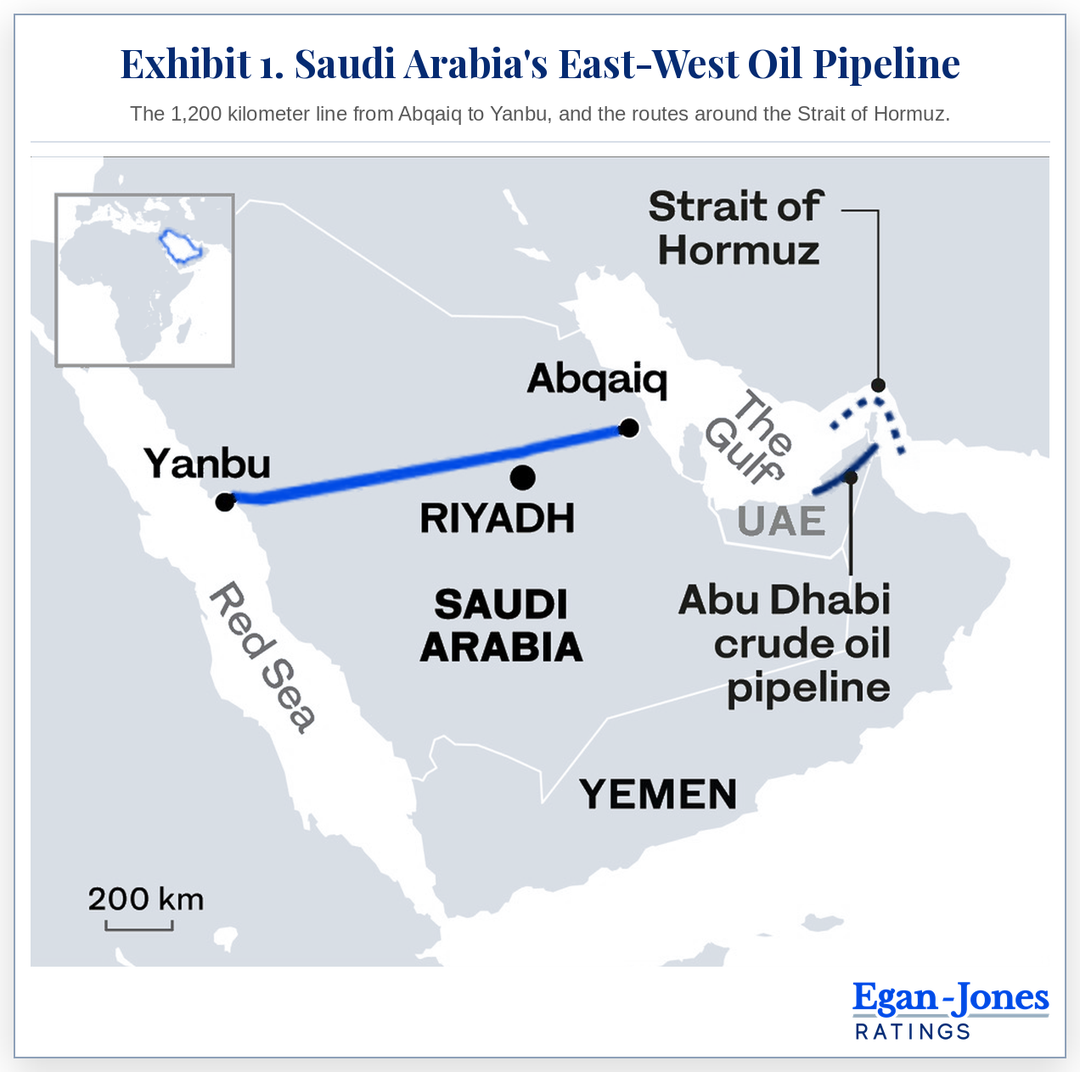
Saudi Arabia has two ways to get oil to a customer. One route runs east through the Strait of Hormuz. The other runs west, 1,200 kilometers across the peninsula through the East-West Pipeline to Yanbu on the Red Sea,1 and from there north through Suez or south through the Bab el-Mandeb Strait.
Source: AFP via Arab News. Map reproduced with positions, labels and routes unchanged; restyledin Egan-Jones colours.
Iran's forced closure of Hormuz has restricted roughly 20 percent of global crude and petroleum product supply.2 The western export option was built in 1981 after the Iranian Revolution made Gulf shipping look fragile. Red Sea exports averaged 4.7 million barrels a day from March through June against 1.6million a year earlier, and Yanbu handled 92 percent of Saudi seaborne crude inJune.3,4
However, on July 20 the Houthis declared a maritime embargo on Saudi-linked shipping. Crossings at the Babel-Mandeb fell to fifteen commodity vessels in a day, down 56 percent inside a week, and Saudi Arabia has loaded no west-coast crude through the strait since.4,5 Asian cargoes now go north through Suez, adding about thirty days.4
However, Suez carries its own history. Egypt closed it in June 1967 and kept it shut for eight years.6 Although Egyptian leaders have made no claims they would seek to shut the Canal today (canal revenue in peace time is equivalent to 10%-15% of Egyptian government revenue), the chokepoint could be vulnerable to drone attacks. Remember that a single ship blocked the canal for six days in 2021.7 Given that drones can be hidden inbox trucks and moved quickly it's not inconceivable to see a rolling crisis in this chokepoint as there has been one in the Strait of Hormuz.
An alternative would be to pipe oil northward directly up to the Mediterranean. However, this requires transit of oil across countries with potentially unstable regimes. Looking at a map, the most obvious egress would be Israel, though this is unlikely to be politically palatable. This is not to mention that the oil pipeline itself would be vulnerable to attack. Recall the destruction of Nord Stream 2 pipeline in 2022.8,9
There still is plenty of room left on the conventional escalation ladder.10Those watching the recent American surge to the Persian Gulf region and reported Iranian attacks on domestic American water purification facilities should be wary of prior failed negotiations.
III. Water Vulnerability
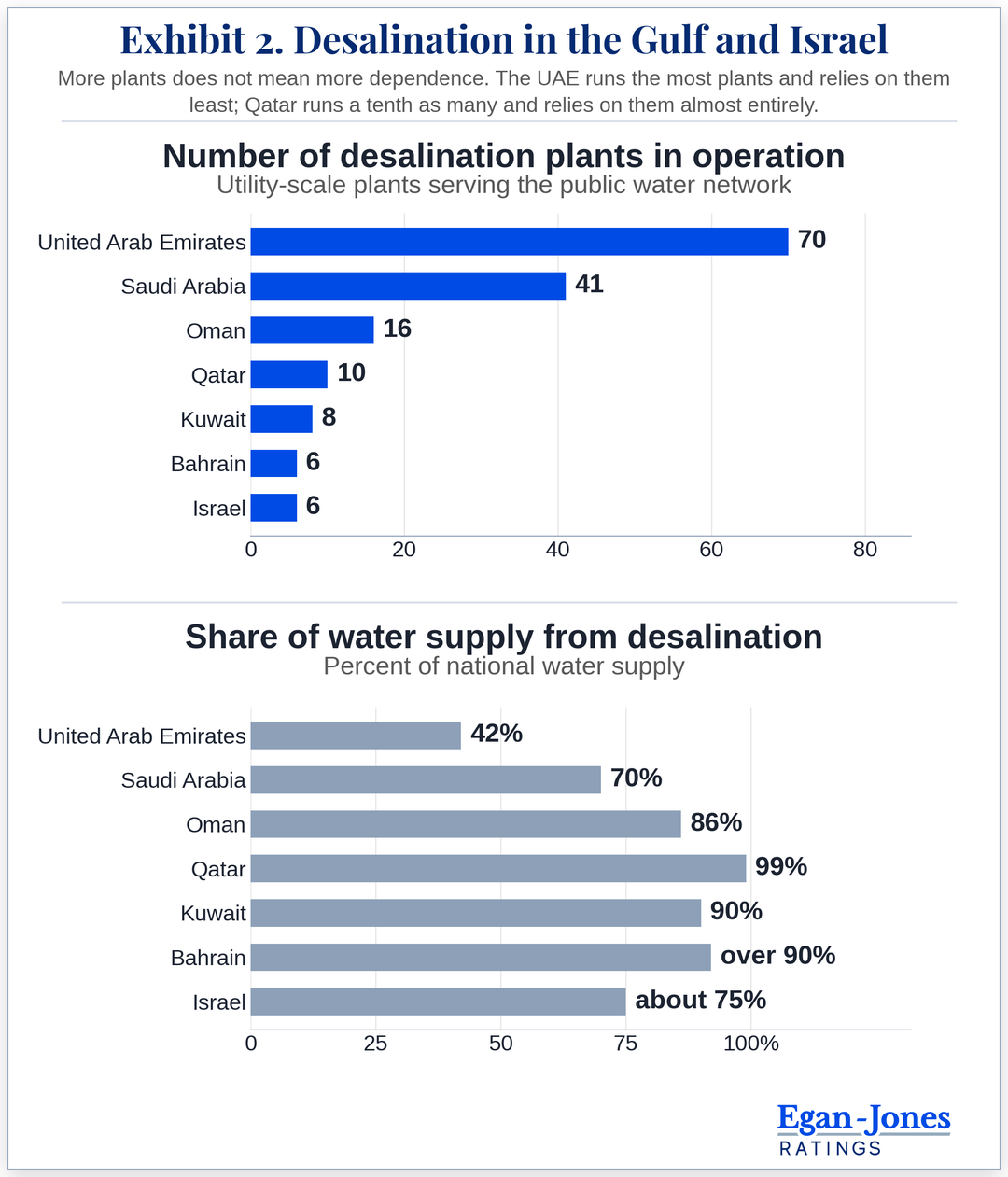
Desalination supplies a significant portion of the drinking water in Gulf countries.
Source: UAE Government portal; Saudi Water Authority; Nama Water Services; Kahramaa and QEWC; Kuwait Ministry of Electricity and Water; Bahrain Electricity and Water Authority; Israel Water Authority.11
What is counted: utility-scale plants supplying the public water network, in operation as of mid-2026. Oman's national operator reports 61 desalination facilities in total once small and remote units are included; the 16 shown here are its major independent water projects. Saudi Arabia's 41 comprises 33 Saudi Water Authority plants plus 8 privately owned plants. No plant is shared between any two countries; the proposed Gulf Water Interconnection Project, which would have built three jointly used plants, has been dormant since 2013. Israel's share is of potable supply.
Water storage is also particularly thin. The UAE's water strategy targets reserves covering roughly two days of normal demand, stretching to 16-45 days under rationing; Bahrain, Kuwait, and Qatar hold less.11
Food is similarly contrained. The GCC imports about 85 percent of its food and 90 percent of its cereals, andmore than 70 percent of that tonnage arrives through Hormuz.12,13
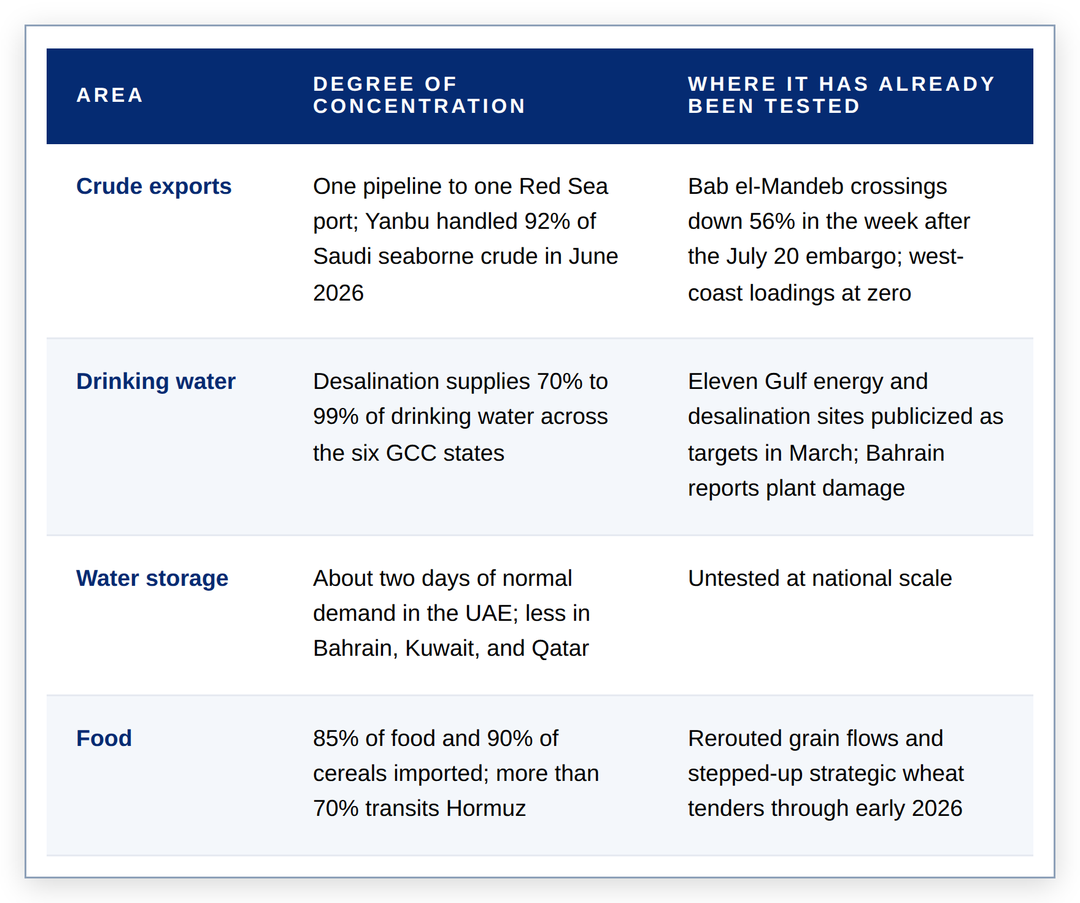
Sources: CSIS; Anadolu Agency; The Conversation; World Economic Forum; Chatham House via Arab News; The National.14,15
IV. Relative Population
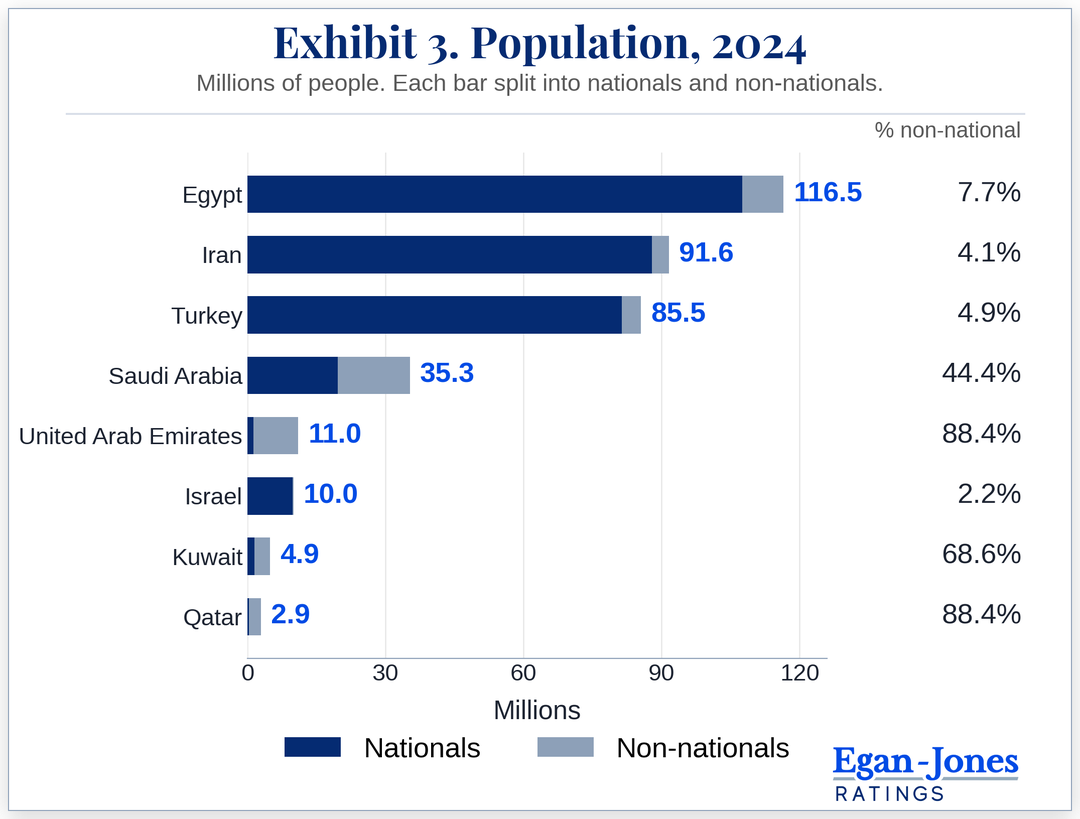
Although artificial intelligence is changing the story, it still seems likely that population size will continue to be relevant for regional powers for the foreseeable future. Further, it will be important for that population to stay to support the nation under pressure.
At 35.3 million Saudi Arabia is roughly a third the size of Egypt and about 40 percent the size of Iran or Turkey, and 44.4 percent of that total holds a foreign passport.16,17
Impact: A workforce that is 44 percent foreign is mobile in a crisis. Construction timelines and general economic support can dwindle quickly.
Source: Totals, World Bank, 2024. Splits, national statistical offices, UNHCR, IOM, and Turkey's Presidency of Migration Management.16,17
Splits are official for Saudi Arabia (GASTAT), Kuwait (PACI) and Israel (CBS). UAE and Qatar shares are estimated; neither state publishes a citizen count. Egypt, Iran and Turkey are foreign-resident and displaced-population estimates, not directly comparable.
V. Internal Strife
Many of the countries in the region do not have a record of stability. In November 2017 the Saudi government held much of the business and royal elite at the Riyadh Ritz-Carlton apparently against their will, and released them for about $106.7 billion and presumably other concessions.18 In October 2018 Jamal Khashoggi was killed inside the Saudi consulate in Istanbul, and the Office of the Director of National Intelligence later assessed that the Crown Prince approved theoperation.19 Typically governments that are highly confident in their stability do not need to take such drastic action. Further, there is the concern of Jihadism.
VI. The Nuclear Question
In November 2025 Washington and Riyadh signed a joint declaration completing negotiations on civil nuclear cooperation.20 In July 2026 President Trump approved a thirty-year Section 123 agreement, now before Congress, that opens a path to uranium enrichment inside the kingdom. Prior nuclear deals with Saudi Arabia were challenged due to concerns over nuclear proliferation and the nation's governance.21
VII. Israel's Challenges
Unfortunately, Israel has vulnerabilities as well. The attacks in southern Israel in October 2023 were a manifestation of their vulnerability and unfortunately the underlying hostility hasn't been resolved. Challenges listed below.
Israel faces decreasing support from the United States from both sides of the political aisle.
Israel's highly educated population may tire of lack of security and leave the country for perceived greener pastures, particularly during times of great crisis.
Israel faces hostility from neighbors including Iran, Turkey, Houthis, Hezbollah, and Hamas. There appears to be no clear solution to this.
The strife with Palestinians is unlikely to subside despite promises to disarm. The population of Gaza is over 2 million people. Although estimates claim that the population has dropped by as much as 10% since 2023, it is likely that the population will rebound in the coming years.22 The ill will accumulated since October 2023 is unlikely to dissipate.
The political winds in the region regularly shift. Egypt has had a peace treaty with Israel since 1979 but recall the 2011 uprising and the Muslim Brotherhood government that followed, which could have destabilized that peace.
VIII. The Key Point: I Know YouKnow
The key point is that both sides know that the escalation ladder in the Iran War has plenty of room and that America's allies in the region are highly vulnerable. Were the United States to start an indiscriminate air campaign hitting Iranian oil, water, and electric infrastructure, this would lead to a militarily effective response on the Iranian side because the Americans have failed to sufficiently degrade offensive Iranian capabilities. Sufficient destruction would likely precipitate a global depression and is exactly what Mr. Trump seeks to avoid. Therefore, steep escalation appears unlikely.
The tit-for-tat campaign has achieved no change in the status quo, and the prior Memorandum of Understanding, which handed Iran the Strait of Hormuz, proved unpalatable to Washington. Another round of negotiations is ongoing though we are skeptical of a sustainable outcome in the near term. What is clear is that America has not gained significant coercive leverage since the MOU was signed. Expect future pieces to describe our views on likely outcomes.
IX. Conclusion
In many assessments, concentration risk gets its closest examination at the fund and issuer level, where one counter party or one collateral type can undo a sound structure. The same discipline belongs in sovereign work.
The world is changing rapidly. This installment aims to provide a framework for evaluating those exposures for the benefit of sophisticated institutional investors and risk managers.
Sources & Footnotes
Damage to an East-West Pipeline pumping station costing about 700,000 barrels a day, and the line's subsequent restoration to roughly seven million barrels a day: Engineering News-Record; Al Jazeera. enr.com · aljazeera.com
Iran's forced closure of the Strait of Hormuz restricting about 20 percent of global crude and petroleum product supply: Engineering News-Record. enr.com
Saudi Red Sea exports of crude and products averaging 4.7 million barrels a day from March through June against 1.6 million in the same period a year earlier (Bimco), and the September 2019 Abqaiq and Khurais strikes removing 5.7 million barrels a day, roughly 5 percent of global supply, and triggering the largest single-day jump in oil prices on record: AGBI. agbi.com
Yanbu handling 92 percent of Saudi seaborne crude exports in June, the shift of all Asia-bound cargoes to Suez adding about thirty days, zero west-coast loadings via Bab el-Mandeb since the embargo, and Baltic Exchange rates of $382,397 a day for VLCCs against $103,500 for Suezmaxes on July 24: The National. thenationalnews.com
Bab el-Mandeb transits falling to fifteen commodity vessels, down 56 percent from the thirty-four crossing on July 20, the day the Houthis announced the maritime embargo on Saudi-linked shipping (Kpler data): The National. thenationalnews.com
The Suez Canal closed from June 1967 to June 1975, eight years, after the Six-Day War: Atlantic Council. atlanticcouncil.org
The Ever Given blocking the canal for six days in March 2021, with more than three hundred vessels waiting: CBC News. cbc.ca
The September 2022 explosions severely damaging Nord Stream 1 and Nord Stream 2 in the Baltic Sea: United Nations Security Council meetings coverage. press.un.org
Charges attached at roughly eighty meters depth, the first blast at 2:03 a.m. on September 26, 2022, and HMX residue recovered by investigators: CBC News. cbc.ca
More than 1,200 missile and rocket attacks on Saudi energy infrastructure and government facilities attributed by researchers to Iran and Iran-backed groups from February to May 2026: Congressional Research Service, “Prospects for U.S.-Saudi Nuclear Energy Cooperation.” congress.gov
Desalination shares of drinking water (Qatar 99 percent, Bahrain over 90 percent, Kuwait 90 percent, Oman 86 percent, Saudi Arabia 70 percent, UAE 42 percent) and the UAE water security strategy providing about two days of normal demand, or 16 to 45 days under emergency rationing: CSIS. csis.org
GCC states importing up to 85 percent of their food, including 90 percent of cereals and nearly all rice: World Economic Forum. weforum.org
More than 70 percent of GCC foodstuffs arriving through the Strait of Hormuz, per Neil Quilliam of Chatham House, and regional dependence of up to 90 percent on food imports: Arab News. arabnews.com
More than four hundred desalination plants along the Gulf coast, roughly 40 percent of world desalination output, and Iranian media circulating images of eleven energy and desalination facilities across Gulf countries and Jordan on March 23: Anadolu Agency. aa.com.tr
Missile strikes and drone interceptions at or near Gulf desalination and water-and-power complexes, and Bahrain's statement that Iran damaged a desalination plant: The Conversation. theconversation.com
Saudi nationals at 55.6 percent of the population, exceeding 19.6 million, with non-Saudi residents at approximately 15.7 million in 2024: Saudi General Authority for Statistics, Population Estimates Publication 2024. stats.gov.sa
The anti-corruption sweep beginning November 4, 2017, with 381 individuals summoned for questioning and settlements of SAR 400 billion, about $106.7 billion, in real estate, commercial entities, cash and other assets: Al Jazeera. aljazeera.com
The assessment that Crown Prince Muhammad bin Salman approved an operation in Istanbul to capture or kill Jamal Khashoggi on October 2, 2018: Office of the Director of National Intelligence, declassified February 2021. archive.dni.gov
The November 2025 Joint Declaration on the Completion of Negotiations on Civil Nuclear Energy Cooperation, signed during Crown Prince Mohammed bin Salman's visit to the United States, and the subsequent draft agreement presented for congressional review: Congressional Research Service. congress.gov
President Trump's July 2026 approval of a thirty-year Section 123 agreement with Saudi Arabia, the reported “black box” enrichment provision, the ten-year bar on independent Saudi enrichment, US firms constructing and controlling the facility, and congressional review: Atlantic Council. atlanticcouncil.org
Palestinians in the State of Palestine at 5.56 million at the end of 2025, Gaza at 2.13 million following a decline of approximately 254,000 (10.6 percent), and 64 percent of the population under thirty: Palestinian Central Bureau of Statistics. pcbs.gov.ps
Additional Sources
Fifteen of the nineteen September 11 hijackers being Saudi nationals, alongside the finding of no evidence that the Saudi government as an institution or senior Saudi officials individually funded al-Qaeda: NPR. npr.org
The UAE's 2009 civil nuclear pact with Washington forgoing uranium enrichment and reprocessing, the so-called gold standard: Reuters, via AOL. aol.com
Ahmed al-Sharaa, formerly Abu Mohammad al-Julani, founder of the Nusra Front and emir of Hayat Tahrir al-Sham, serving as president of Syria: Encyclopaedia Britannica. britannica.com
Al-Sharaa describing work toward a security agreement with Israel amid repeated Israeli incursions and strikes in southern Syria: Al Jazeera. aljazeera.com
Exhibit 1 - Map reproduced from AFP via Arab News, restyled in Egan-Jones colours; positions, labels and routes unchanged.
Exhibit 2 - UAE Government portal; Saudi Water Authority; Nama Water Services; Kahramaa and QEWC; Kuwait Ministry of Electricity and Water; Bahrain Electricity and Water Authority; Israel Water Authority.
Exhibit 3 - Totals: World Bank, 2024. Splits: national statistical offices, UNHCR, IOM, and Turkey's Presidency of Migration Management.
Concentration table - CSIS; Anadolu Agency; The Conversation; World Economic Forum; Chatham House via Arab News; The National.
Egan-Jones Insight
Receive the latest insights on the proxy market.
Thank you! Your submission has been received!
Oops! Something went wrong while submitting the form.
.svg)


.jpg)