.svg)

On January 3 the United States put roughly 200 special operations personnel into Caracas, removed a head of state in about two and a half hours, and lost nobody doing it.1 Eight weeks later Washington sought to repeat its success in Iran via Operation Epic Fury.2 However, as the conflict enters its fifth month, America has failed to fully achieve its major objectives. This premise is borrowed from John Mearsheimer.3
America has not met her objectives at the start of the Iran War.
Instead, America has inherited other serious problems.
The key question for investors is what the possible outcomes and their probabilities are. On one end of the spectrum is an open strait with no tolls in the near future. On the other is a supply shock throughout the region and a catalyst for global depression. This installment aims to provide our view and to judge how each scenario affects portfolios.
Before the outcomes, the assumptions.
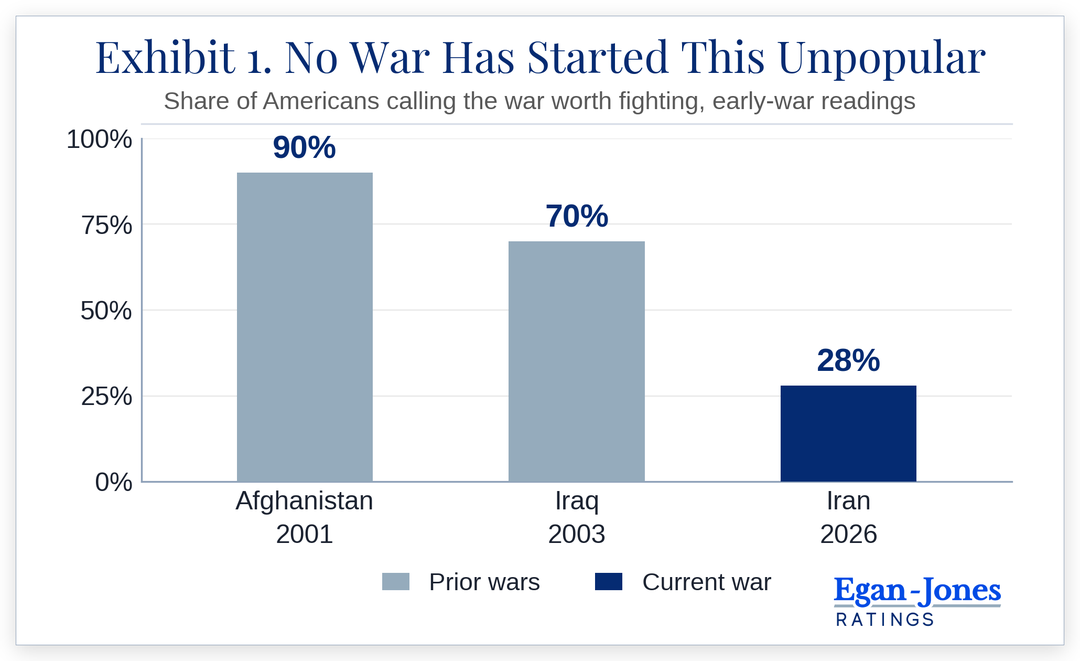
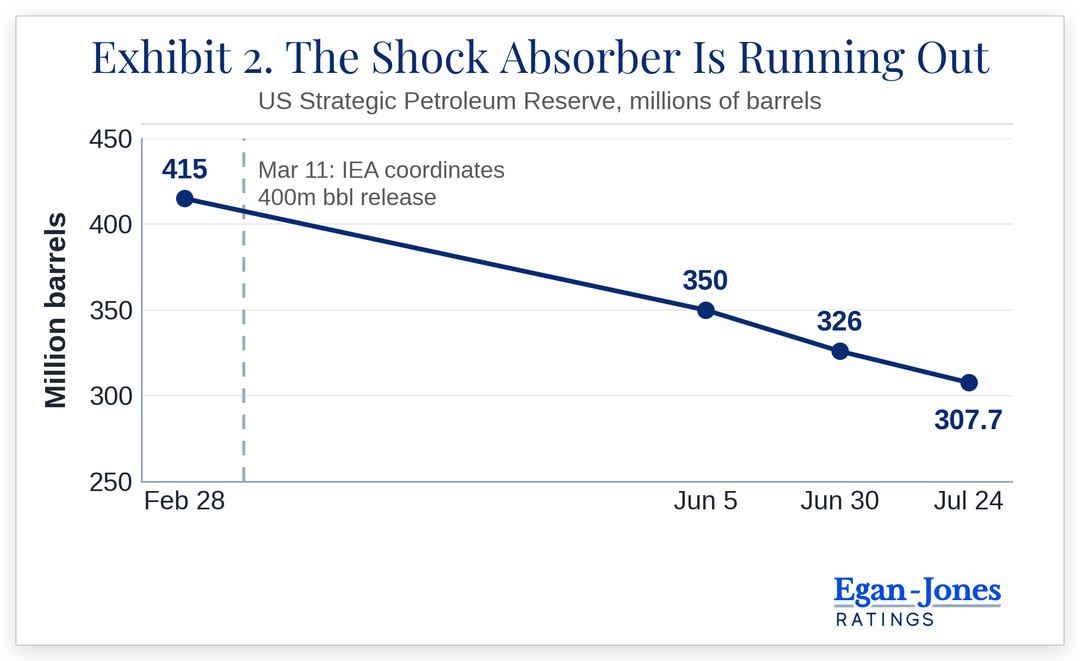
The obvious question is who benefits from the war continuing.
.png)
It appears that Saudi diplomacy is the reason the August 1 strike did not happen.8 However, we remain skeptical that the current round of talks will yield a lasting peace. Recall that achieving a settlement in Afghanistan and Ukraine was difficult considering the lack of a decisive victory. Below we examine various scenarios to end the war.
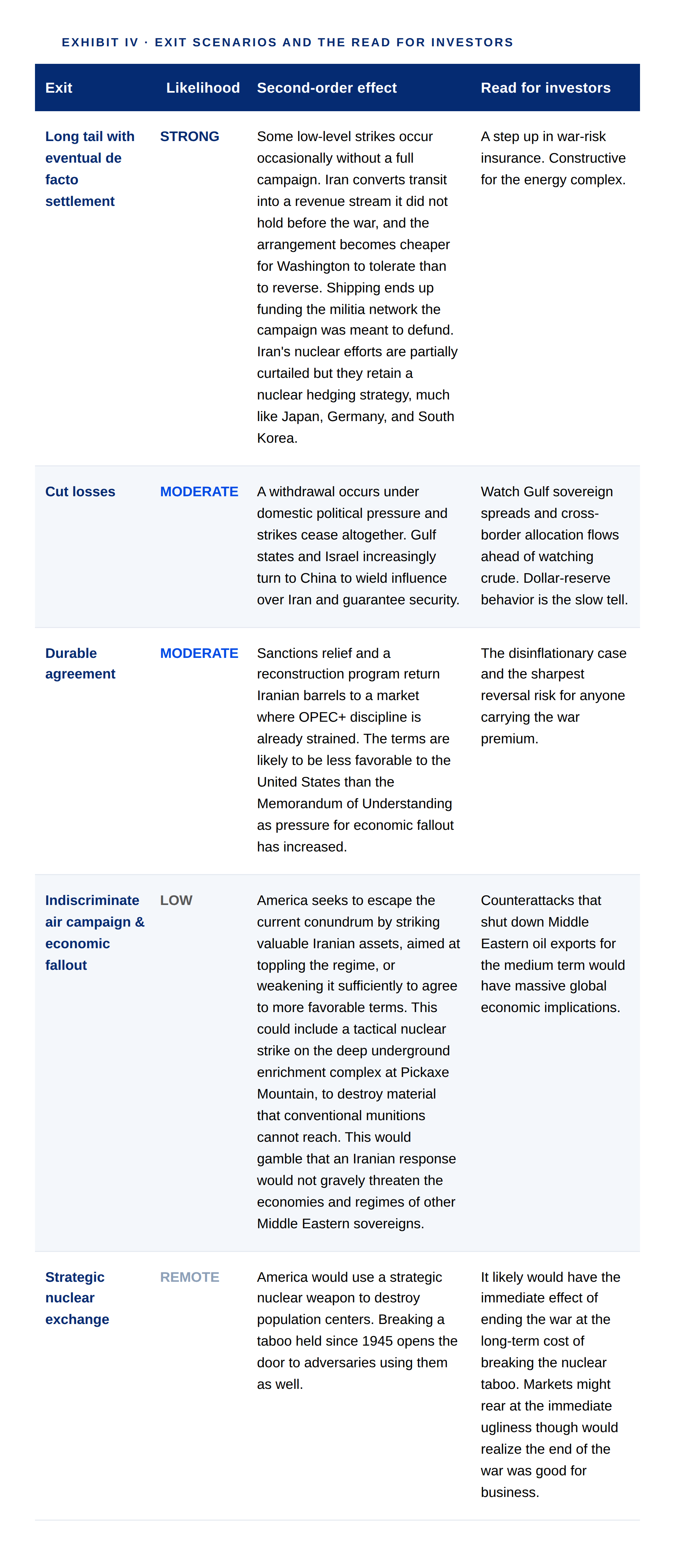
Of course, the market is still working out the probability of each of these scenarios.
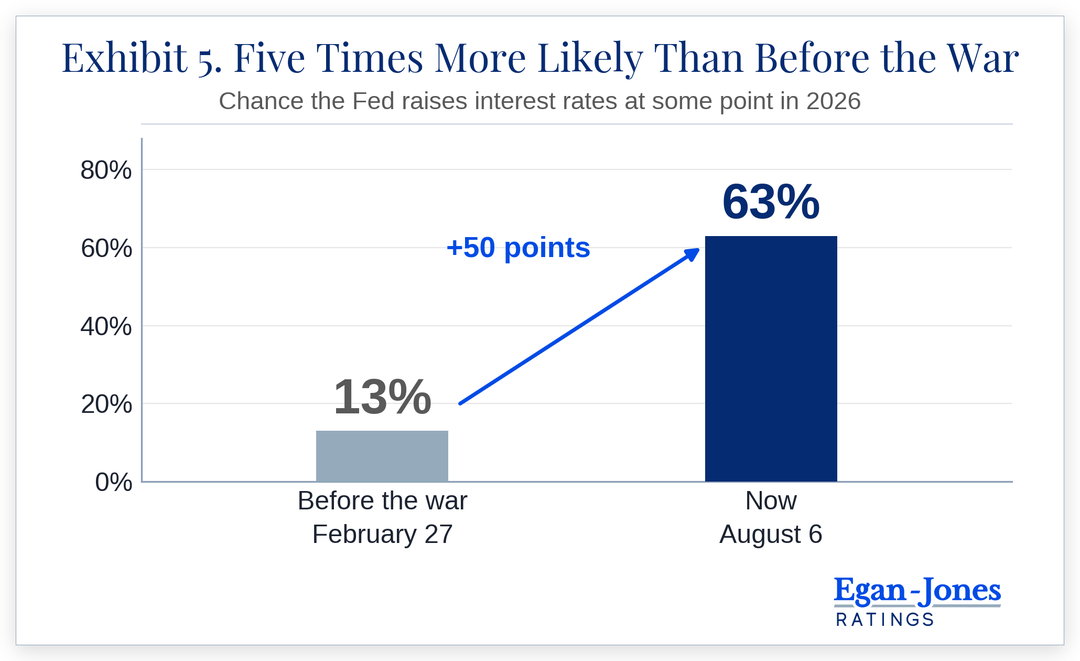
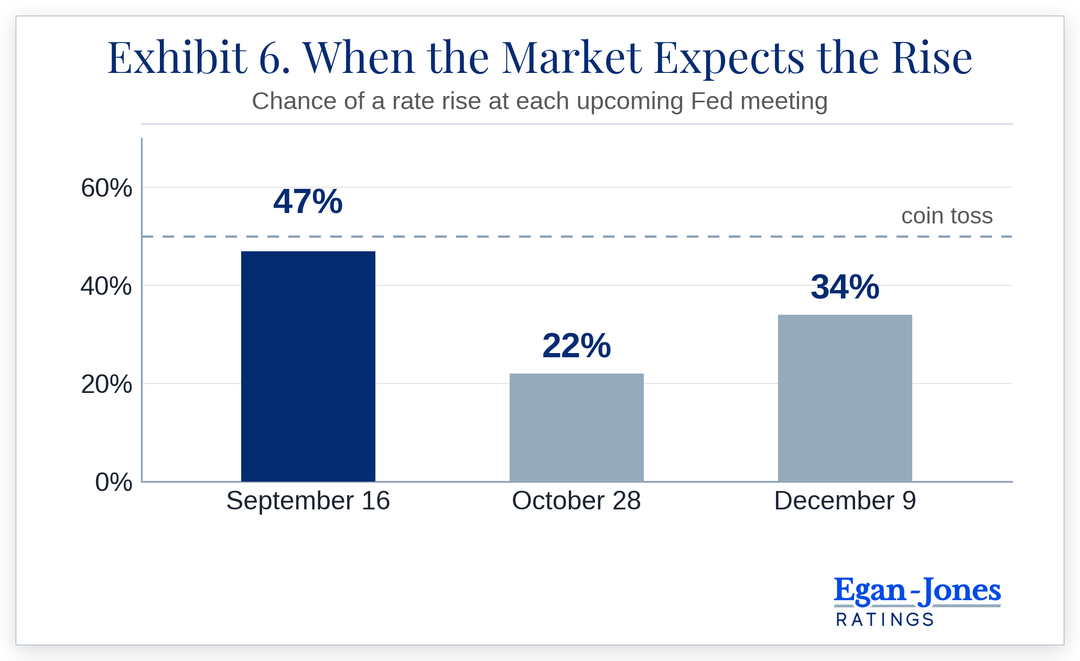
Each bar is the chance of a rise at that meeting alone. The three are not cumulative and do not sum.
The war has spurred inflation and thus raised the possibility of a Federal Reserve rate hike.
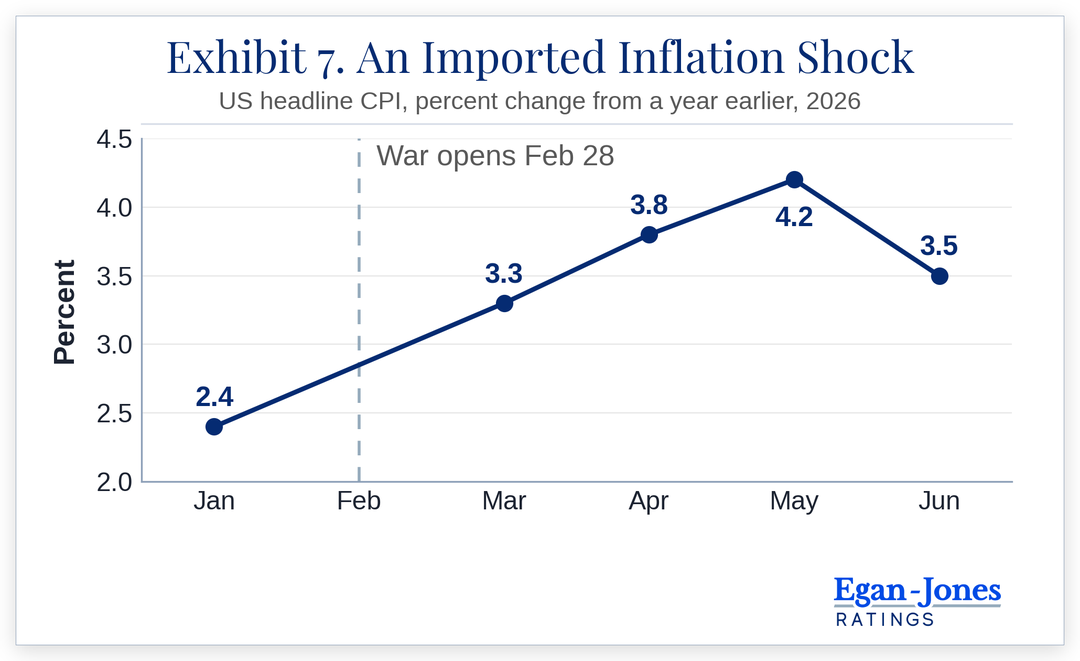
The Federal Reserve is holding at 3.50 to 3.75 percent with three members preferring an increase, and expectations have moved from cuts in 2026 toward one or two hikes.9
Market predictors have vastly different views: Goldman Sachs has Brent averaging above $100 for 2026 on another month of restricted transit and $120 in the third quarter on a longer disruption, against a World Bank base case of $86 this year easing to $70 in 2027.10
Our view is that the forward-basing model that carried American power through the second half of the twentieth century is being retired. Eventually the same will apply to America's aircraft carrier strategy. Washington maintains 40,000 to 50,000 personnel across at least nineteen sites in roughly ten Middle-East countries. At least eleven of those installations were struck this year and several were left barely usable.11 The basing and fleet system worked for Britain but technology has changed sufficiently that it no longer does. The bases and aircraft-carrier-based fleets will persist for a while, because sunk costs, industrial contracts, and allies' expectations are influential. This is not to mention that it is understandably difficult to admit mistakes.
The world is changing rapidly. This installment aims to provide a framework of possible outcomes for the benefit of sophisticated institutional investors and risk managers.
1. The January 3, 2026 Venezuela operation, roughly 200 special operations personnel in Caracas, the capture of Nicolás Maduro and Cilia Flores with no US deaths, and the assessment of a well-executed raid without a viable endgame: Center for Strategic and International Studies · CSIS imagery analysis · Wikipedia · Congressional Research Service
2. Operation Epic Fury opening February 28, 2026 against more than 1,200 military and nuclear sites, the killing of Supreme Leader Ali Khamenei in the opening wave, and the succession of Mojtaba Khamenei: Wikipedia · Wikipedia analysis
3. The three strategies available to an attacker on the modern battlefield (attrition, blitzkrieg, limited aims), and the judgment that a limited aims strategy is seldom attractive yet seldom unattractive enough to hold deterrence: John J. Mearsheimer, Conventional Deterrence (Cornell University Press, 1983) · Wikipedia
4. Roughly 13 million barrels a day of pre-war Hormuz transit, about one fifth of world oil consumption; the IRGC closure of March 2, 2026; and the characterization of the disruption as the largest in the history of the oil market: World Bank Commodity Markets Outlook · International Energy Agency Oil Market Report
5. The Houthi declaration of a naval blockade of Saudi Arabian ports effective July 20, 2026; Yanbu loadings rising from about 763,000 barrels a day pre-crisis to roughly 3.8 million as the principal workaround to Hormuz; Bab el-Mandeb carrying about one tenth of seaborne oil trade and roughly a quarter of container trade; vessels holding in the Red Sea and switching off transponders; and the SUMED part-discharge constraint on laden VLCCs transiting Suez: Al Jazeera · Al Jazeera on Suez · Lloyd's List Intelligence
6. Strategic Petroleum Reserve levels (about 415 million barrels entering the war, 350 million at June 5, 326 million at end-June, 307.7 million in the week ending July 24, the lowest in more than forty-three years and under half of stated capacity of just over 700 million); the GAO finding that more than a quarter of inventory was unavailable for drawdown; the March 11 IEA-coordinated release of 400 million barrels across 32 countries; and the EIA projection of an OECD inventory trough in December at the lowest level since 2003: CNBC · EPRINC · Turner, Mason & Company · EIA weekly data
7. Support at 33 percent against 62 percent opposed (Reuters/Ipsos, July 24-26, 1,246 respondents, margin of error 3 points); 28 percent calling the war worth fighting (Washington Post/Ipsos); early-war support of roughly 70 percent for Iraq and close to 90 percent for Afghanistan (Gallup historical polling); 69 percent saying the goals have not been clearly explained, including four in ten Republicans; and gasoline averaging just over $4 a gallon against about $3 before February 28: Military Times · The Hill · Silver Bulletin polling average
8. The August 1, 2026 cancellation of planned strikes citing progress in talks and Saudi diplomatic pressure; the CENTCOM plan against Iranian energy infrastructure and the reported Israeli position that an operation was worth running only if it damaged economic and regime targets; and the resumption of negotiations on August 3: CNN live coverage · Al Jazeera live coverage
9. Headline CPI of 2.4 percent in January, 3.3 percent in March, 3.8 percent in April, 4.2 percent in May and 3.5 percent in June 2026; the June monthly decline of 0.4 percent, the largest since April 2020; energy up 15.7 percent and gasoline up 26.7 percent year on year; core CPI easing from 2.9 to 2.6 percent; the federal funds target range of 3.50 to 3.75 percent with three members preferring an increase; and the shift in market expectations from cuts toward one or two increases: CNBC · CBS News · Quartz · US Bank Asset Management Group
10. Brent price scenarios conditional on the duration of the closure, including an average above $100 for 2026 on a further month of restricted transit and $120 in the third quarter on a longer disruption, against a World Bank base case of $86 for 2026 falling to $70 in 2027: Goldman Sachs via OilPrice.com · World Bank Commodity Markets Outlook · Trading Economics price history
11. US regional posture of 40,000 to 50,000 personnel across at least nineteen sites in roughly ten countries; at least eleven bases struck during the 2026 war with several left barely usable and the Al Udeid air operations center rendered inoperable; and Gulf states expending the majority of their Patriot interceptors within the first month: Council on Foreign Relations · Middle East Institute · Breaking Defense · Wikipedia
Additional Sources
• Global oil supply losses of 12.8 million barrels a day since February, Gulf output 14.4 million barrels a day below pre-war levels, and cumulative Gulf supply losses exceeding one billion barrels: International Energy Agency Oil Market Report
• The Islamabad Talks of April 11-12, 2026, twenty-one hours across three rounds, agreement on most ceasefire points with Hormuz and the nuclear program unresolved, and no memorandum issued: Wikipedia
• The June 17, 2026 Islamabad Memorandum of Understanding signed by Presidents Trump and Pezeshkian: fourteen points, lifted naval blockade, transit at no charge, supervised down-blending of near-weapons-grade uranium, a sixty-day negotiating window, sanctions waivers, released assets, a reconstruction plan reported at $300 billion, and the American regional military presence placed within scope; OFAC General License X authorizing Iranian energy transactions through August 21, 2026; and the Iran-Oman negotiations on a joint mechanism to govern the strait: CNN · Al Jazeera · WilmerHale · Council on Foreign Relations
• Exhibits 1 and 2 - Gallup historical polling; Washington Post/Ipsos via Reuters; US Energy Information Administration Weekly Petroleum Status Report; Department of Energy Office of Petroleum Reserves; EPRINC; Turner, Mason & Company
• Exhibit 3 - Egan-Jones assessment of stated aims and observed conduct
• Exhibits 5 and 6 - Kalshi, a CFTC-regulated US event exchange; contract series KXFEDHIKE (FEDHIKE-26DEC31) and KXFEDDECISION (September, October and December 2026 meetings), daily closing prices from the Kalshi public market data API: Kalshi
• Exhibit 7 - US Bureau of Labor Statistics, via CNBC and CBS News reporting on the June 2026 release; February not plotted


.jpg)