Technology has yet again upended prior assumptions. In this case, the order which has existed for centuries is threatening to unravel with, of course, massive consequences.
As usual, this Commentary is written for the benefit of sophisticated institutional investors and risk managers.
For the past few centuries, nations were built on the notion of free trade whereby most nations could trade with others and the global economy benefited from the increased efficiency. That is, if one had an advantage in growing wheat, the excess supply could be transported at relatively low cost via vessel to other nations in exchange for goods and currency. Over the last several decades this system became known as the petrodollar system whereby the all-important petroleum products could be shipped out of the Middle East, thereby fueling manufacturing and tech developments globally.
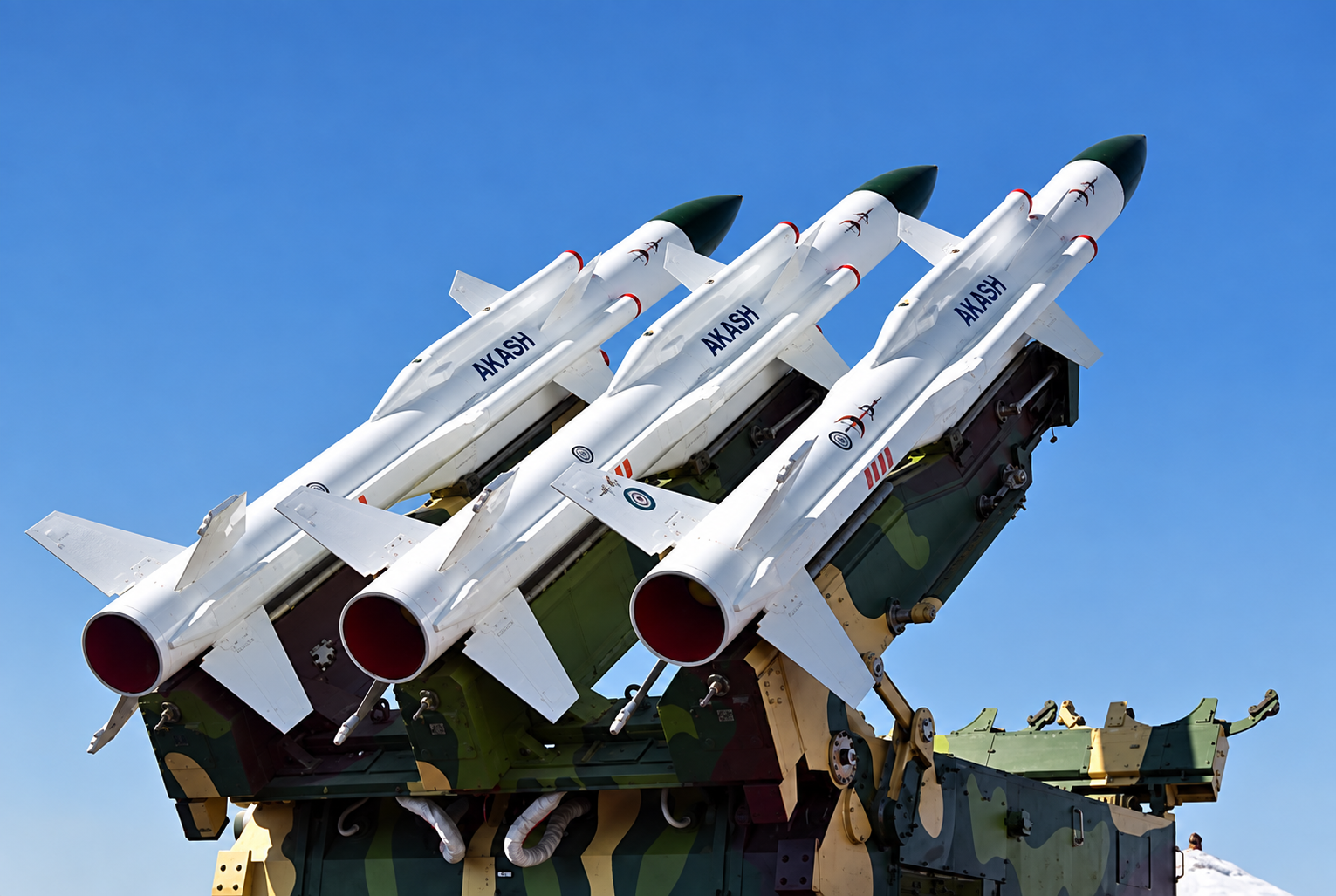
While this system worked for many, some felt disenfranchised. Perhaps this is always the case, but with the development of more sophisticated arms, the disenfranchised now have leverage. With newly developed, relatively inexpensive missiles and drones, Shiite groups can shut down a significant portion of petroleum exports from the Middle East. The below map highlights the Shiite strongholds and, as can be seen, they are present at the major choke points for Middle East petroleum exports.
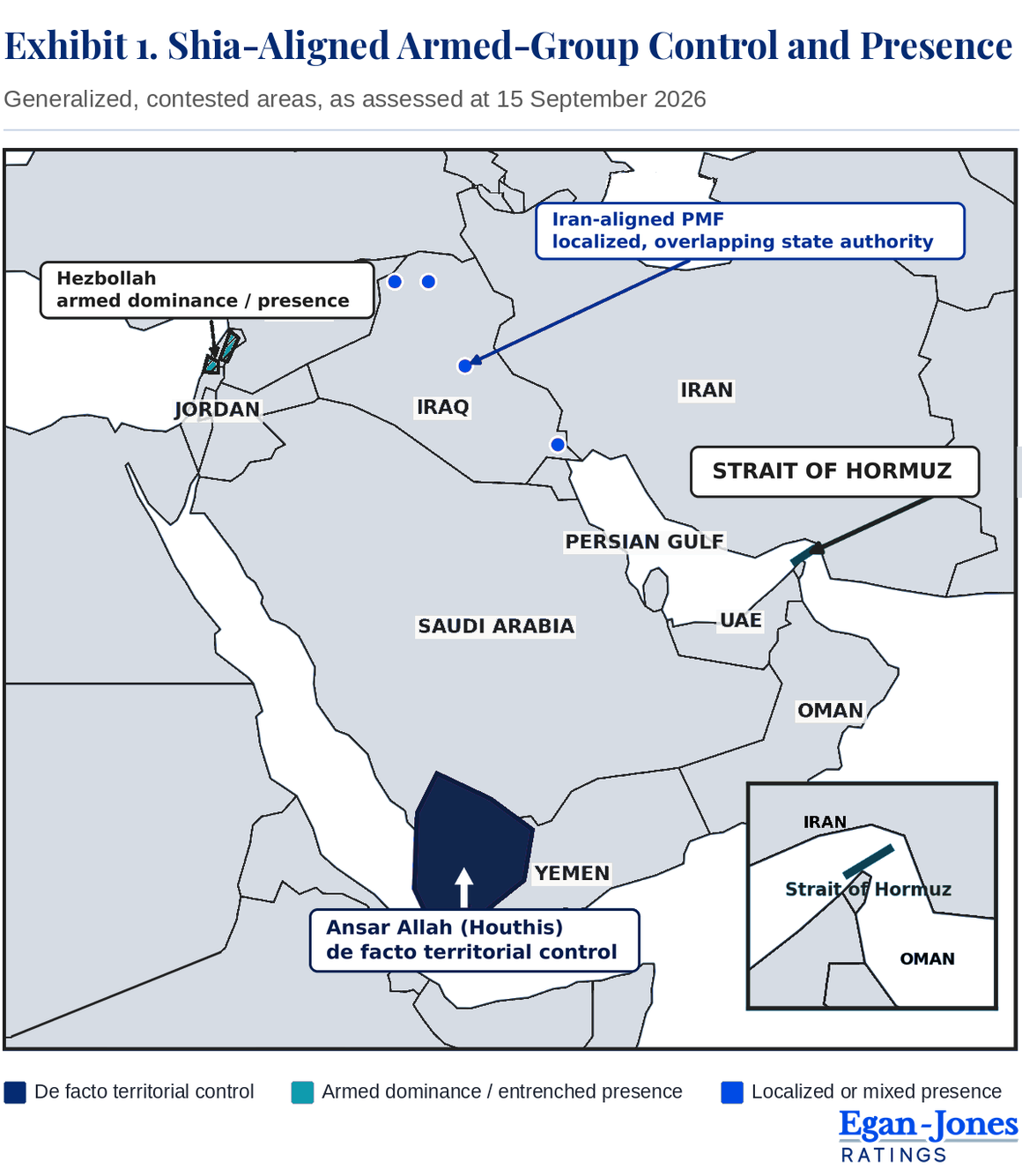
The latest development is the Yemen-based Houthis gaining control of the strategic island of Mayun in the Red Sea, and the shutdown of the cross-peninsula Saudi Arabian pipeline after drones launched from Iraq struck it.1 Saudi Arabia has been fighting the Houthis for the past decade and has not been successful, perhaps because of the difficult terrain of Yemen (the mountains provide easy cover) and the indomitable spirit of the fighters. While U.S. vessels cleared mines near the Strait of Hormuz, the missile and drone attacks remain a credible threat.
In years past, England or the U.S. would send in troops to clear the pirates and restore maritime order. (Hence the Marine anthem “to the shores of Tripoli”). However, punishing wars in Afghanistan and Iraq have chastened the U.S. against similar engagements. Compounding the problem are concerns that the current administration’s efforts in Iran appear to be bogged down.
Turning to other nations that have a stake in the current system, the EU has difficulty agreeing on much of anything and is probably more concerned about Russia’s activities in Ukraine. In the case of China, India, and Japan, all are threatened, but presumably can rely on some energy from Indonesia and other locales, and to an increasing extent are shifting to electric vehicles and other power sources.
The current strategy of the West appears to be one of starving Iran of economic resources in an attempt to rein in the IRGC (Islamic Revolutionary Guard Corps). The underlying premise is that if the population suffers, at some point, they will rise up and overthrow the current regime. The deterioration of the value of Iran’s currency is an indication of the pain, but is not a guarantee of a successful uprising, particularly when the regime is willing to kill scores of demonstrators. (The rial weakened from roughly 186,500 per dollar in 2021 to 2.3 million in September 2026, an approximately 91.9% loss in dollar value.)
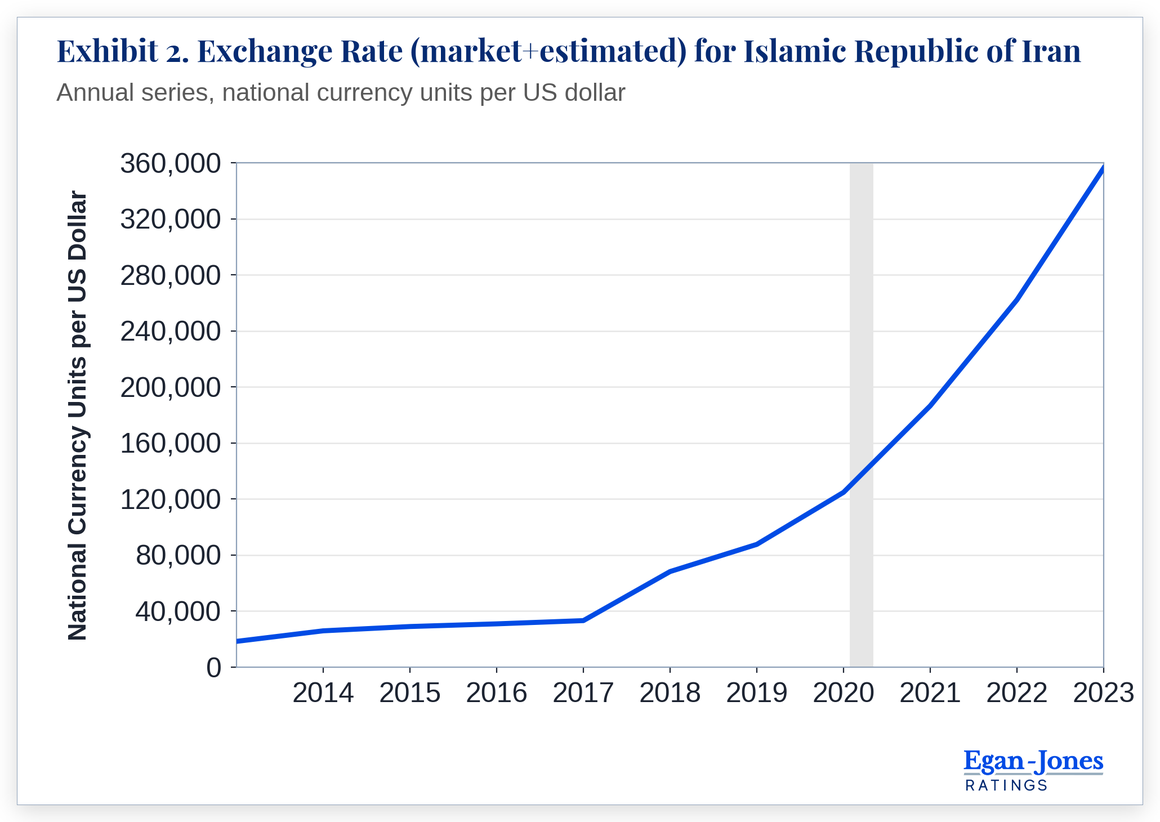
The series is annual and its last observation is 2023. The September 2026 figure cited above is the current Tehran open-market quote, which is measured on a different basis and is not part of this series.
Alternatively, the IRGC’s strategy appears to be one of restricting the transport of energy until the West accepts its key demands, which appear to be securing nuclear weapons and control of the Strait of Hormuz. Given the cooperation of Iran with nuclear-armed states of N. Korea, Russia, and China, it is probably a good assumption that Iran could easily secure nuclear material, but perhaps the IRGC wants a more fully developed, credible program.
Now for the difficult part of assessing likely outcomes. A reasonable view is that the primary motivators of the IRGC leaders are the normal ones of power and money (as opposed to a religious reordering of the world). If that is the case, watch for the push for a tolling system for the movement of petroleum and either covert or overt gaining of nuclear access. While such an outcome is unpalatable and is likely to result in the nuclear arming of other Gulf states, over time, it is probably manageable.
Alternatively, the curtailment of Middle East energy exports will result in a very different world, and major economic distress. Essentially all economies based on petroleum, natural gas and derivatives will need to make major adjustments. Perhaps the starting place is food production (which typically relies on petroleum-based fertilizer) and transportation. Global GDP would likely take a major hit at a time when sovereigns and many other creditors are struggling to stay ahead of obligations.
We have prided ourselves on providing advanced warning to sophisticated institutional investors and risk managers of pending developments. We hope we are wrong about conditions, but typically it is best to understand underlying conditions and adjust rather than ignore emerging threats.
Egan-Jones against the other NRSRO on the same tranche, with collateral test cushions.
The ten most recent Egan-Jones CLO tranche ratings are shown below alongside the other NRSRO’s equivalent rating on the same tranche and the current collateral test cushions. Every rated tranche is listed in the complete Egan-Jones CLO ratings table at egan-jones.io/non-nrsro-ratings/clo.
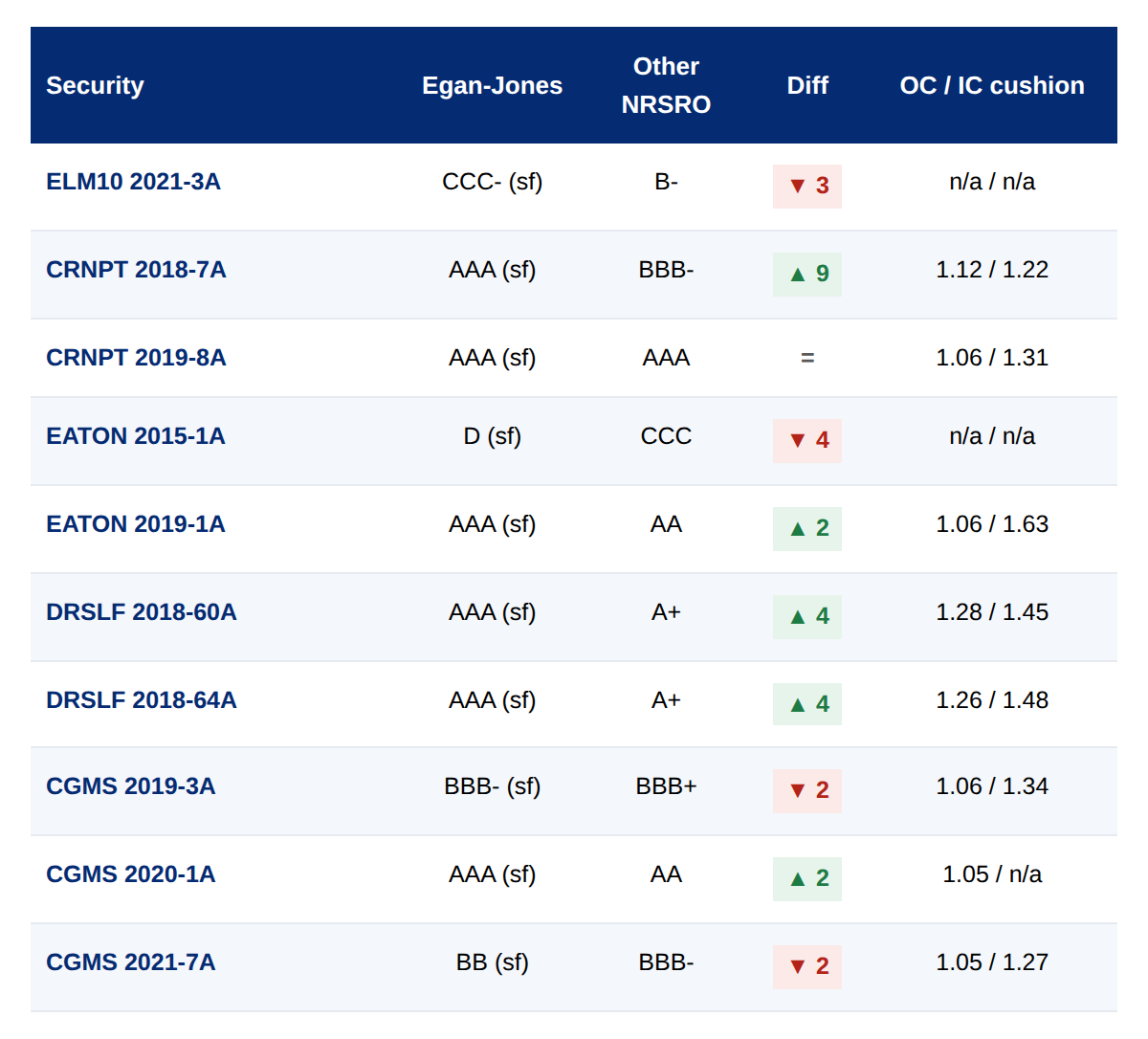
Egan-Jones Ratings Company CLO rating reports; report data as of 08/12/26.
Diff is the gap in notches between the Egan-Jones rating and the other NRSRO’s equivalent rating on the same tranche, measured on a 22-step scale from AAA to D. Green is Egan-Jones higher; red is Egan-Jones lower; “=” is a match. Cushion is the current test level divided by its trigger, so a figure below 1.00 means the test is failing. “n/a” appears where the report shows no test of that type for the class. Egan-Jones ratings shown here are not NRSRO ratings.