.svg)

Of late, much (perhaps too much) attention has been devoted to the field of artificial intelligence (AI), with the common refrain that it will replace a significant amount of current work. AI is now supposedly at the point where it can pass the bar exam far better than the average law school student, read and interpret X-rays more effectively than the average doctor, and write code faster than the typical programmer.
The acolytes claim that most humans will not have to work and that we will soon be in an era of massive prosperity. Providing solace to many social commentators is the notion that there will be some form of universal income so that the fruits of this massive productivity gain will be shared with all. Our views do not mesh with this notion. Instead, there is a high possibility or perhaps likelihood that the AI beneficiaries will not share their gains, thereby creating major dislocations.
The AI world will supposedly be one in which a massive number of jobs will be replaced by a variety of robots. While some of this is already happening, such as on factory and warehouse floors, changes are also occurring in truck driving, taxis, and a variety of other fields. The upshot of all of this is likely to be a significant improvement in GDP and productivity.
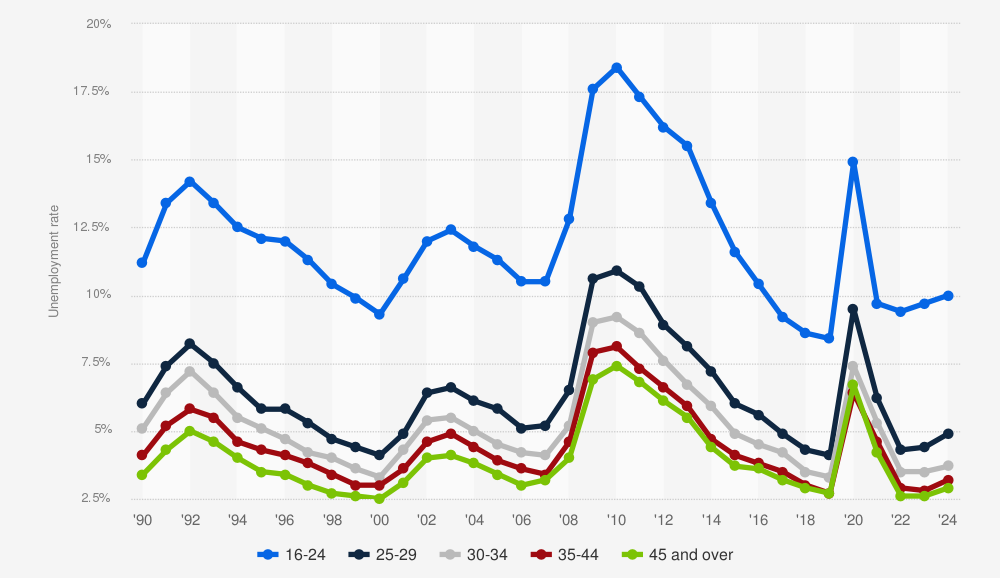
Now for the hard part, and that is the reallocation of citizens into productive occupations. With the decline of birthrates in many developed economies, the pool of available labor is likely to shrink over time. However, our anticipation is that the job losses will rise faster than the population declines, thereby raising the issue of how to support the displaced workers. The youth-unemployment graph below supports this notion:
Our premise is that major AI investors will be reluctant to share their newly won gains with the broader population. For example, rarely does one see an entertainment or sports star redistributing their wealth among other citizens.
Over the past year, Salesforce (NYSE: CRM) has lost more than a quarter of its stock price. Among other factors, Salesforce’s stock has faced negative pressure because investors anticipate it will become increasingly easy to develop alternative platforms by implementing AI in the process.

AI-led software development is the mission of “Macrohard,” a company being developed by Elon Musk’s xAI to challenge legacy firms such as Microsoft. As usual, the line of attack comes in the form of faster, better, cheaper.
Some claim that AI’s fortunes will be broadly shared because parts of it are open source. However, just as Linux is open source in the software field, massive areas of the field are not open source, and therefore the wealth built will not be freely distributed. Furthermore, the investors pouring millions into the area are expecting a reasonable (and perhaps unreasonable) return.
Hence, we return to where we began: the image from the Star Wars film Attack of the Clones, in which massive productivity is generated by a few (in that case, by the operator of the clone factory). Assuming wealth need not be distributed, and products can easily be shipped globally, we may be left with a Singapore, Switzerland, or Monte Carlo-style model in which the country caters to the affluent. Perhaps in the short run we have a continuation of the current patterns whereby the affluent move from high-tax blue states in favor of Southern states, while northern areas have increasing difficulty retaining their most productive citizens. Additionally, geographic “creative cores” might emerge over time.
There is little doubt that AI is transforming society. The challenge lies in anticipating these major shifts and positioning oneself, hopefully, to benefit from them.


.jpg)