
In a manner reminiscent of the discredited MMT (Modern Monetary Theory), French politicians are suggesting an ingenious (but deeply flawed) solution to their growing debt concerns.1 For the benefit of sophisticated Institutional Investors and Risk Managers we discuss how we arrived at this point and more importantly, likely outcomes.
For centuries, France was THE continental power of Europe while the Dutch and later England dominated the sea lanes. Via this wealth and power, France built some of the most beautiful palaces of the world and became the envy of much of the developed world. However, quickly forgotten is the fact that all that gold masked some underlying problems which resurfaced on a periodic basis. Long forgotten is the fact that France defaulted a total of nine times, many times because of questionable wars, lavish spending, and misguided policies.2
For better or worse, France is yet again in peril as indicated by the typical measures: a rising debt to GDP, gapping out debt yields, and a stubborn level of deficits.3 Compounding the troubles are a declining birth rate, rising dependency levels and calls for increased military spending to respond to (A) heightened tension with Russia, (B) heightened pressure from the US to increase spending and (C) skepticism over its military relationship with America.

The dashed segment bridges the publication lag between the last OECD monthly average and the latest market quote. The August 2026 point is a point-in-time observation, not a monthly average.
Now for the interesting part and that is possible solutions. The normal alternatives are listed below and comments on each:
Given the fact that France is on the verge of a major election with a left-of-center and a right-of-center populist party (led by Jean-Luc Mélenchon, and Marine Le Pen respectively), perhaps it is worthwhile examining their platforms for a hint of what’s to come. If we are to believe the politicians (always a dicey undertaking) then it appears that Mr. Mélenchon is taking the matter seriously and is proposing a solution. (Hint: we like the first part but hate the second). The proposal might be considered genius by some and borderline fraud by others.
In a plan that might have been inspired by that late great magician, a true master of misdirection Mr. Harry Houdini, Mr. Mélenchon is proposing that the central bank simply cancel the bonds it holds that were issued under eurozone-wide quantitative easing. Simple, just cancel the debt, no pains, no worries, no default. Vanished! With a stroke of a pen, billions of euros of indebtedness vanish.
For those feeling befuddled, join the crowd. This sleight of hand has a cost, but it takes a bit of thought to determine where and how. First off, the bank has seen a major asset disappear from its balance sheet and the liabilities (in the form of currency issued) remains. Hence, it is akin to Germany’s printing of increasing amounts of currency during the Weimar Republic. Second, the European Central Bank (ECB), might have concerns about its currency being debauched. (The proposal would give France immediate relief from refinancing and interest costs, but it faces a decisive obstacle: the ECB considers it prohibited monetary financing under Article 123 of the EU treaty.6) Lastly, funding costs for the country might increase based on concerns about the chicanery and that might be continued thereby offsetting any gains.
Unfortunately, France is not alone; the debt to GDP has risen for many of the developed countries. Our sense is that governments often do not take such drastic actions unless they are forced to and perhaps the increased yields (see the “bond vigilantes” of yesteryear) or problems funding the various programs will be the catalyst. In the meantime, watch for a muddling through and central banks standing ready to suppress long-term yields via quantitative easing.
The Credit Crisis of 2008 was a watershed event which saw the Treasury Secretary asking for a “bazooka” in the form of 17 unprecedented programs to assist in bucking up the precarious financial system (people forget that the US had to backstop the commercial paper market because a major issuer could not roll its paper).7 Coupled with that power was Bernanke’s claim that the Great Depression was caused by the government failing to step in early in force to replace the private sector demand which had exited the market. While there is little doubt that those expansive powers granted the Central banks post the crisis were critical, the concerns remain whether those same powers will delay the adjustments needed for a more sustainable path.
Our North Star has been and remains assisting sophisticated institutional investors and risk managers. With that, we believe the most likely course is the usage of QE supplemented with IMF SDRs (Special Drawing Rights) or similar tools in the short and medium term to address sovereign credit quality concerns.
Egan-Jones against the other NRSRO on the same tranche, with collateral test cushions.
The ten most recent Egan-Jones CLO tranche ratings are shown below alongside the other NRSRO’s equivalent rating on the same tranche and the current collateral test cushions. Every rated tranche is listed in the complete Egan-Jones CLO ratings table at egan-jones.io/non-nrsro-ratings/clo.
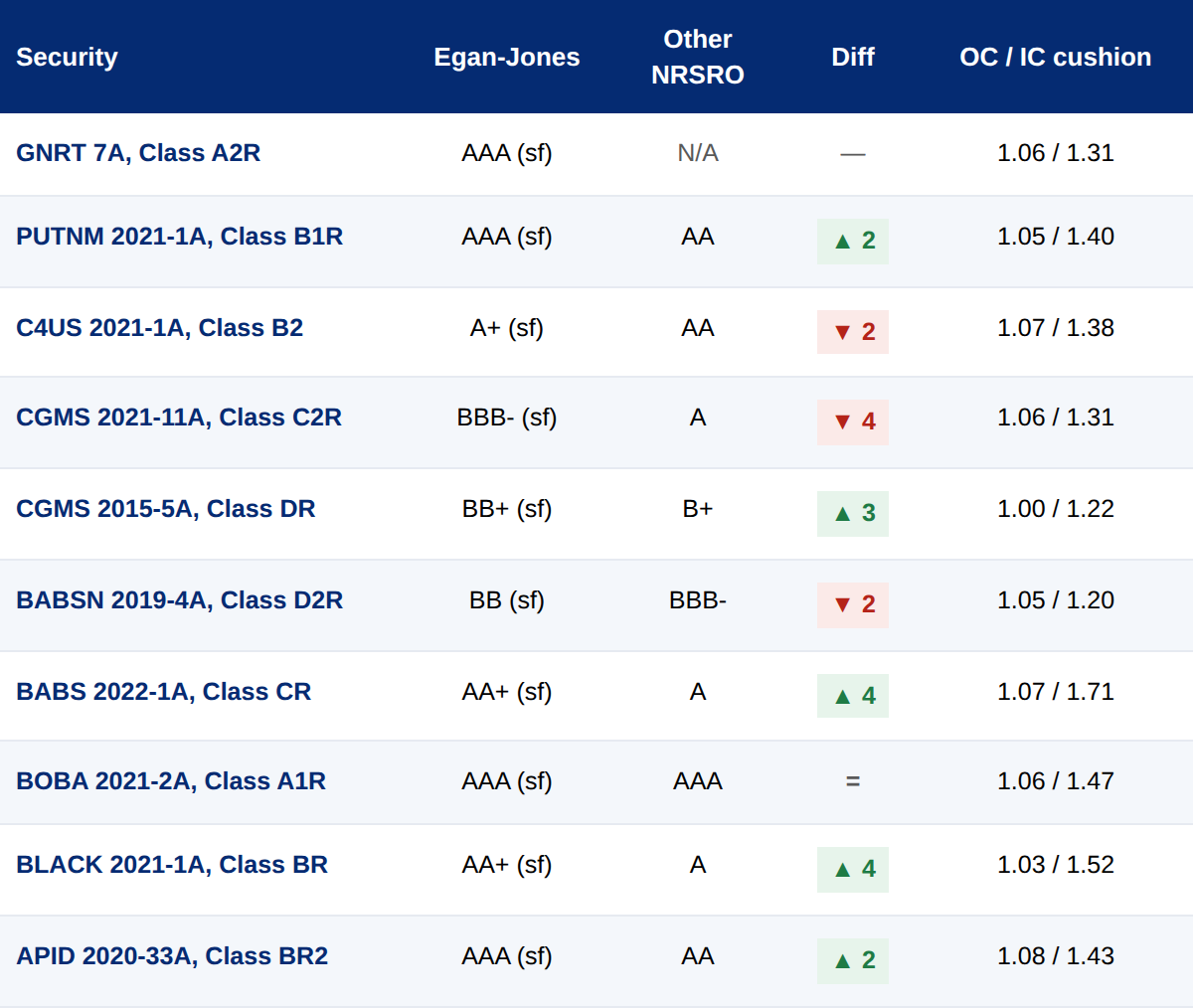
Diff is the gap in notches between the Egan-Jones rating and the other NRSRO’s equivalent rating on the same tranche, measured on a 22-step scale from AAA to D. Green is Egan-Jones higher; red is Egan-Jones lower; “=” is a match. Cushion is the current test level divided by its trigger, so a figure below 1.00 means the test is failing. “n/a” appears where the report shows no test of that type for the class, and “—” where no comparison is available because the tranche is unrated by one of the two. Egan-Jones ratings shown here are not NRSRO ratings.