Nvidia Board Fallout
November 17, 2026

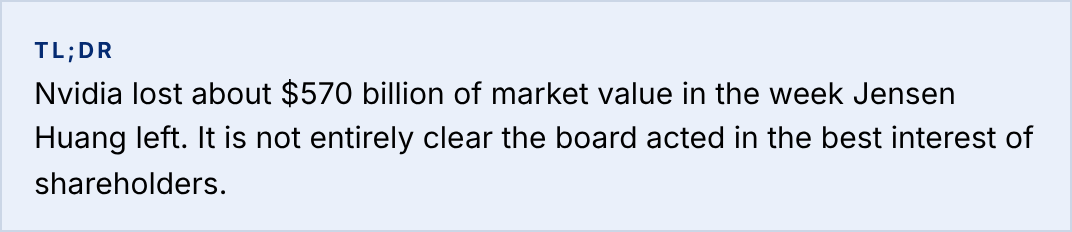
Nvidia lost about $570 billion of market value in the week Jensen Huang left,¹ and therefore the decisions made by its board should be considered carefully. The board announced Huang’s resignation on November 12, effective immediately, four days after opening an investigation into reports about him and two days after hiring the law firm Wachtell, Lipton, Rosen & Katz to run the investigation.
How the market reacted
• Before Huang admitted the affair. Nvidia’s share price was already falling in the month before Huang admitted the affair on November 8, as were those of other chipmakers.²
• After the admission. Nvidia kept falling while other chip stocks rebounded. Most of the gap between Nvidia and its peers opened in these three trading days.²
• The ouster. After the market closed on November 11, The New York Times reported a second affair and The Wall Street Journal reported that the board would meet to discuss Huang’s future.³ By the next morning Huang was out, and the stock opened about 14% below the November 11 close before recovering part of the loss.
• Since the ouster. Other chip stocks have fallen too, some by about as much as Nvidia, while the total market has fallen less.
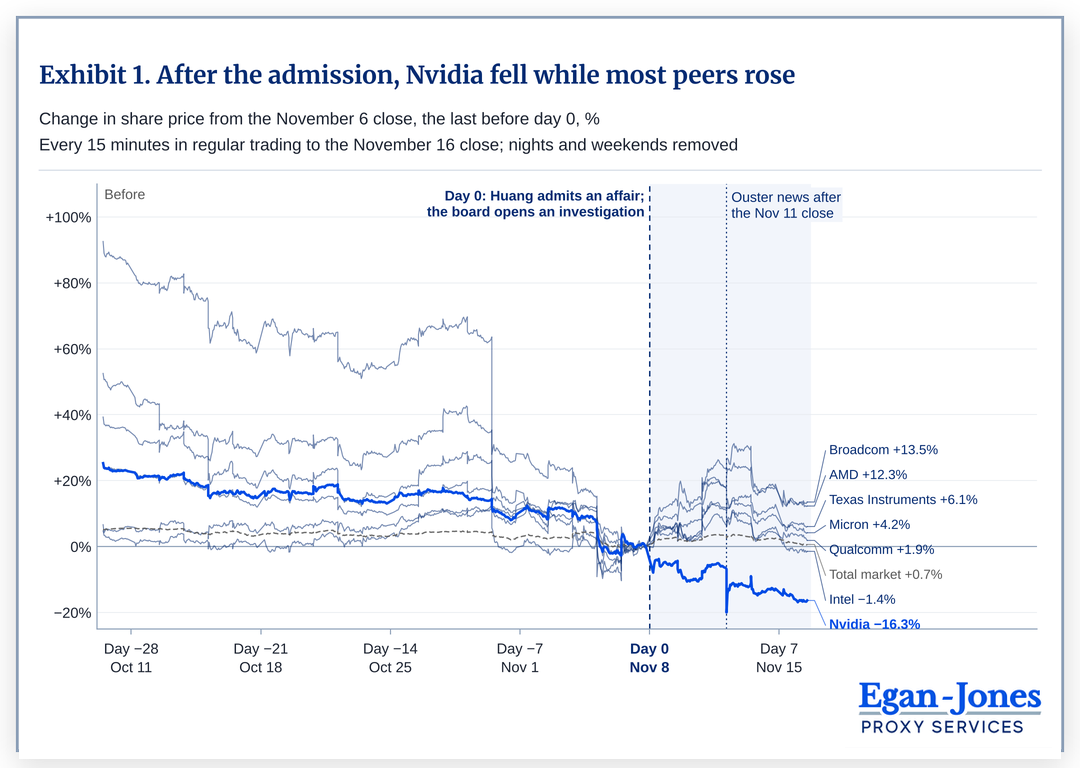
Source: Yahoo Finance 15-minute prices in regular trading for each company’s U.S.-listed shares. The total market is the Vanguard Total Stock Market ETF (VTI). Event timing is from the reporting cited below.
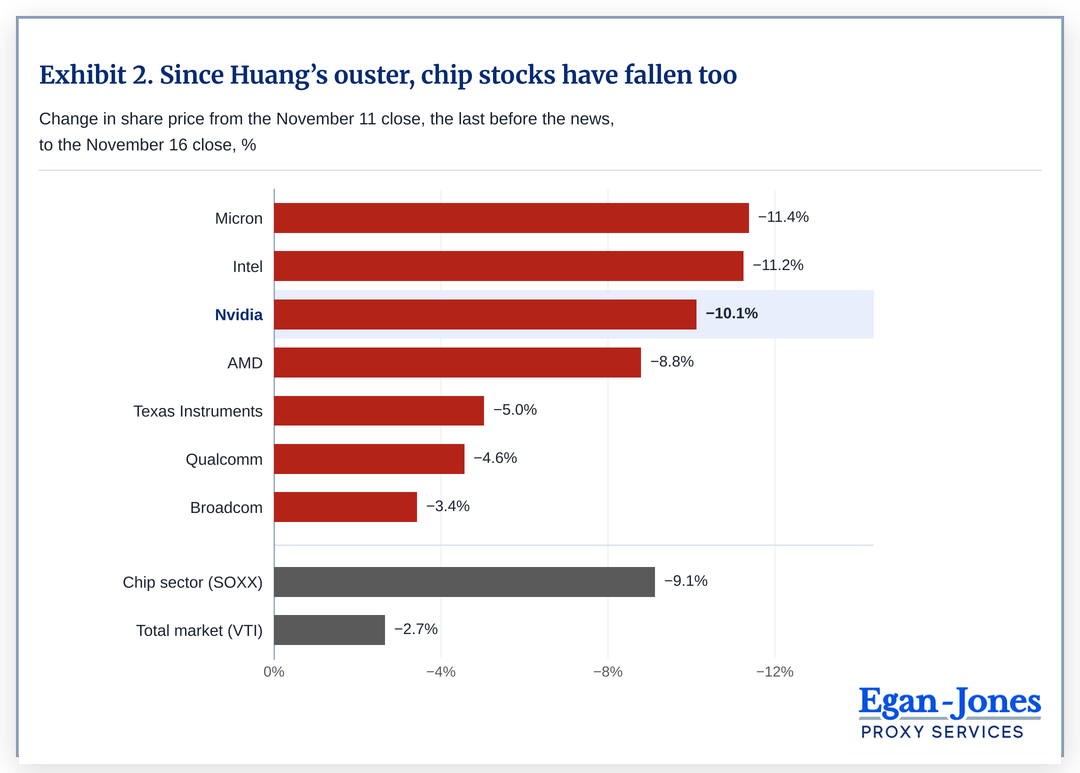
Source: Yahoo Finance prices of each company’s U.S.-listed shares. The chip sector is the iShares Semiconductor ETF (SOXX) and the total market is the Vanguard Total Stock Market ETF (VTI).
Known faults of Jensen Huang
There is no doubt that at least two things went terribly wrong:
• Personal conduct. Huang’s infidelity is immoral, though not illegal, and it jeopardized the firm through bad publicity and created conflicts of interest within Nvidia.
Huang admitted an affair to employees on November 8.⁴ Reports tie him to at least three women, one of whom is a suspected Chinese spy, Alice Huang, an executive at Megaspeed.
• No successor. Had Huang been incapacitated or otherwise unable to perform his duties as chief executive, there would have been no clear successor. Not putting a successor in place was a disservice to shareholders.
The damage due to his departure was exacerbated by the hub-and-spoke model he installed at the firm, with about 60 direct reports and no chief operating officer, as opposed to a pyramid structure.⁵ With that stated, clearly the hub-and-spoke model has been highly effective at Nvidia.
Open questions
Beyond this, there is much speculation, though as far as we understand, nothing is confirmed:
• Legal exposure. The federal government has not accused Huang of a crime, let alone convicted him, despite his immoral behavior. The Justice Department is reportedly investigating whether Megaspeed smuggled Nvidia chips into China, and President Trump has said the FBI is looking into Huang’s relationship with Alice Huang.⁶
• The relationships. Their nature is not totally clear, including how long they lasted. Huang and Alice Huang were photographed together in 2024 and 2025.⁷
• Alice Huang’s status. It is not clear whether Jensen Huang’s mistress, Alice Huang, was a Chinese spy or a businesswoman looking to make money by gaining better access to Nvidia chips and thereby providing access to China via the cloud.
• Jensen Huang’s knowledge. It is not clear what Jensen Huang knew about Alice Huang’s status as a potential spy or what information he shared with her.
• Why the board pushed Huang out. Nvidia has given no reason.⁸ It is unclear whether it was over immoral behavior, governance concerns, or cooperation with a Chinese spy.
Some seem to assume that the board has material information that the public does not. Boards’ information advantage is often limited because they lack a day-to-day role. In this case, the board had just hired a law firm to run its investigation, so it seems it was still gathering information. On November 8 it said it had no reason to believe national security or Nvidia’s secrets were compromised.⁵
Some claim that Huang is a “fall guy” for Nvidia’s own conduct, in particular giving China access to Nvidia chips. Senator Elizabeth Warren has said the company’s leaders “still owe Congress answers about the company’s compliance with U.S. export controls.”⁹ We have seen no evidence of illegal activity.
• Whether Huang returns. Polymarket traders see a return as unlikely this year and more likely by the end of 2027 (Exhibit 3). Sources familiar with the board’s thinking claim it is not considering Huang’s return.¹⁰
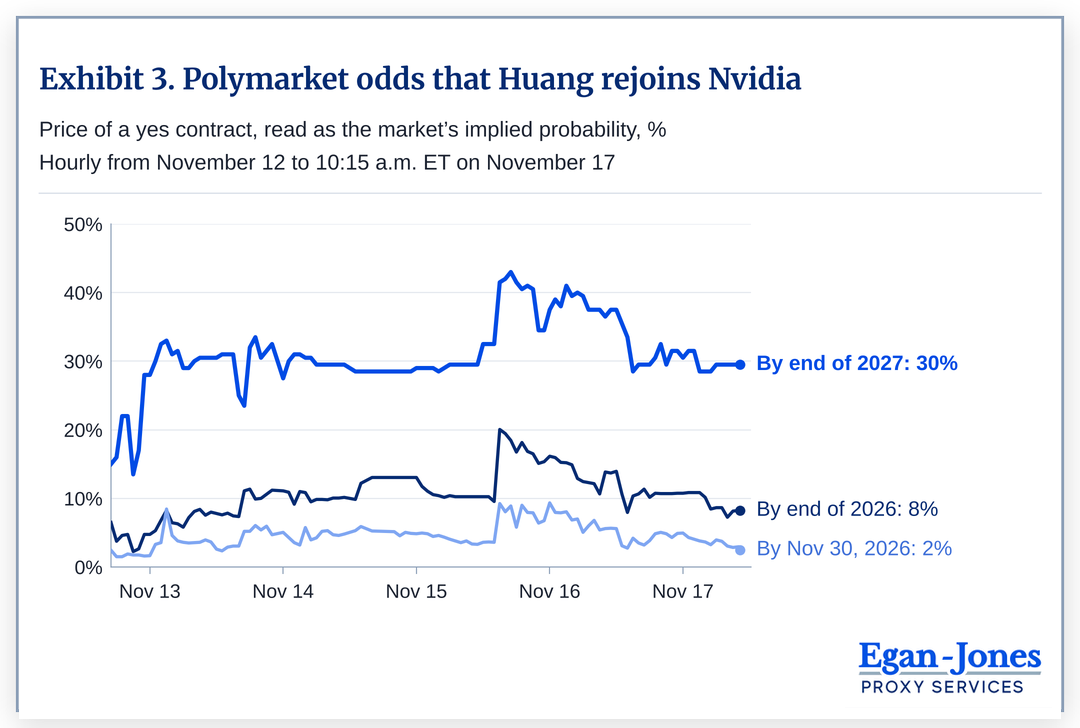
Source: Polymarket hourly prices from November 12 to 10:15 a.m. ET on November 17, 2026. Prices reflect traders’ bets and are not Egan-Jones forecasts.
Supplying chips to China
Ironically, China has claimed publicly, though it may not be true, that it does not want Nvidia chips and would rather support a domestic silicon industry. Beijing told its AI companies not to buy Nvidia’s H20 and for months held back purchases of the H200 after Washington approved its sale.¹¹ This is not unlike how China has promoted its domestic banking, manufacturing, farming, telecommunications, and electronics industries.
Arguments for restricting China
Limiting Chinese access to chips will slow Chinese development of AI. Anthropic’s chief executive, Dario Amodei, has likened H200 sales to China to “selling nuclear weapons to North Korea.”¹²
Further, some claim that open models, which are popular among Chinese AI companies, pose greater risk to society as they offer users easier access to “restricted” topics such as biological or chemical weapons.
Arguments against restricting China
Some argue America need not cede this massive market, from which it can learn, generate profit, and develop Chinese reliance on the American tech stack. Huang made this argument in his interview with Dwarkesh Patel in April.¹³
Huang also argued that a closed system is not safer due to its opaque nature, and that defenses tested in the open by thousands of developers hold up better than those guarded by a few AI model firms.¹⁴ He also has contended that open models let companies and countries run AI on their own terms, which keeps the U.S. ecosystem ahead and stops users from drifting to foreign alternatives.¹⁵
Argument relevance
For China to have gained access to Nvidia’s chips, it was not required that it import them. Rather, access to them was via the cloud in another nation. It appears that was the notable role of Megaspeed.
Precedent for board action
There is precedent for boards removing chief executives over relationships, typically where a company rule was broken:
• McDonald’s fired Steve Easterbrook in 2019 over a consensual relationship with an employee that broke company policy, later sued him for hiding others, and recovered about $105 million.¹⁶,¹⁷
• Intel’s Brian Krzanich resigned in 2018 after a past relationship with an employee was found to breach company policy.¹⁶
• Nestlé dismissed Laurent Freixe in 2025 over an undisclosed relationship with a direct subordinate, which he had first denied to the board.¹⁸
The board’s role
The role of a corporate board ultimately is to serve the interests of shareholders. To that end, governance is one of the key areas that it oversees. A relevant question is whether the board has seen governance in this instance as an end in and of itself at the expense of shareholders’ financial interests.
Further, board members, like most employed people, are highly concerned with ensuring their continued employment. Often, board members also have concerns about social issues.
It is clear that Huang is a once-in-a-generation talent, having spearheaded the creation of hardware that is enabling perhaps the most revolutionary technology mankind has ever seen. He also has led efforts to finance many other firms in the space at a time when other investors have lacked the vision or capacity to do so.
Fiduciary duty
It appears difficult to argue that the board failed to uphold its fiduciary duty, considering courts have historically given boards significant leeway in this space.¹⁹
Whether the board acted in a way that maximized shareholder value is less clear. Of particular interest is Huang’s immediate removal rather than a measured transition plan. We expect more information to come out.
Considerations for board vote recommendations
Arguably, we have witnessed the most important executive transition of the past couple of decades.
Shareholders will vote on Nvidia’s directors at the 2027 annual meeting, likely in June.²⁰ Egan-Jones will issue vote recommendations to shareholders for that meeting. A few points are notable as we approach the shareholder meeting, about seven months away.
1. Maximizing wealth. It is not clear that the board acted in the best interest of shareholders or maximized shareholder wealth, as demonstrated by the market’s reaction to Huang’s departure. Huang has been instrumental in the growth and success of the company, and his departure makes it more uncertain whether that growth can continue.
2. CEO succession. The CEO succession plan appears to have been inadequate given that there was no clear successor. Typically, the nominating and governance committee, and especially its chair and the lead independent director, would be responsible. The firm could have taken proactive steps for an easier transition.
We appreciate that chief executives want to protect their position by ensuring the next-best alternative is as weak as possible.
3. Quick action. The immediate removal makes the transition to better governance more challenging.
4. Lack of information. The board has been largely reserved in sharing its process and thinking with shareholders regarding the removal.
These points will be considered differently for each of our voting policies (frameworks by which we develop recommendations for different investors).
Wealth-Focused Policy
Recommendations under this policy rest only on protecting and enhancing investor wealth.²¹,²² This policy does not insist that firms implement “best-practice” governance standards.
Our other policies
Our Governance Policy and other policies give more weight to market-standard governance practices as precursors to enhancing shareholder wealth.²²
Conclusion
This has been a dramatic shift in the value of Nvidia, with serious knock-on effects for the value of other firms and for the AI race. It is not entirely clear that the board acted in the best interest of shareholders. Egan-Jones is watching closely ahead of the annual meeting.
Sources and Footnotes
1. Investing.com, “Nvidia stock slides to worst week since April 2025 after Huang resignation”, November 13, 2026; NewsBytes, “NVIDIA stock falls 13% after CEO Jensen Huang was ousted”, November 14, 2026. Market value lost from the November 6 close to the November 13 close; by Egan-Jones calculation, the share price fell from $186.64 to $162.85 on about 24.1 billion shares outstanding, a loss of about $573 billion.
2. Egan-Jones calculations from Yahoo Finance closing prices. From October 9, 30 days before day 0, to the November 6 close, Nvidia fell 18.6% and the iShares Semiconductor ETF (SOXX) fell 26.8%. From the November 6 close to the November 11 close, Nvidia fell 6.9% while SOXX rose 13.8%.
3. TechCrunch, “The unfolding Jensen Huang scandal: a timeline”, November 13, 2026.
4. CBS News, “Nvidia investigates CEO Jensen Huang amid allegations he was target of Chinese intelligence effort”, November 2026.
5. Fortune, “Nvidia’s Jensen Huang resigns, CFO Colette Kress named interim CEO”, November 11, 2026.
6. NBC News, “Trump says FBI is investigating Nvidia CEO Jensen Huang’s relationship with alleged Chinese spy”, November 2026.
7. Axios, “Who is Alice Huang? The woman at the center of Nvidia’s scandal”, November 9, 2026.
8. Al Jazeera, “Why did Nvidia CEO Jensen Huang resign, and who is Colette Kress?”, November 12, 2026.
9. CBS News, “Nvidia CEO Jensen Huang resigns in wake of affair with woman suspected of spying for China”, November 12, 2026.
10. CNBC, “Nvidia board is not considering bringing Jensen Huang back as CEO, source tells CNBC”, November 16, 2026.
11. Brookings Institution, “Ball game’s over - the US is out of the AI chip market in China”, 2026.
12. Forbes, “US-China AI Race May Hinge On Whether Dario Amodei Or Jensen Huang Is Right”, May 29, 2026.
13. Newsweek, “Why Nvidia Is a War Over ‘America First’”, November 16, 2026, on Huang’s April 2026 interview with Dwarkesh Patel.
14. GamesBeat, “Nvidia CEO Jensen Huang leads charge for open source AI”, July 2026, reprinting Huang’s open letter “Open Weights and American AI Leadership”; GamesBeat, “AI industry forms Open Secure AI Alliance for safety”, 2026.
15. The Register, “Jensen puts his thumb on the scales against open-weights fearmongering”, July 2026; GamesBeat, “Nvidia CEO Jensen Huang leads charge for open source AI”, July 2026.
16. Quartz, “Workplace relationship policies and the C-suite, explained”, November 2026.
17. Fast Company, “CEOs still think they can get away with affairs after #MeToo”, November 2026.
18. Reuters, “Nestle abruptly removes CEO Freixe over undisclosed relationship with subordinate”, September 1, 2025.
19. Associated Press, “Del. Supreme Court Upholds Decision in Disney Shareholder Lawsuit”, via Insurance Journal, June 12, 2006, on In re Walt Disney Co. Derivative Litigation, in which the court applied the business judgment rule to the board’s hiring and firing of Michael Ovitz.
20. NVIDIA 2026 proxy statement, filed May 12, 2026, for the annual meeting held June 24, 2026.
21. Egan-Jones Proxy, “Proxy Voting via the Wealth-Focused Policy”, December 4, 2025.
22. Business Wire, “Egan-Jones Proxy Publishes Its 2026 Draft Proxy Policies”, December 1, 2025.
Additional Sources
• NVIDIA, “NVIDIA Announces CEO Transition”, November 12, 2026; Bloomberg, “Nvidia’s Huang Ousted by Board After Reports of Three Affairs”, via Insurance Journal, November 12, 2026.
• CNN, “What we know about Alice Huang, the alleged spy at the center of the Nvidia scandal”, November 10, 2026.
• TechCrunch, “Jensen Huang accused of having another affair, with an Nvidia exec”, November 11, 2026, reporting on The New York Times.
• Fox Business, “Jensen Huang weighs Nvidia CEO comeback as ally plans ‘war room’: report”, November 16, 2026.
• Anthropic, “Our position on open-weights models”, July 27, 2026; Nextgov, “Anthropic calls for threading the needle on open-source AI”, July 2026.
• CBS News, “Nvidia sheds nearly $500 billion in value as Jensen Huang resigns”, November 12, 2026.
• Exhibit 1: Yahoo Finance 15-minute prices in regular trading; the total market is the Vanguard Total Stock Market ETF (VTI).
• Exhibit 2: Yahoo Finance; chip sector, iShares Semiconductor ETF (SOXX); total market, Vanguard Total Stock Market ETF (VTI).
• Exhibit 3: Polymarket, November 12 to 10:15 a.m. ET on November 17, 2026.