Choked Petroleum Flows and the Impact on Investors
October 1, 2026
Overview
Our installments aim to address those developments which have the greatest impact on sophisticated institutional investors and risk managers. In a development anticipated by few and generally underappreciated, the dominant source of the world’s energy and feedstock has been curtailed.
I. Boxed In
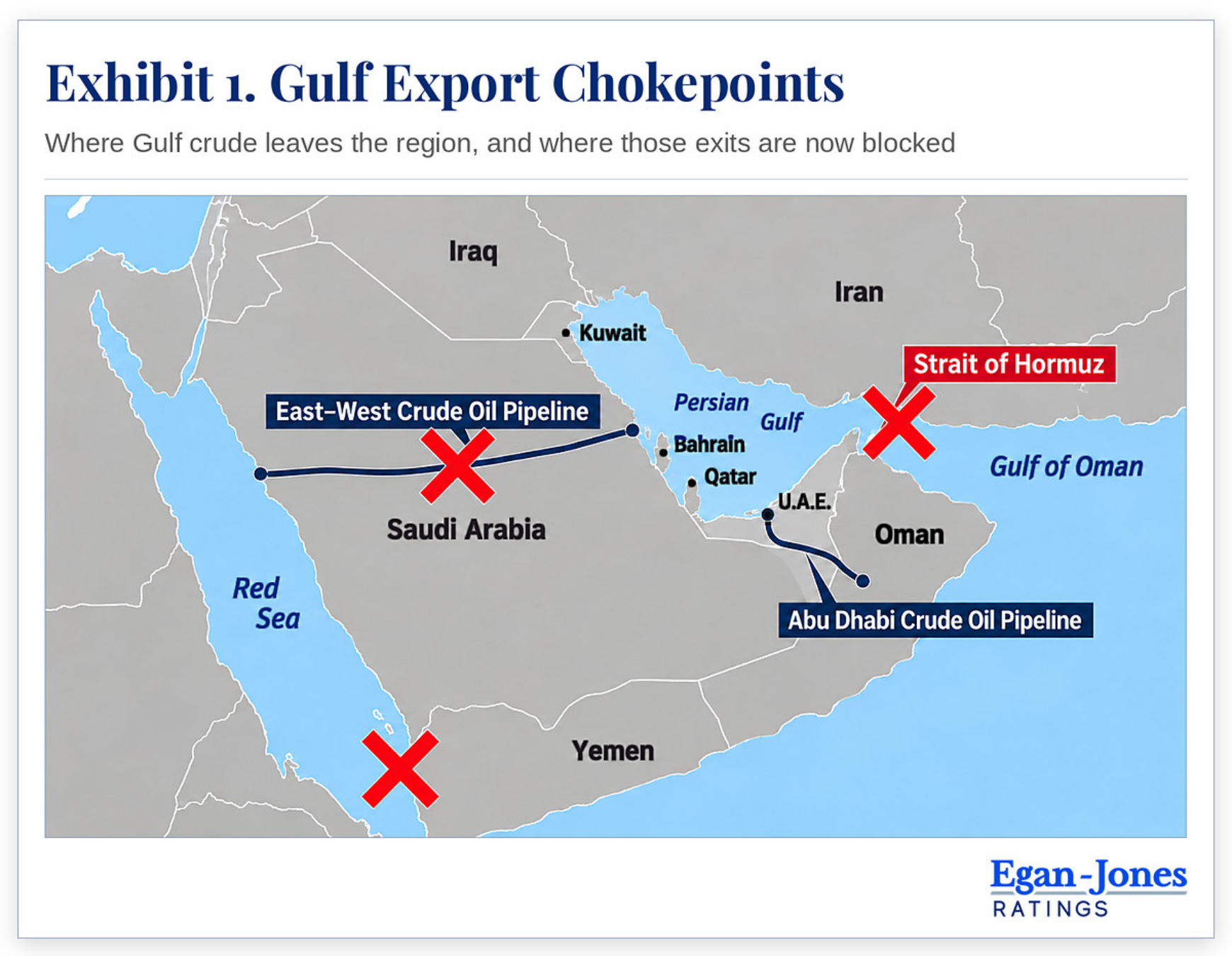
The Houthis’ control of southwestern Yemen and Iranian militias bombing the East-West Pipeline have effectively curtailed a large portion of energy exports from the Gulf. Small exceptions are the few ships traveling north via the Suez Canal, and those vessels bearing American flags traveling south. While the U.S. has placed considerable pressure on the IRGC controlling Iran, relatively few vessels are exiting. Also note that the Suez Canal could be targeted by Iran or its proxies via drones. This could occur either by attacking ships directly or by dropping mines. Recall the multi-day closure of the canal in March 2021 when the Ever Given became lodged. Thus, the only remaining egress of oil from the region is not guaranteed.
II. Paper Tiger
On paper, the Saudi Army has a large population, but fewer troops than the Houthis.¹,²,³
Exhibit II · Population and Armed Strength, Houthi Versus Saudi Arabia
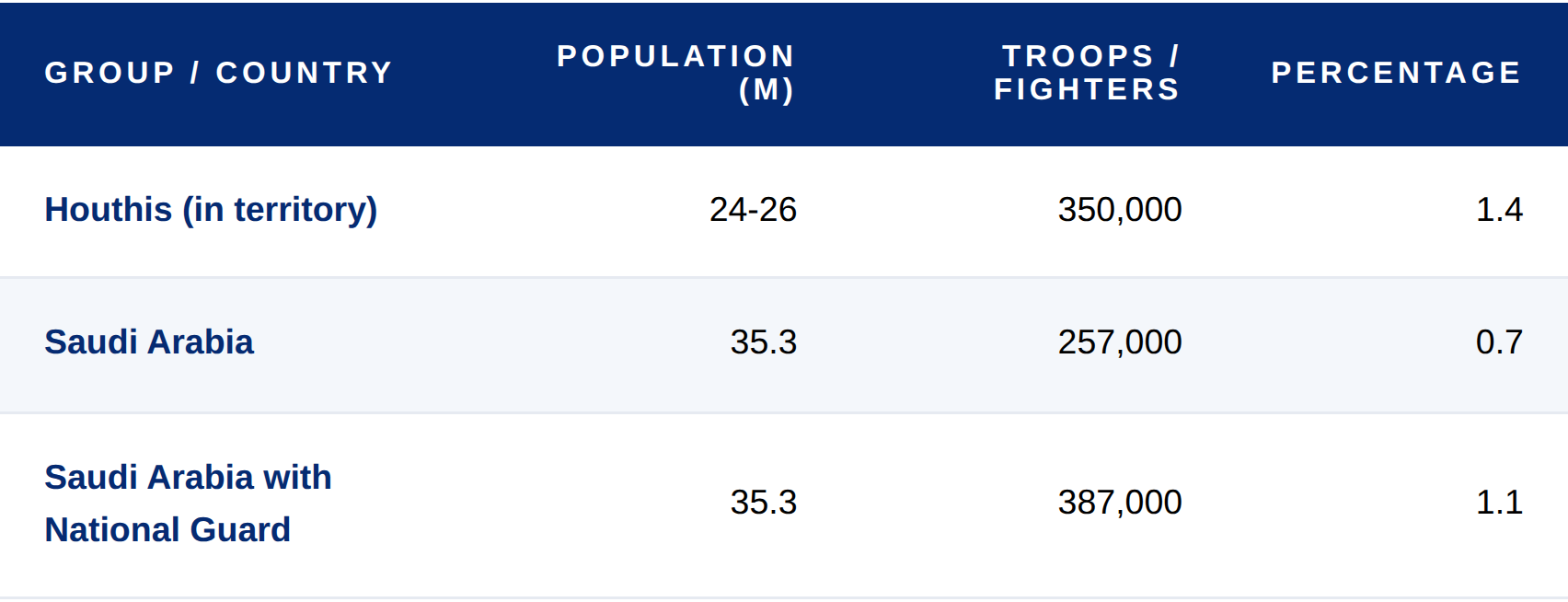 Sources: U.S. State Department report, Saudi General Authority for Statistics, UN Panel of Experts on Yemen
However, the Saudi strength has withered and apparently a good portion of the army is staffed by foreigners and presumably is less dependable than would normally be the case.
III. Let’s Make a Deal
THE issue for most observers is what might be the terms for a re-opening of the shipping. As of September 20, 2026, Iran’s most recent publicly stated conditions for ending the current war with the United States and Israel are:
- End the war on every front, expressly including Israeli military operations in Lebanon. - Release Iran’s frozen foreign assets, reportedly totaling billions of dollars. - End the U.S. naval blockade of Iranian ports. - Stop U.S. interference in Iran’s internal affairs. - End U.S. cooperation with Iranian opposition groups, described by Tehran as “opponents of our revolution.” - End all U.S. attacks on Iranian territory.
Mohsen Rezaei, secretary of Iran’s Supreme National Security Council, said these conditions had been delivered to Washington through Qatar. Iran is awaiting the U.S. response.⁴
IV. The Elephant(s) in the Room
There are a few considerations (mostly unspoken) involved in the process:
- Midterms - Although few in the Administration will admit it, the major concern in the Administration is the pending midterm elections. The concern is that polling for Republicans is weak, in part because of high gas prices and the unpopularity of the war. Hence, an agreement might be forthcoming. While some tout the benefit of the Venezuela energy deal, it is likely to take several quarters before the results will be felt. - Saudi Budget - Saudi Arabia depends on the regular flow of petroleum to fund their economy. With export problems, a fair assumption is that the government will have to sell assets including US Treasuries and possibly borrow. - Energy Prices - crude prices provide a ready signal for the market’s concerns. The latest is that Brent has reached the relatively high level of $104 per barrel. Western Europe is likely to be particularly hard hit with the curtailment of supplies from Russia and now from the Middle East. Below is a graph of diesel prices:
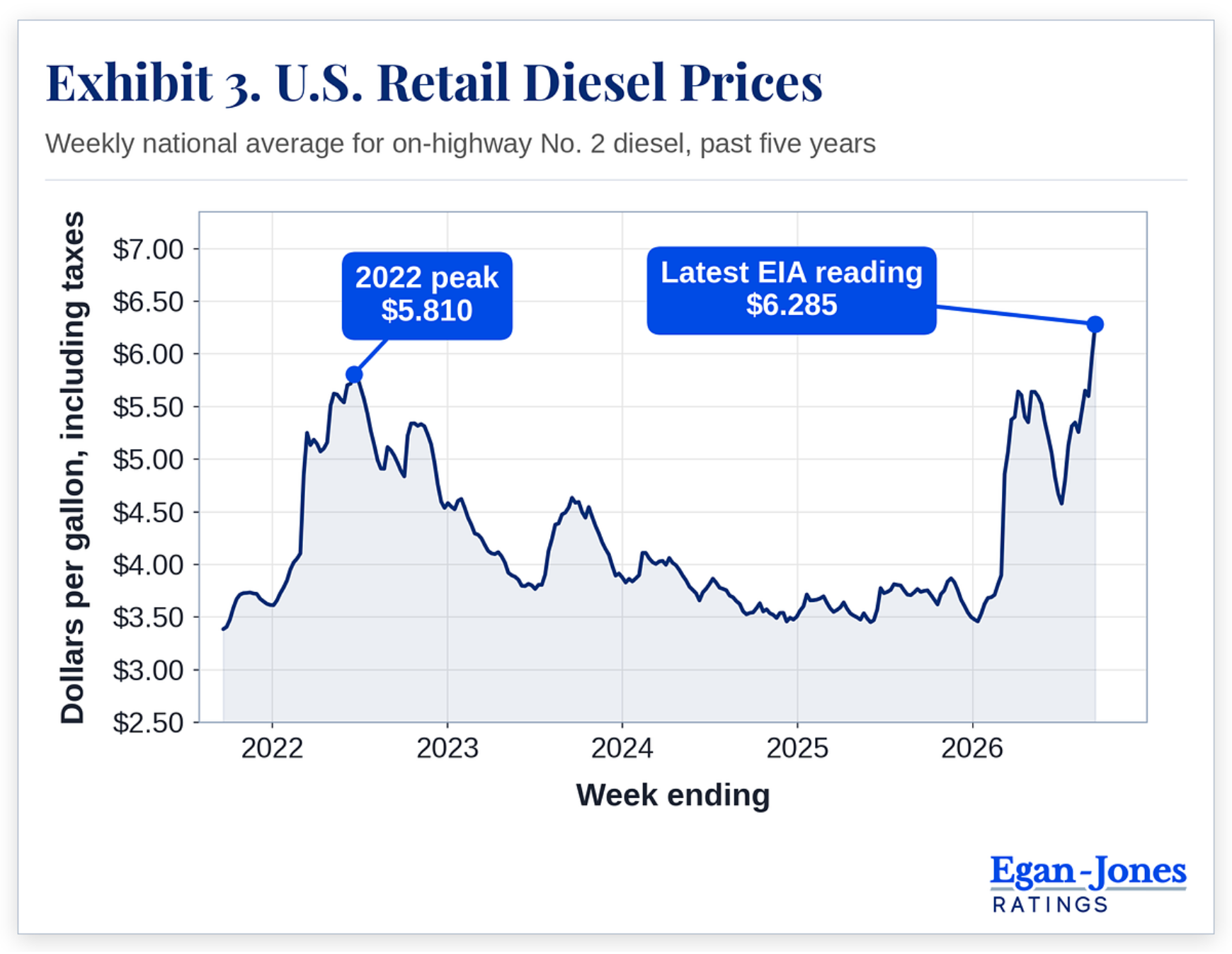 Source: U.S. Energy Information Administration, weekly on-highway No. 2 diesel retail price.
- Interest Rates - this crisis could not have come at a worse time for many sovereignties as they are pressed to meet increased funding costs, high social service costs, and a rise in interest rates.If the petroleum flows are not restored shortly, the probability of a recession increases.The pending summit between Mr. Trump and Mr. Xi might be helpful as many would benefit from an easing of hostilities.
V. Conclusion
We have prided ourselves in providing advanced warning to sophisticated institutional investors and risk managers of pending developments. We hope we are wrong about conditions, but typically it is best to understand underlying conditions and adjust rather than ignore emerging threats.
Federal Republic of Germany
Rating Analysis | 8/13/26
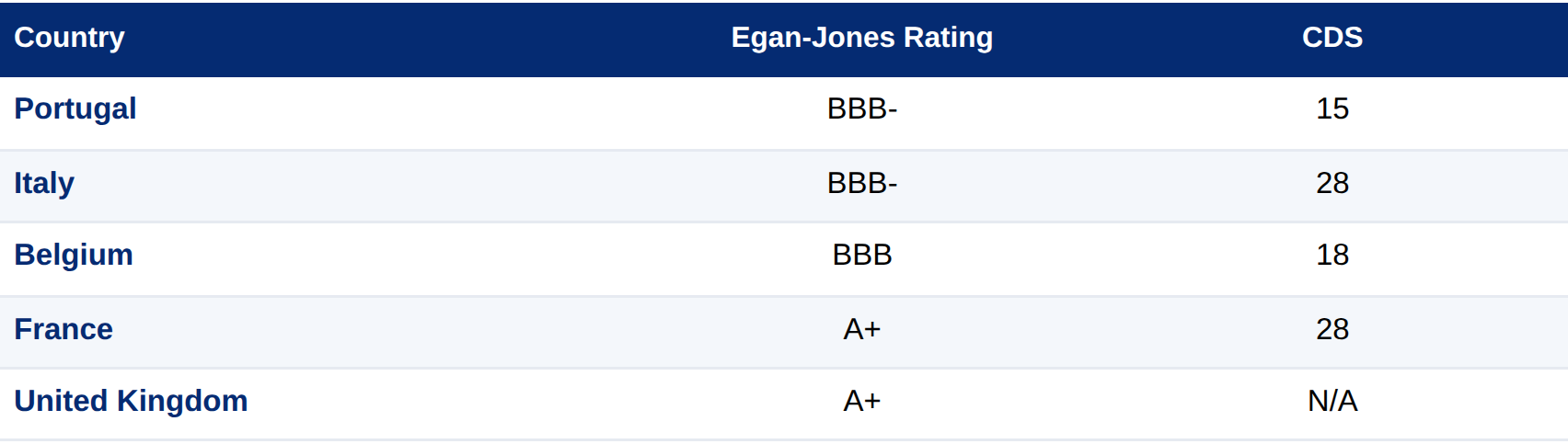
Egan-Jones Senior Rating (Current / Projected): AA / AA. This is a non-NRSRO rating.
Germany’s economic recovery in 2026 remains subdued, with GDP growth forecast at 0.5% to 0.6% for the calendar year, following a contraction in 2024 and minimal growth of 0.1% in 2025. The economy is in a recovery phase after a multi-year downturn.
Expansionary fiscal policy, including record investment borrowing and a €500 billion infrastructure fund, is bolstering the domestic economy and preventing a stronger slide. Defense, infrastructure, and climate protection spending are providing key economic stimulus, particularly benefiting companies in the defense and civil engineering industries. However, industrial performance remains weak, with international business barely expanding due to declining competitiveness, high geopolitical uncertainty, and persistent trade policy burdens. Downside risks include intensifying trade tensions, further energy price increases, and long-term risks to public fiscal stability due to massive new debt accumulation, which will require significant consolidation efforts toward the end of the decade. Affirming.
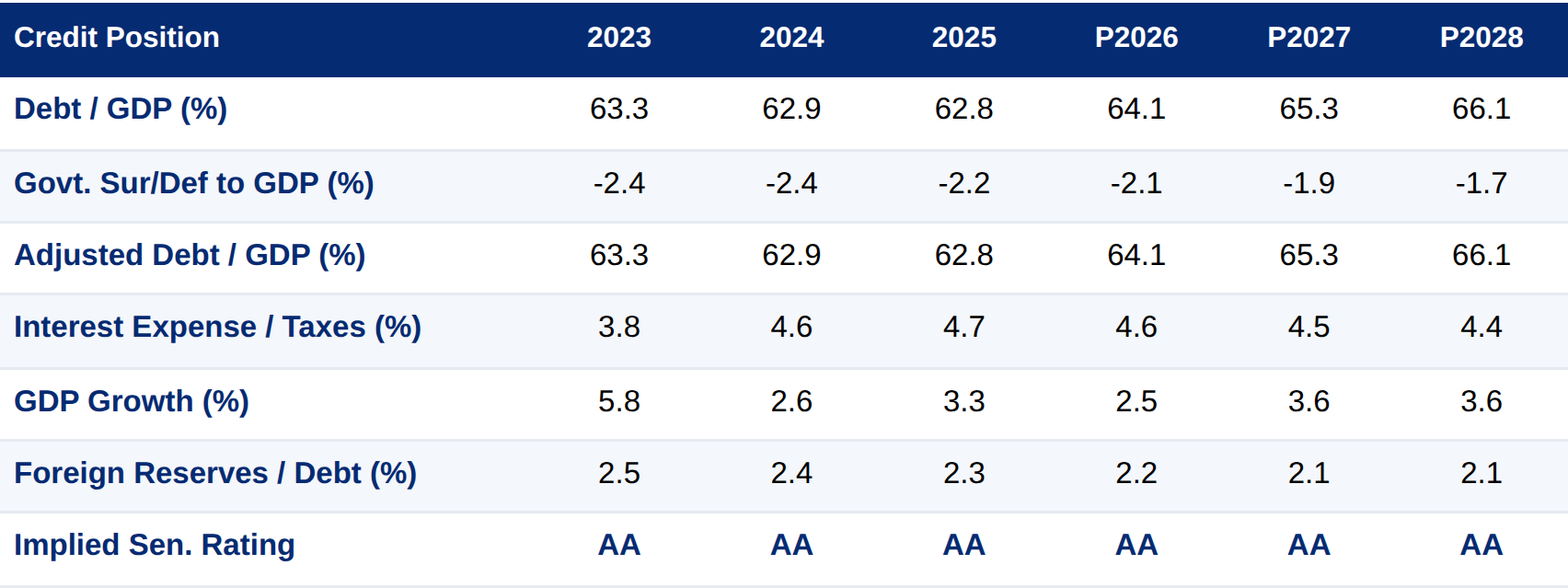 Annual ratios; source for past results: IMF.
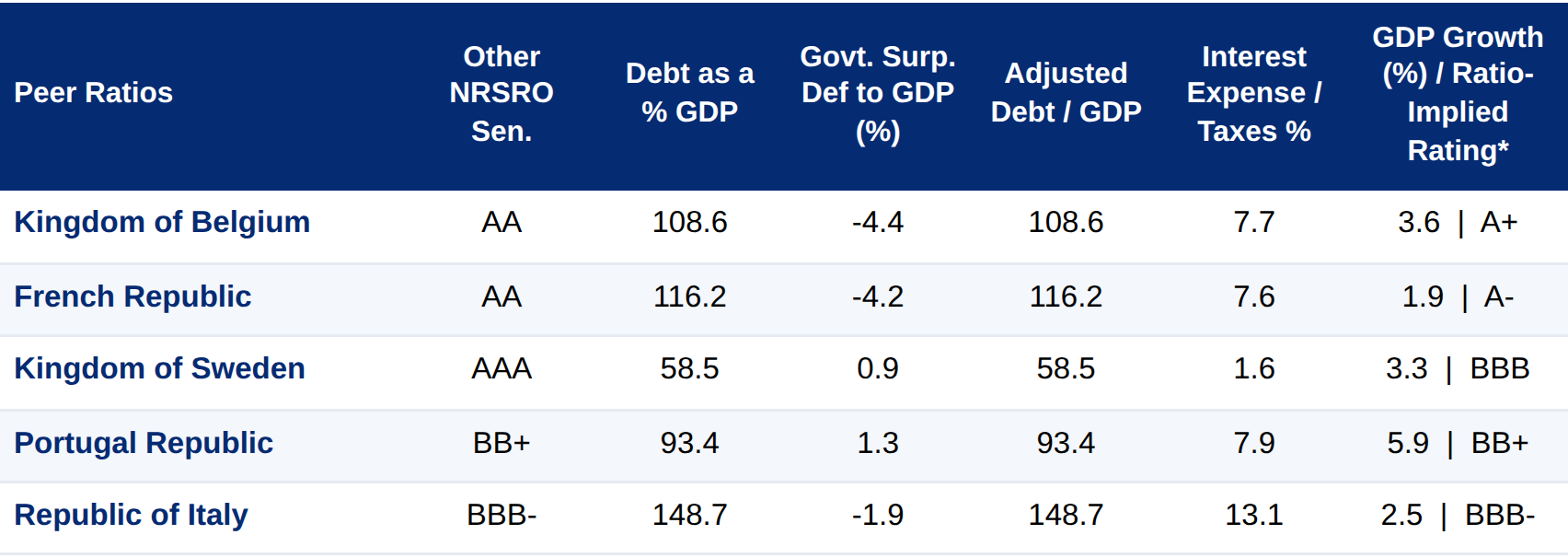 * Ratio-implied rating.
Economic Growth
Germany’s GDP is forecast to grow by 0.5% in 2026 (revised down from an earlier estimate of 1.0%) and by 0.8% to 0.9% in 2027. The energy price shock from the war in Iran is hitting the recovery hard, with rising oil and gas prices weighing on businesses and further reducing industrial production. High energy costs are a significant drag on private investment, compounding the effects of declining competitiveness and geopolitical uncertainty. Private consumption is dampened by higher inflation, which reduces real wages and household net income. However, expansionary fiscal policy is providing counter-cyclical stimulus. Structural challenges are also constraining growth potential. Germany’s production potential growth is currently 0.2% and is expected to stagnate by the end of the decade due to demographic factors, including a declining working-age population and reduced hours per employee. The government’s reform agenda aims to reduce bureaucracy, modernize administration, accelerate infrastructure investment, strengthen innovation policy, reduce energy system costs, and expand labor supply through improved work incentives.
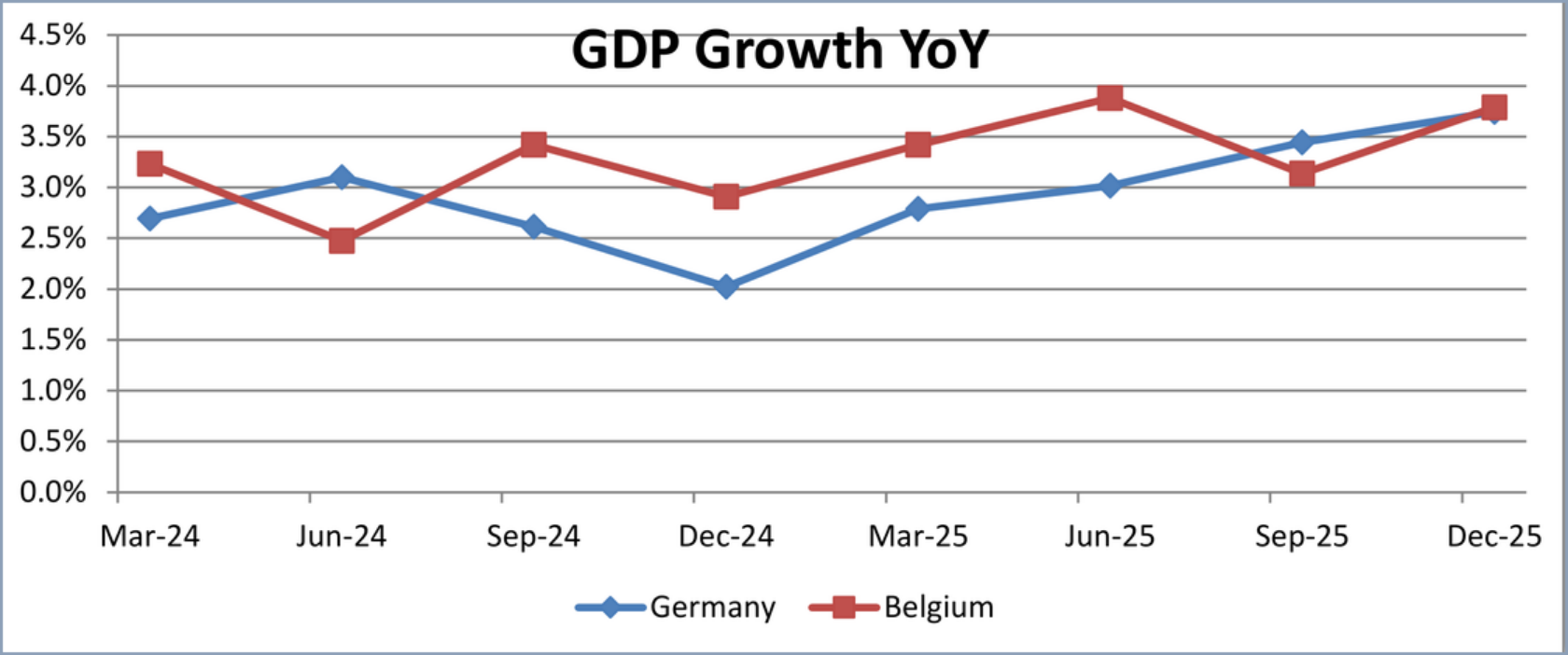 Source: International Financial Statistics.
Fiscal Policy
Germany’s 2026 budget marks a historic shift away from decades of fiscal discipline, with soaring borrowing levels and record investment. The draft budget approved by the cabinet features total spending of €520.5 billion in the core budget, with additional spending from special funds bringing the total to around €630 billion. The increase in investment is facilitated by a dedicated €500 billion infrastructure fund (exempt from Germany’s debt brake) and a constitutional waiver from debt regulations for defense expenditures approved in March 2025.
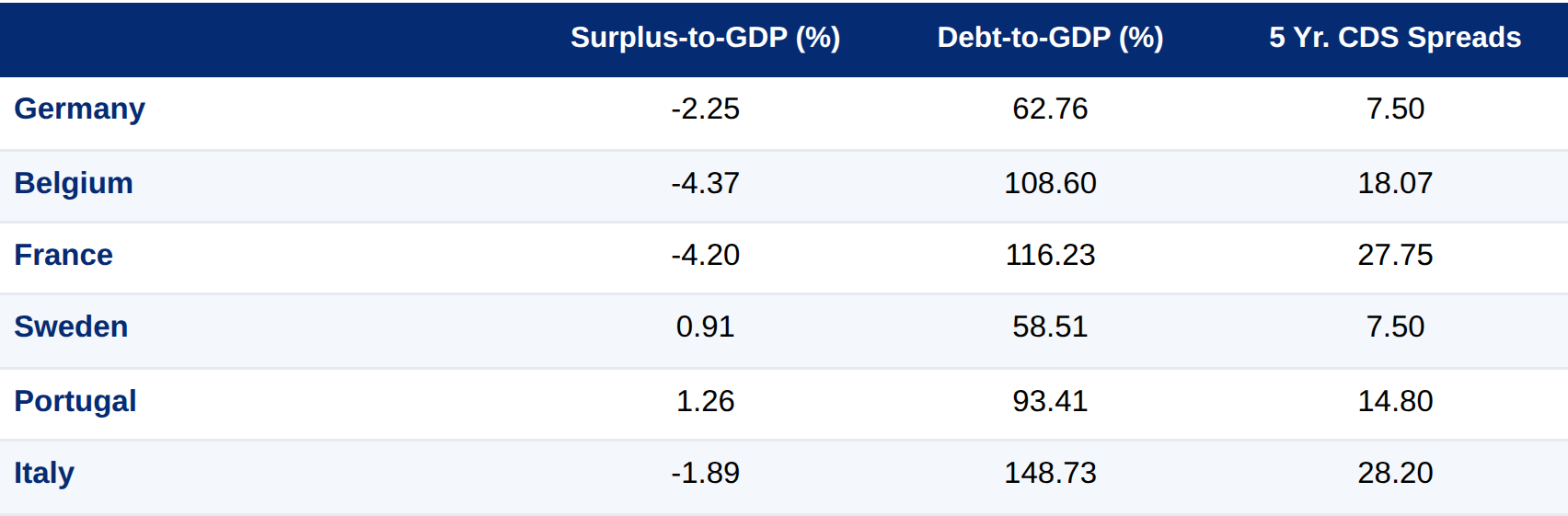 Sources: Thomson Reuters and IFS.
Unemployment
Germany’s unemployment rate stood at 6.3% in May 2026, down 0.1 percentage points from April 2026 but 0.1 percentage points higher than the previous year. The number of unemployed fell below 3 million for the first time since December 2025, reaching approximately 2.95 million in May 2026 (a decrease of 58,000 from April). The Institute for Employment Research projects that unemployment will increase by 160,000 in 2025 before declining in 2026. Employment is expected to decline by around 100,000.
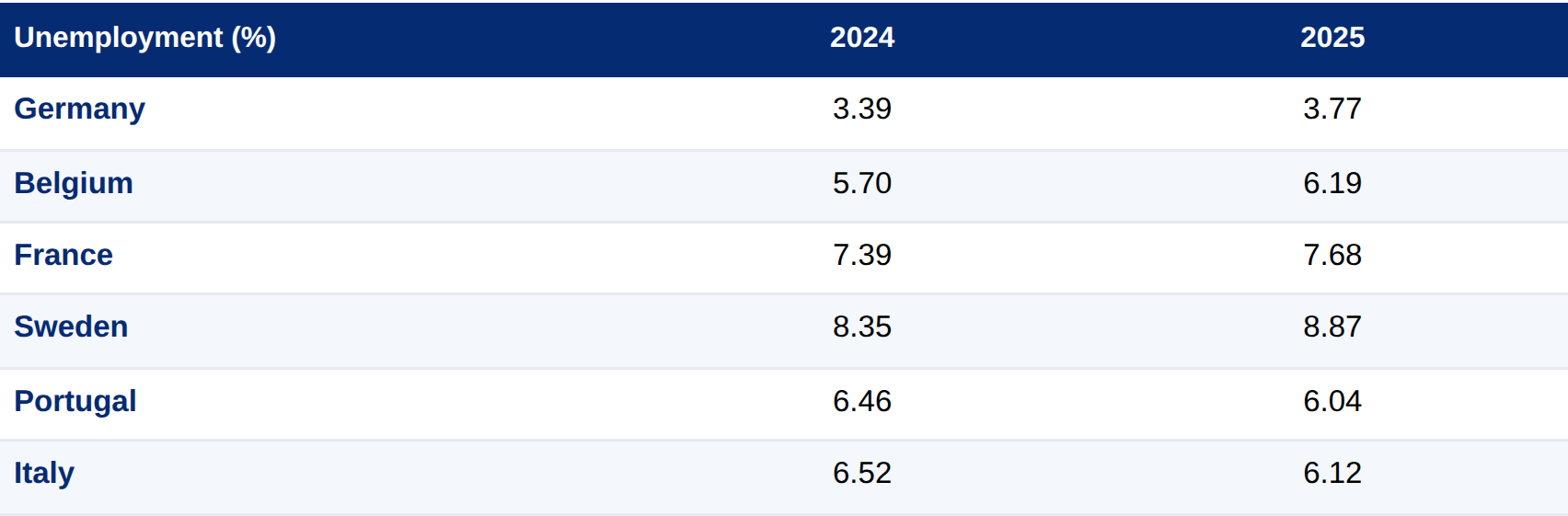 Source: International Financial Statistics.
Banking Sector
The German banking sector in 2026 faces increased risks amid economic weakness, but banks remain mostly profitable and well-capitalized. BaFin (Federal Financial Supervisory Authority) sees potential for sudden market corrections and plans to closely monitor the credit risks of banks and insurers in 2026. Given the ongoing weakness of the German economy, company insolvencies are rising, increasing the proportion of non-performing loans on German banks’ balance sheets.
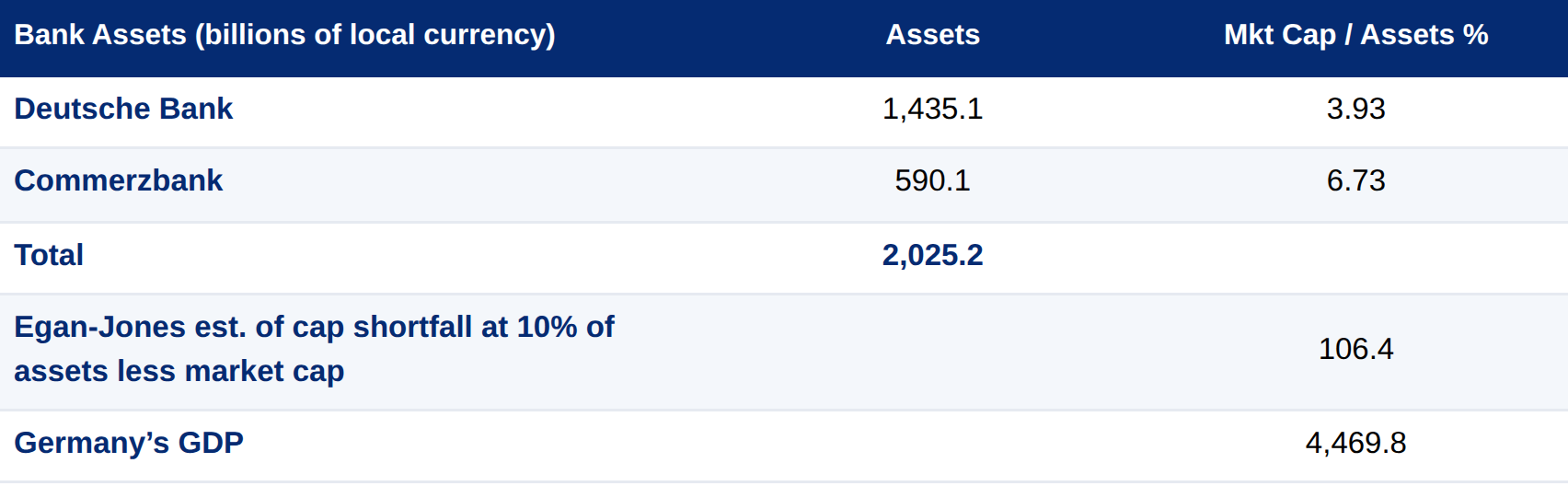
Funding Costs
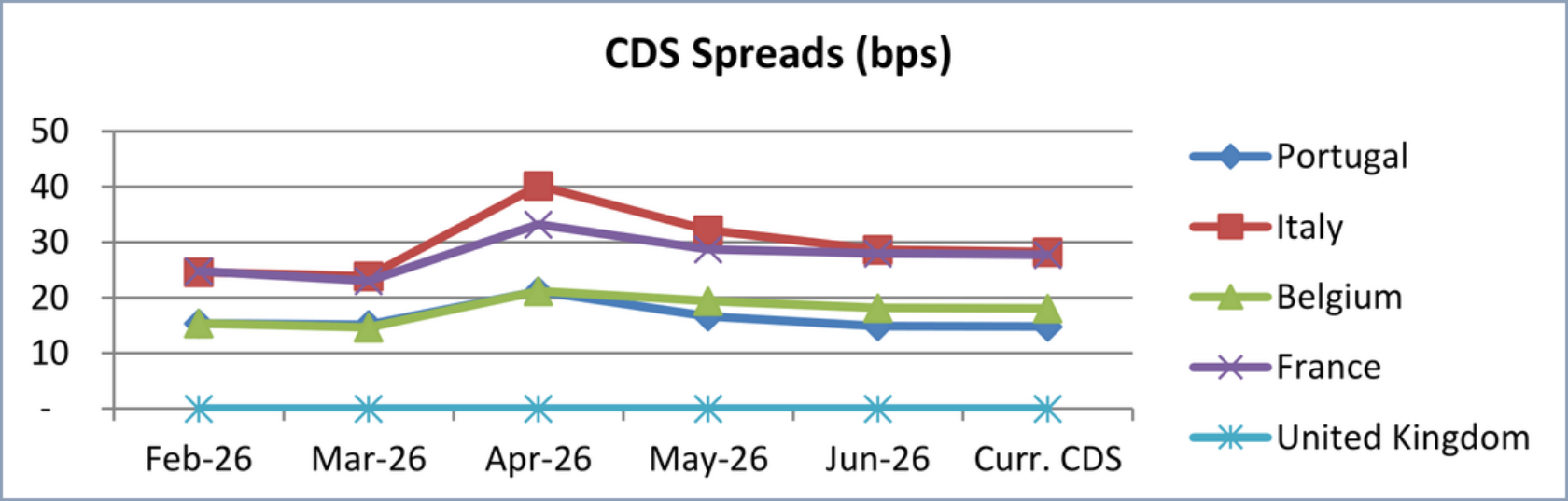
Germany’s 10-year Bund yield slipped to around 2.85% in February 2026 after the ECB kept interest rates unchanged, then climbed to a 39-week high of 2.89% in December 2025. As of May 2026, the 10-year yield is approximately 2.91%. The composite cost-of-borrowing indicator for all loans to corporations decreased in February 2026. Average credit costs for businesses dropped by 24 basis points to 3.6%.
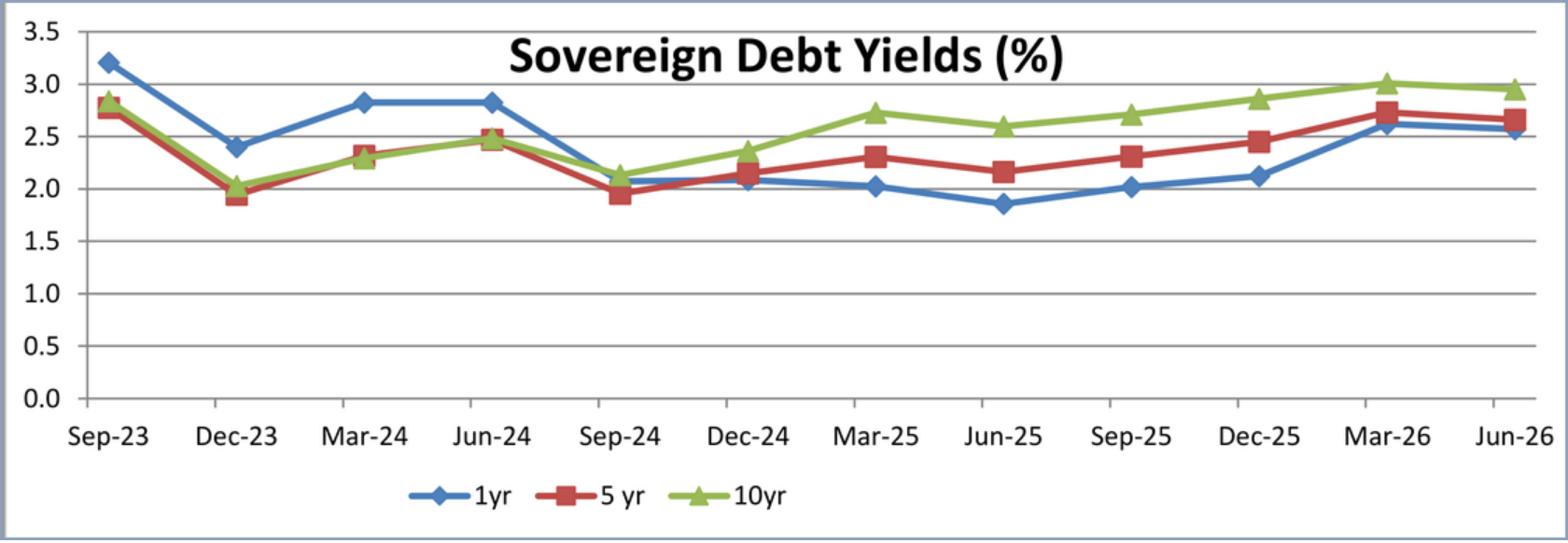 Source: Thomson Reuters.
Ease of Doing Business
Major factors for growing the economy are the ease of doing business and the economic freedom; although not the sole factor for determining economic growth, a country which makes it easy for businesses to operate and provides a reasonably free environment to conduct business has a good chance for growth. The table below indicates that with an overall rank of 22 (1 is best, 189 worst) Germany is strong.
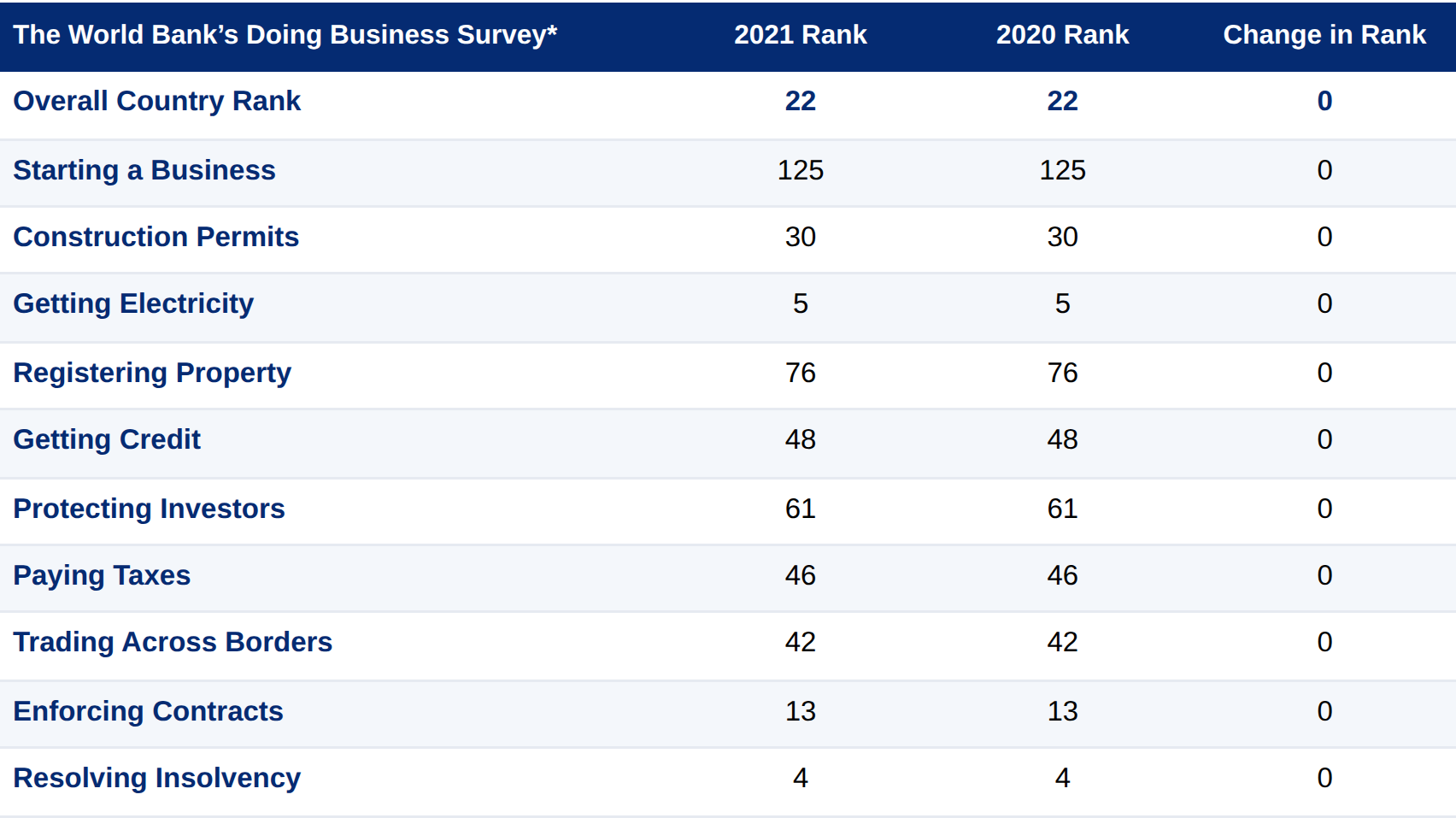 * Based on a scale of 1 to 189 with 1 being the highest ranking.
Economic Freedom
As can be seen below, Germany is above average in its overall rank of 71.7 for Economic Freedom with 100 being best.
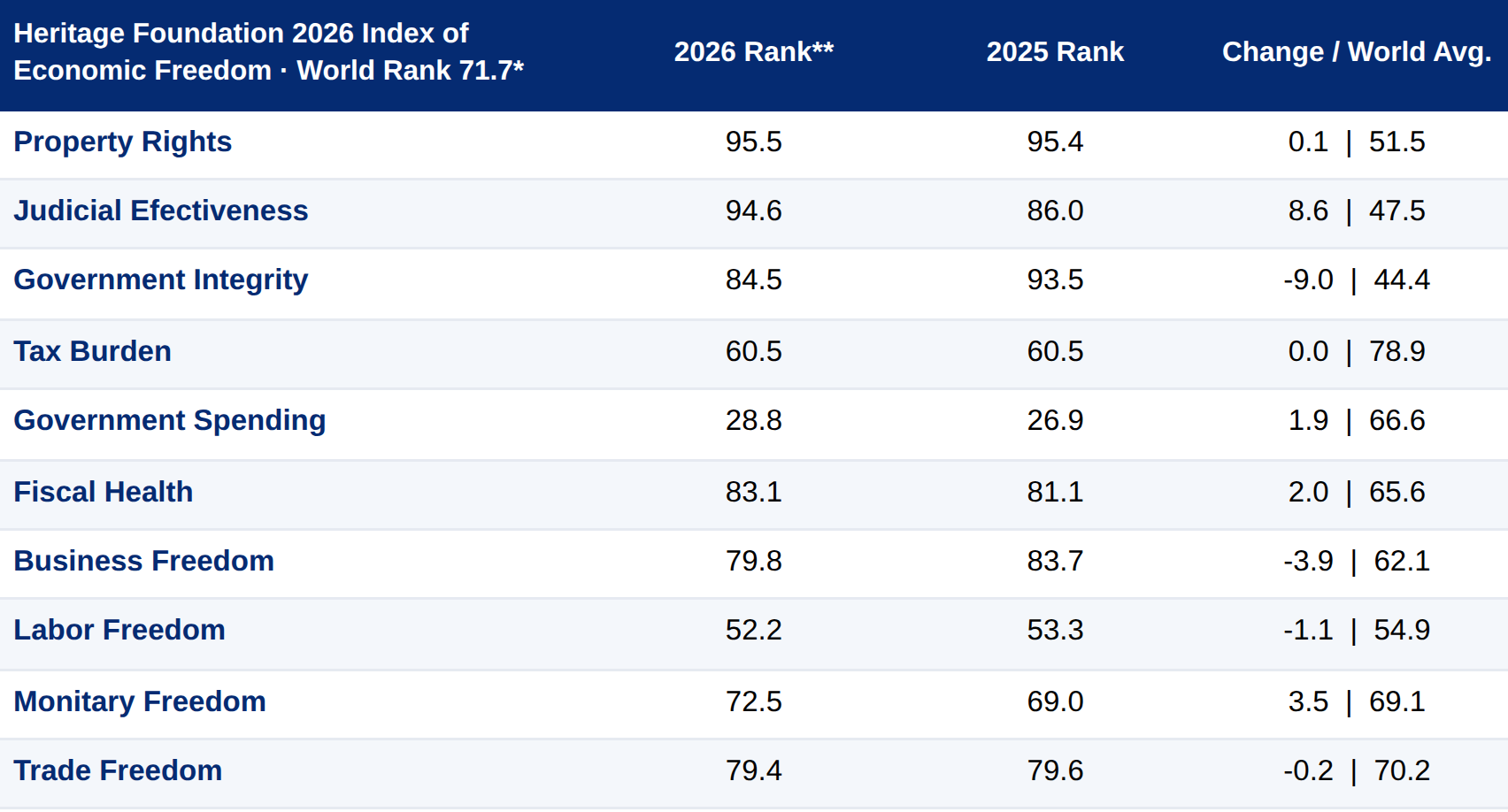 * Based on a scale of 1-100 with 100 being the highest ranking. ** The ten economic freedoms are based on a scale of 0 (least free) to 100 (most free). Source: The Heritage Foundation. Spellings as in the source report.
Credit Quality Driver: Taxes Growth
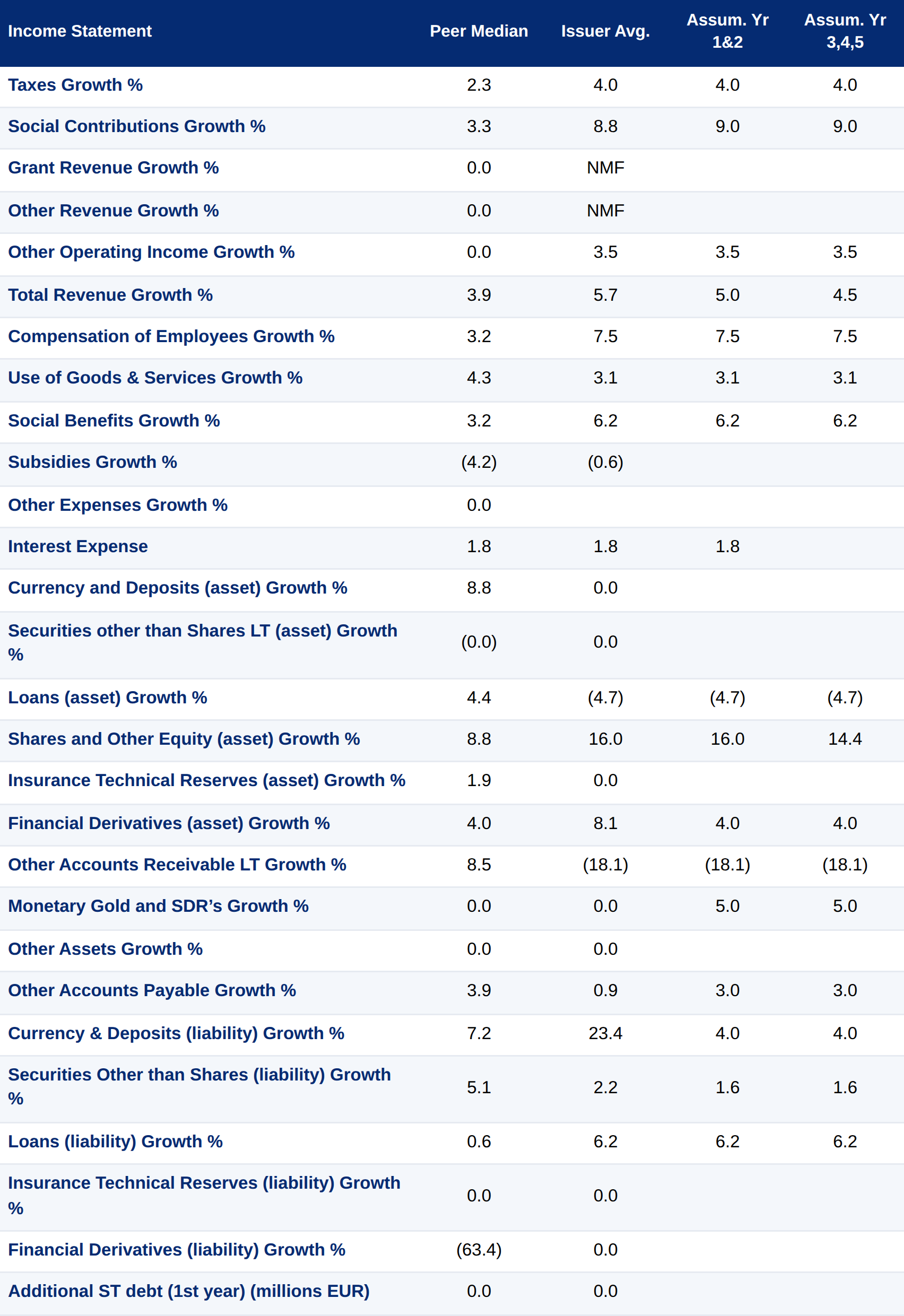
Germany has grown its taxes of 4.0% per annum in the last fiscal year which is more than the average for its peers. We expect tax revenues will grow approximately 4.0% per annum over the next couple of years and 4.0% per annum for the next couple of years thereafter.
Credit Quality Driver: Total Revenue Growth
Germany’s total revenue growth has been more than its peers and we assumed a 5.0% growth in total revenue over the next two years.
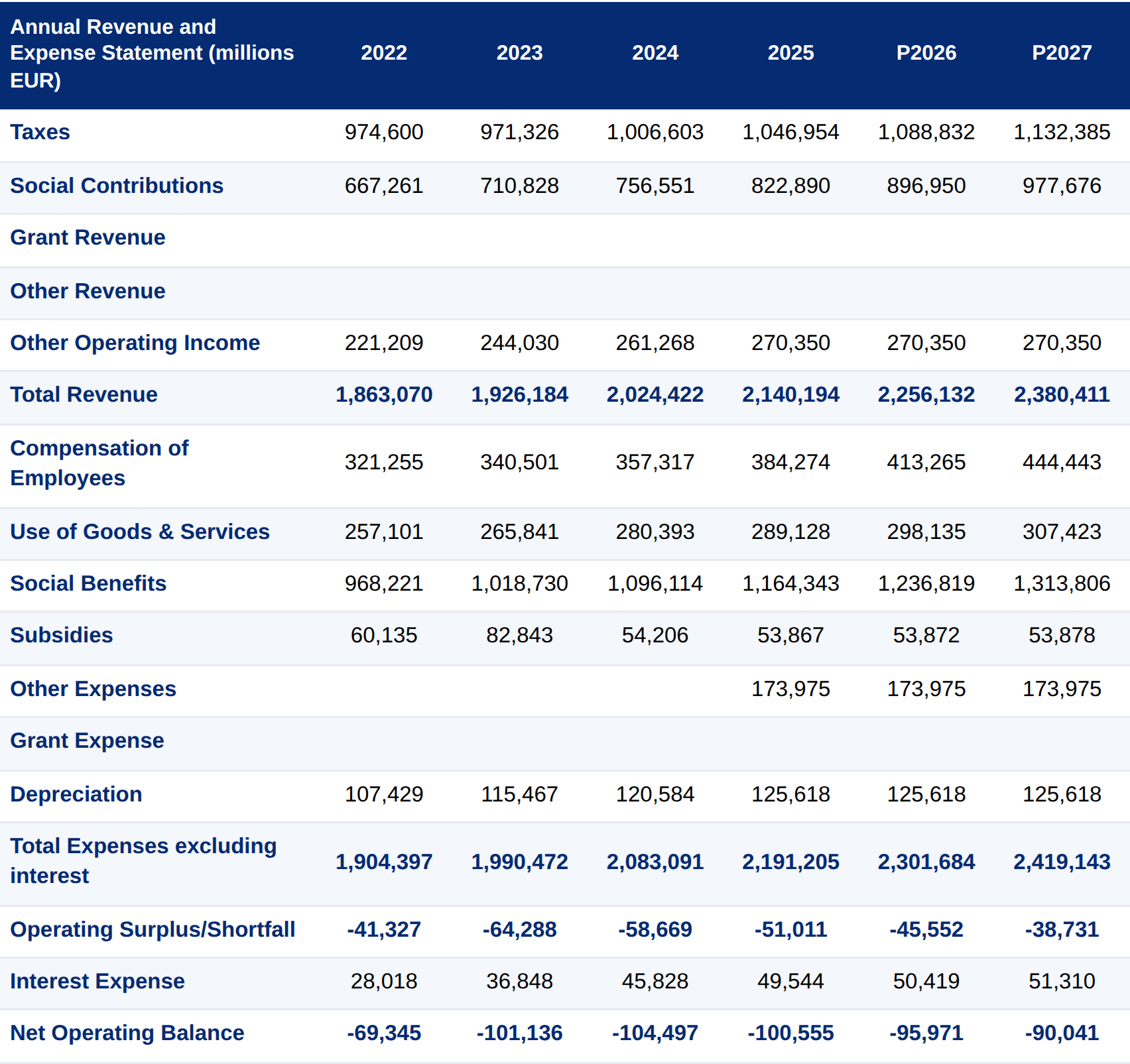
Annual Income Statements
Below are Germany’s annual income statements with the projected years based on the assumptions listed in the credit quality driver section.
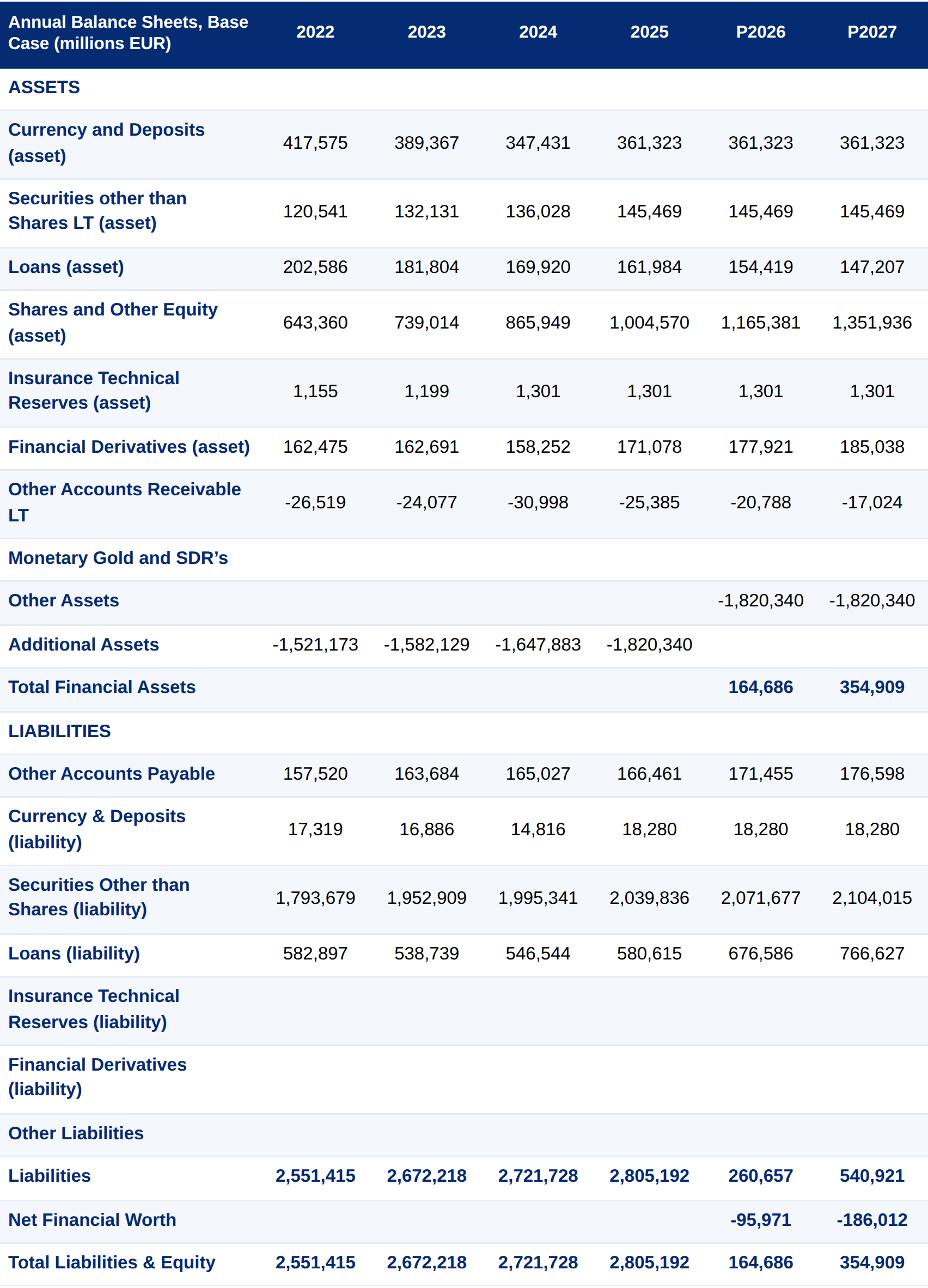
Annual Balance Sheets
Below are Germany’s balance sheets with the projected years based on the assumptions listed in the credit quality driver section.
Comments on the Difference between the Model and Assigned Rating
In this case, there has been little change in the recent results and therefore we have used our best judgement in making adjustments which are reflected in the results for the projected ratings. We have assigned a rating of “AA” whereas the ratio-implied rating for the most recent period is “AA”; we expect results to remain approximately the same.
Changes in Indicative Ratios
We have not made any adjustment in the indicative ratios at this time.
SEC Rule 17g-7(a) Disclosure
Below are the disclosures as required by Paragraph (a) of Rule 17g-7.
1. The symbol in the rating scale used to denote the credit rating categories and notches within categories and the identity of the obligor, security, or money market instrument as required by Paragraph (a)(1)(ii)(A) of Rule 17g-7:
For the issuer FEDERAL REPUBLIC OF GERMANY with the ticker of 3413Z GR we have assigned the senior unsecured rating of AA. There are three notches in our rating categories (e.g., A-, A, and A+) other than those deep into speculative grade; for CC, C, and D there are no notches.
2. The version of the procedure or methodology used to determine the credit rating as required by Paragraph (a)(1)(ii)(B) of Rule 17g-7:
We are using the methodology version #16 available via egan-jones.com under the tab at the bottom of the page “Methodologies”.
3. The main assumptions and principles used in constructing the procedures and methodologies used to determine the credit rating as required by Paragraph (a)(1)(ii)(C) of Rule 17g-7:
The credit rating assigned reflects our judgement regarding the future credit quality of the issuer. Regarding the specific assumptions used, please refer to the credit quality driver section of this Rating Analysis Report.
4. The potential limitations of the credit rating as required by Paragraph (a)(1)(ii)(D) of Rule 17g-7:
Our rating pertains solely to our view of current and prospective credit quality. Our rating does not address pricing, liquidity, or other risks associated with holding investments in the issuer.
5. Information on the uncertainty of the credit rating as required by Paragraph (a)(1)(ii)(E) of Rule 17g-7:
Our rating is dependant on numerous factors including the reliability, accuracy, and quality of the data relied used in determining the credit rating. The data is sourced from publicly-available 10Q and 10K statements, quarterly reports, 8K filings, earnings reports, and other similar sources. In some cases, the information is limited because of issues such as short operating histories, the lack of reported data, a delay in reporting data, restatements, inaccurate accounting, and other issues. Such shortcomings are not always readily apparent. Egan-Jones aims to identify such shortcomings and make adjustments using its best judgement.
6. Whether and to what extent third-party due diligence services have been used in taking the rating action as required by Paragraph (a)(1)(ii)(F) of Rule 17g-7:
Egan-Jones does not utilize third-party due diligence services.
7. How servicer or remittance reports were used, and with what frequency, to conduct surveillance of the credit rating as required by Paragraph (a)(1)(ii)(G) of Rule 17g-7:
Servicer or remittance reports normally pertain to structured finance issuers; this report does not pertain to a structured finance issuer (Egan-Jones is not an NRSRO for structured finance or sovereigns / municipal issuers). Regarding surveillance, the minimum time period for corporation issuers is normally one year.
8. A description of the data that were relied upon for the purpose of determining the credit rating as required by Paragraph (a)(1)(ii)(H) of Rule 17g-7:
Egan-Jones uses 10Q and 10K statements, quarterly reports, 8K filings, earnings reports, governmental filings and other similar sources for ratings on publicly-traded issuers. In the case of private issuers, Egan-Jones relies on information provided mainly by issuers.
9. A statement containing an overall assessment of the quality of information available and considered in the credit rating as required by Paragraph (a)(1)(ii)(I) of Rule 17g-7:
The information is generally high quality and readily avail.
10. Information relating to conflicts of interest as required by Paragraph (a)(1)(ii)(J) of Rule 17g-7:
This rating is unsolicited.
11. An explanation or measure of the potential volatility of the credit rating as required by Paragraph (a)(1)(ii)(K) of Rule 17g-7:
Our rating aims to assess the probability of the payment of obligations in full and on-time. Factors which affect such probability, and in turn our rating, include changes in the operating performance of the issuer, changes in capital structure, and merger and acquisition events.
12. Information on the content of the credit rating as required by Paragraph (a)(1)(ii)(L) of Rule 17g-7:
Regarding the historical performance of the credit rating, our rating transition matrix is available in our Form NRSRO, exhibit 1. The expected probability of default and the expected loss in the event of default is listed on the first page of this report.
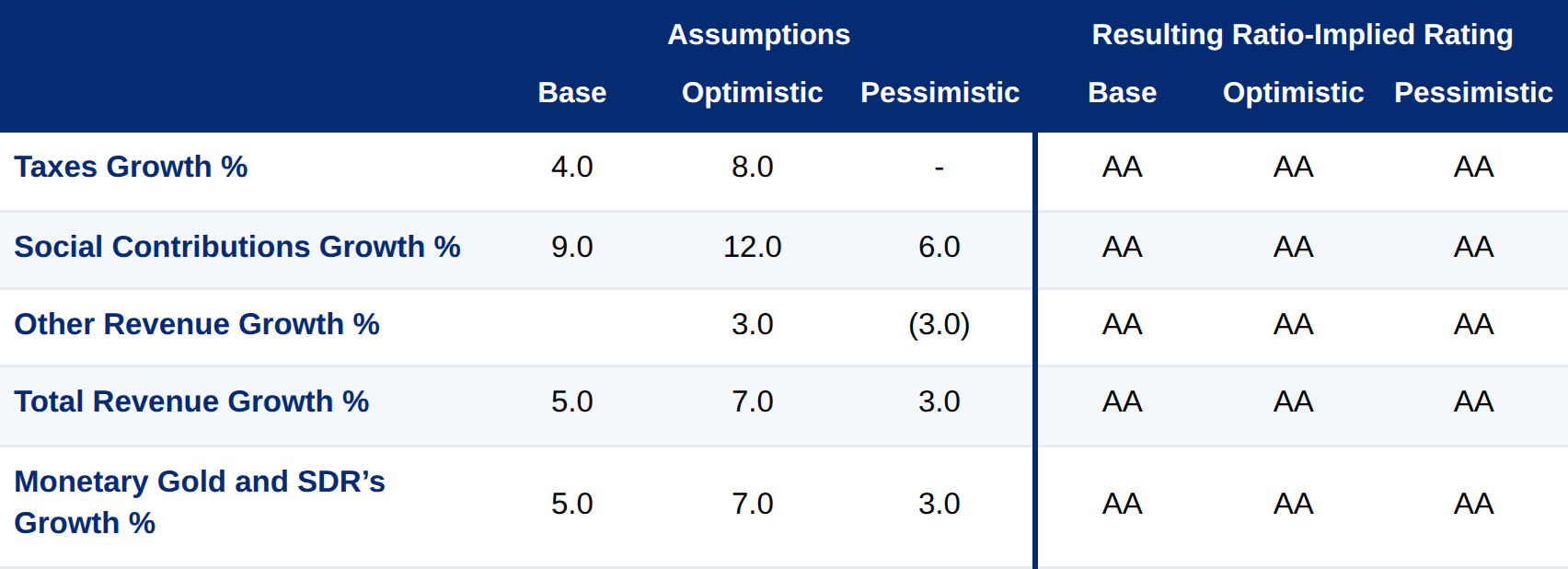
13. Information on the sensitivity of the credit rating to assumptions as required by Paragraph (a)(1)(ii)(M) of Rule 17g-7:
Below is a summary of the impact of the 5 assumptions which independently would have the greatest impact on our “ratio-implied rating”:
14. If the credit rating is assigned to an asset-backed security, a description of: (i) the representations, warranties, and enforcement mechanisms available to investors; and (ii) how they differ from the representations, warranties, and enforcement mechanisms in issuances of similar securities, as required by Paragraph (a)(1)(ii)(N) of Rule 17g-7:
This credit rating is not assigned to an asset-backed security.
Attestation Form
In compliance with the US Securities and Exchange Commission (SEC) Rule 17g-7(a), the Egan-Jones analyst who published the report is responsible for the rating action and to the best knowledge of the person:
- No part of the credit rating was influenced by any other business activities, - The credit rating was based solely upon the merits of the obligor, security, or money market instrument being rated, and - The credit rating was an independent evaluation of the credit risk of the obligor, security, or money market instrument.
Sovereign Rating Methodology (Non-NRSRO)
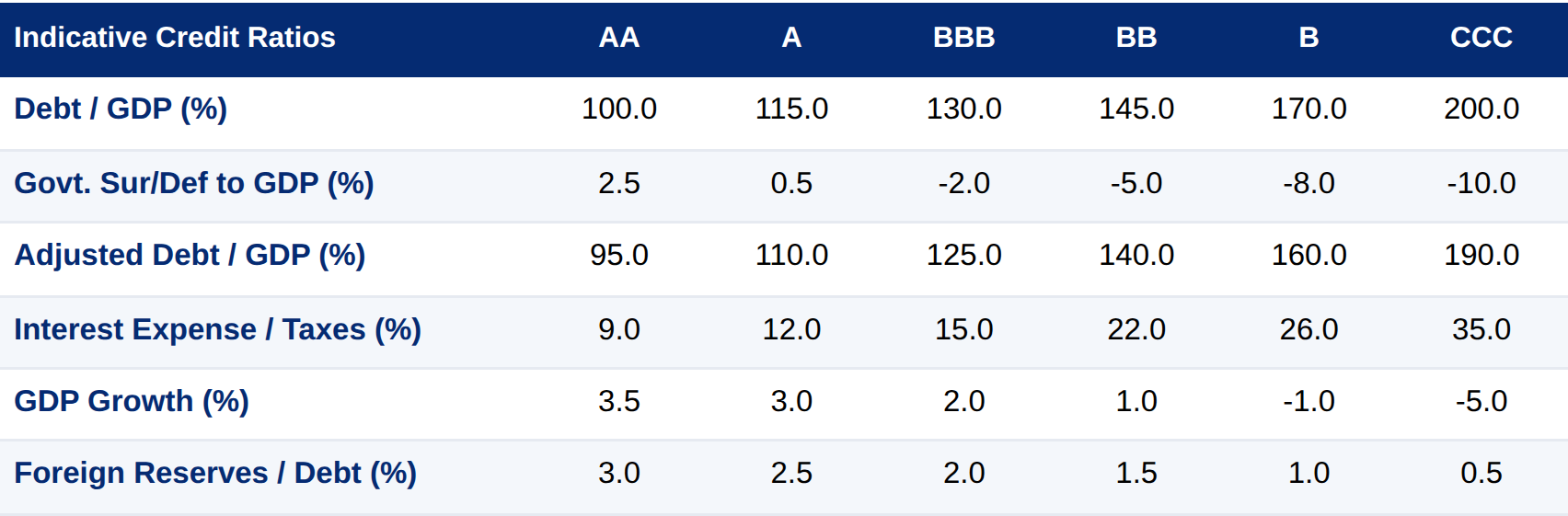
Scope and Limitations. Sovereign Issuer Credit Quality Ratings (CQR) are a forward-looking assessment of a sovereign’s capacity and willingness to honor its existing and future obligations in full and on time. Sovereigns are assigned two CQRs: a Local-Currency CQR, which reflects the likelihood of default on debt issued and payable in the currency of the sovereign, and a Foreign-Currency CQR, which is an assessment of the credit risk associated with debt issued and payable in foreign currencies.Key Rating Drivers. Egan-Jones’ approach to sovereign risk analysis is a synthesis of quantitative and qualitative judgments. The quantitative factors Egan-Jones uses are:
- Debt in relation to GDP. - Surplus or deficit in relation to GDP. - Debt plus potential under-funding of major banks in relation to GDP. - Interest expense in relation to taxes. - GDP growth. - Foreign reserves in relation to debt.
Debt levels for many sovereign issuers have increased at an accelerating rate over the past decade, affecting implied ratings. Egan-Jones also considers unemployment levels and funding costs. Egan-Jones recognizes that no model can fully capture all the relevant influences on sovereign creditworthiness, meaning that its sovereign ratings can and do differ from those implied by the rating model. Some of the qualitative factors that impact its ultimate assessment of credit quality include the flexibility, stability and overall strength of the economy, efficiency of tax collection, acceptance of contract law, ease of doing business, trade balances, prospects for future growth and health and monetary policy, and economic freedom. These subjective and dynamic qualitative issues are not captured by the model but affect sovereign ratings.
For additional information, please see Exhibit 2: Methodologies in Egan-Jones’ Form NRSRO.
Copyright ©2026, Egan-Jones Ratings Company, Inc. (“Egan-Jones”). All rights reserved. The information upon which Egan-Jones ratings and reports are based is obtained by Egan-Jones from sources Egan-Jones believes to be accurate and reliable. Egan-Jones relies on third party reports and information and data provided and Egan-Jones has not, unless required by law or internal policies/procedures, independently verified or performed due diligence related to the accuracy of information, data or reports. Egan-Jones has not consented to, nor will consent to, being named an “expert” under federal securities laws, including without limitation, Section 7 of the Securities Act of 1933. Please note that expected or final ratings are not recommendations to buy, hold or sell the securities. Egan-Jones is not an advisor and is not providing investment advice, strategy or related services. Egan-Jones and its third-party suppliers (“Suppliers”) hereby disclaim any representation or warranty, express or implied, as to the accuracy, timeliness, completeness, merchantability, and fitness for any particular purpose or non-infringement of any of such information. In no event shall Egan-Jones or its directors, officers, employees, independent contractors, agents, representatives, or Suppliers (collectively, Egan-Jones Representatives) be liable (1) for any inaccuracy, delay, loss of data, interruption in service, error (negligent or otherwise) or other circumstance or contingency within or outside the control of Egan-Jones or any Egan-Jones Representative, in connection with or related to obtaining, collecting, compiling, analyzing, interpreting, communicating, publishing or delivering any such information. Ratings and other opinions issued by Egan-Jones are, and must be construed solely as, statements of opinion and not statements of fact as to credit worthiness or recommendations to purchase, sell or hold any securities. A report providing an Egan-Jones rating is neither a prospectus nor a substitute for the information assembled, verified and presented to investors by the issuer and its agents in connection with the sale of the securities. Egan-Jones is not responsible for the content or operation of third party websites accessed through hypertext or other computer links and Egan-Jones shall have no liability to any person or entity for the use of such third party websites. This publication may not be reproduced, retransmitted or distributed in any form without the prior written consent of Egan-Jones. Egan-Jones ratings are subject to disclaimers. Egan-Jones is not an NRSRO (as defined by the SEC) for sovereign/municipal issuers and structured finance/ABS issuers.
Appendix A - Recent CLO Rating Actions
Egan-Jones against the other NRSRO on the same tranche, with collateral test cushions.
The ten most recent Egan-Jones CLO tranche ratings are shown below alongside the other NRSRO’s equivalent rating on the same tranche and the current collateral test cushions. Every rated tranche is listed in the complete Egan-Jones CLO ratings table at [egan-jones.io/non-nrsro-ratings/clo](https://egan-jones.io/non-nrsro-ratings/clo).
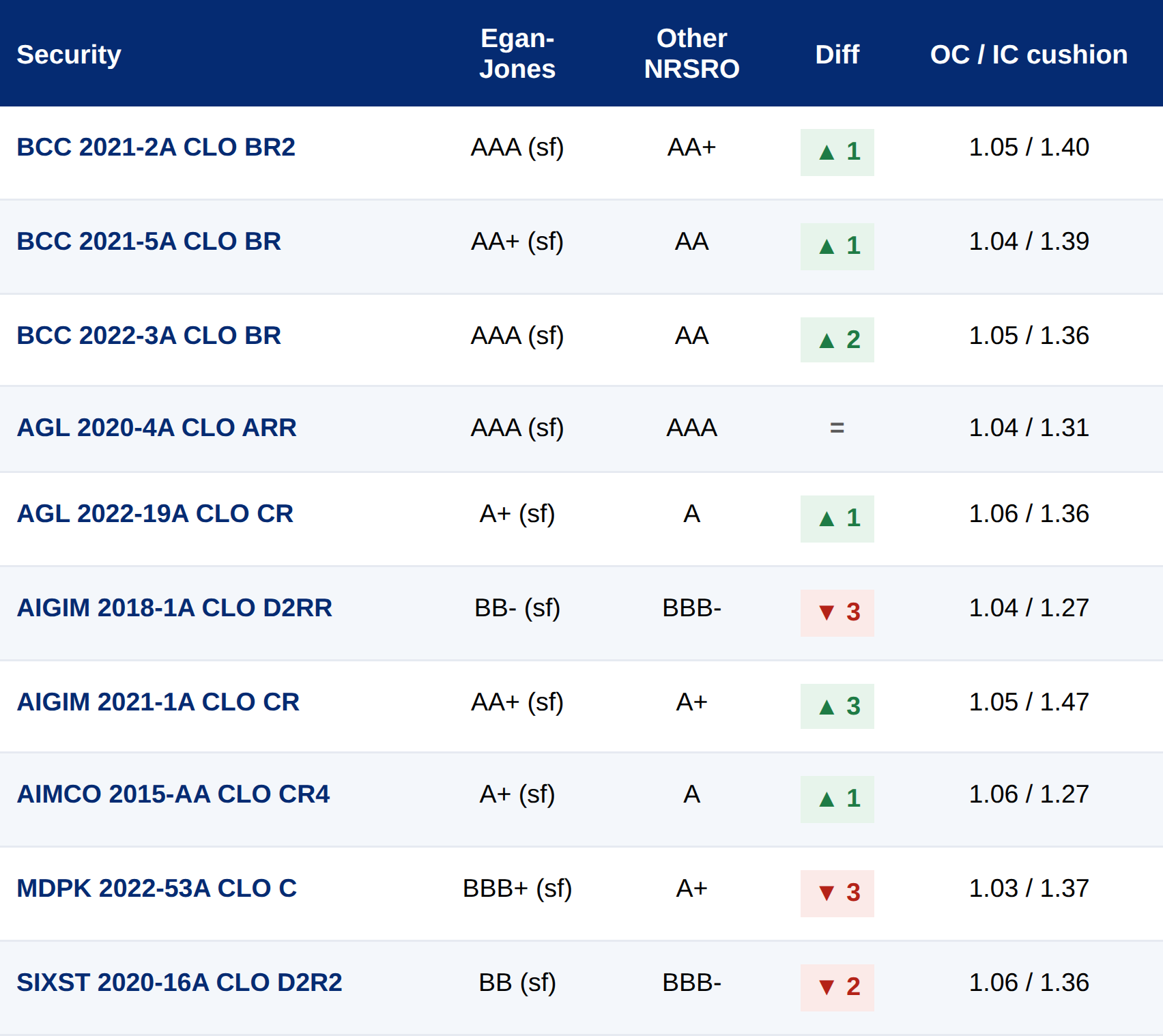 Egan-Jones Ratings Company CLO rating reports; report data as of 09/17/26.
- Diff is the gap in notches between the Egan-Jones rating and the other NRSRO’s equivalent rating on the same tranche, measured on a 22-step scale from AAA to D. Green is Egan-Jones higher; red is Egan-Jones lower; “=” is a match.Cushion is the current test level divided by its trigger, so a figure below 1.00 means the test is failing. Egan-Jones ratings shown here are not NRSRO ratings.
Sources and Footnotes
1. U.S. Department of State, Country Report on Terrorism 2024, Yemen 2. Saudi General Authority for Statistics, Population Estimates 3. UN Panel of Experts on Yemen, final report to the Security Council (S/2024/731), which puts Houthi fighter strength at approximately 350,000 in mid-2024, up from 220,000 in 2022 4. IranWire report, September 9, 2026
Additional Sources
- Exhibit 3 - U.S. Energy Information Administration, weekly on-highway No. 2 diesel retail price - Federal Republic of Germany rating analysis - Egan-Jones Ratings Company, Federal Republic of Germany - Rating Analysis (non-NRSRO sovereign rating). Annual ratios sourced to the IMF; peer and fiscal figures to Thomson Reuters and International Financial Statistics - Germany GDP growth chart - International Financial Statistics; sovereign debt yields chart - Thomson Reuters - Appendix A CLO table - Egan-Jones Ratings Company CLO rating reports, published at [egan-jones.io/non-nrsro-ratings/clo](https://egan-jones.io/non-nrsro-ratings/clo)