Can’t Wave Away Foreign Entanglement
November 16, 2026


Overview
America is entangled in three conflicts it cannot easily end: the Saudi-Houthi war over the Red Sea, the Iran war, and Ukraine. In part due to these wars, Democrats won a massive midterm victory.¹
Meanwhile America's principal adversary, China, benefits from these conflicts. This installment aims to provide a framework for sophisticated institutional investors and risk managers to evaluate how each conflict may evolve under divided government.
 The Truman Show (1998)
I. Blue Tsunami
We believe the recent blue tsunami can be best understood through one lens. Per the talented political strategist for the Bill Clinton 1992 presidential campaign, James Carville, "It's the economy, stupid."
Frustration over the K-shaped economy has been exacerbated by the following:
1. Inflation - This is directly impacted by America's war in Iran and exposure to the Saudi-Houthi war, which impacts shipping through the Bab el-Mandeb Strait. 2. Perceived distraction - We believe American voters see foreign entanglements, and particularly the Iran war, which was highly unpopular from its inception, as a distraction and drain from the domestic economy. 3. Rescinded promises - Trump ran his third presidential campaign on the promise of no new wars, with the tacit promise to focus on domestic issues instead. 4. Perceived corruption - American voters have reacted negatively to the Trump family's exposure to multiple revenue-generating schemes while economic growth has not been felt by Americans universally. These activities include World Liberty Financial crypto venture, the $TRUMP meme coin, a UAE royal's $500 million stake in World Liberty, Trump-branded real estate deals abroad, Jared Kushner's Gulf-funded Affinity Partners, the Trump sons' stakes in Pentagon contractors, Trump's $10 billion lawsuit against the IRS, the G20 summit at Trump's Doral resort, a paid real-time feed of the president's Truth Social posts, frequent personal stock trading, settlements from ABC and CBS, and others. 5. Fear of AI - Many Americans, particularly those in professional services, are concerned about competition from AI and believe the Trump administration has been in favor of AI companies rather than Americans' personal welfare.It is ironic considering that Trump won his first presidential election largely on the immigration issue, which is principally an economic one. Trump recognized then Americans' aversion to competing with foreign labor.
Republicans' case for reelection certainly wasn't aided by ugly images such as those surrounding ICE protests, the bombing of Gaza, and the US bombing of a girls' school in Iran.
The historical evidence is strong that unpopular wars lead to political disruption for the incumbent party. Consider Exhibit 1 below.
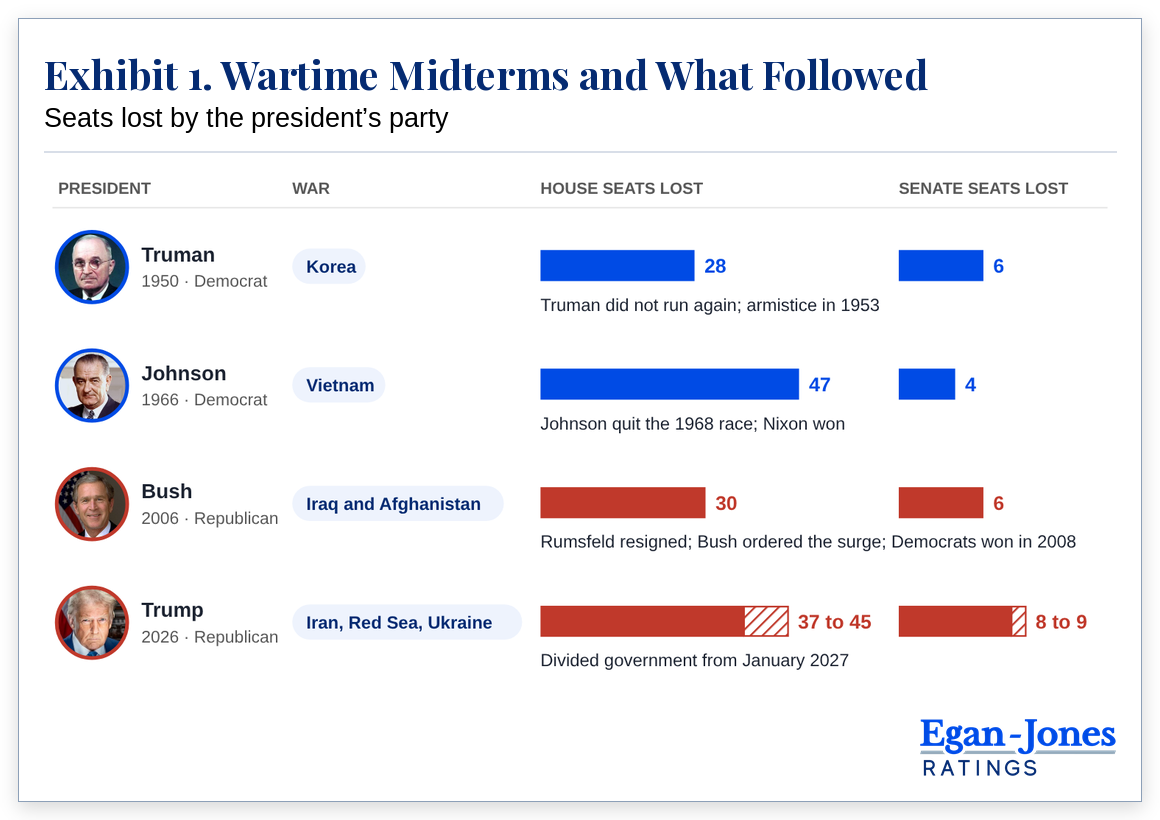 2026 is preliminary (hatched): at least 37 House seats, about 45 if leads hold; 8 Senate seats, 9 if Democrats take Alaska in its November 18 ranked-choice count.
Source: The American Presidency Project; AP calls via Political.org and Democracy Docket; WION; Alaska Public Media.²
II. Yemen
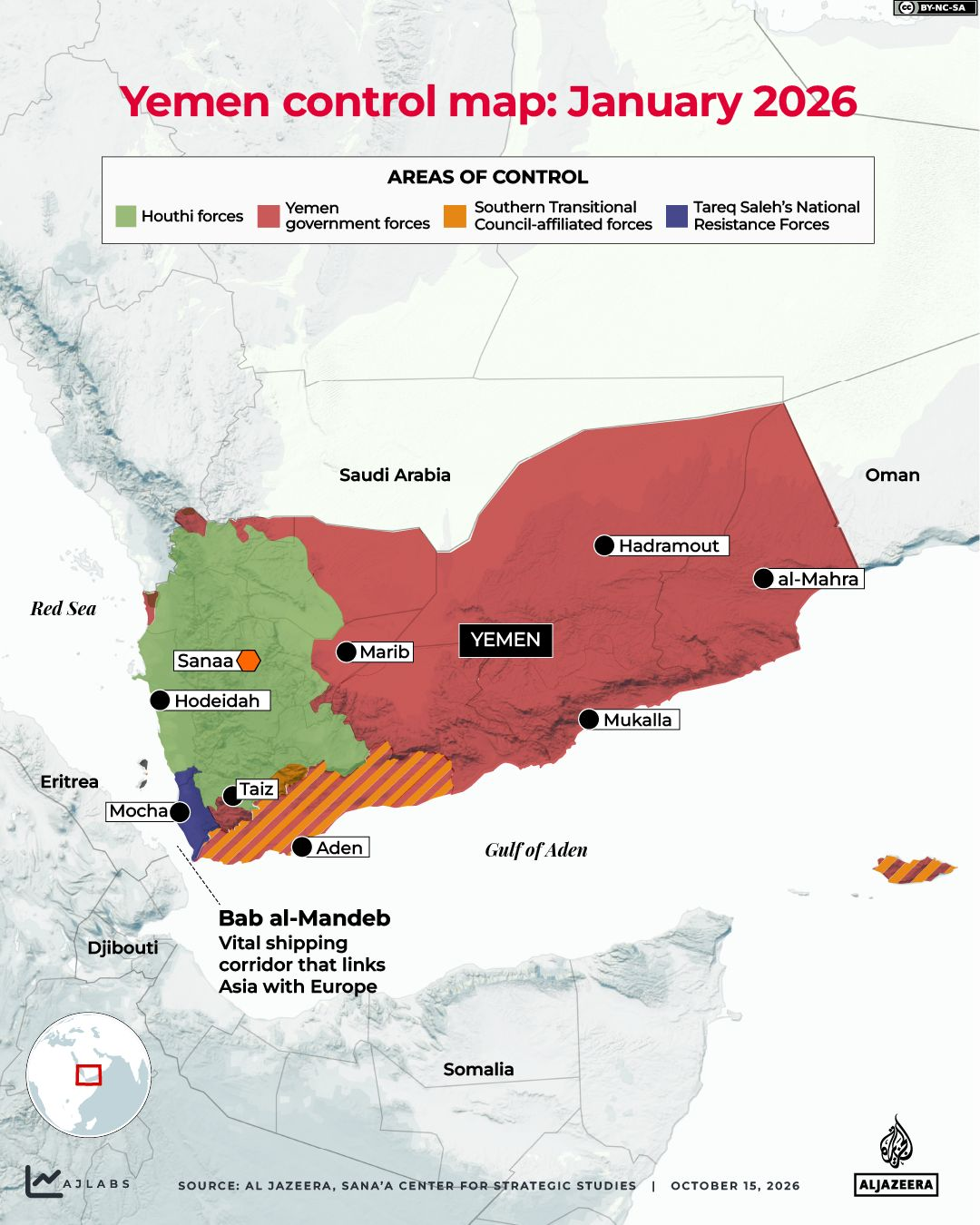
Historically empires have sought to control choke points. For example, Britain held Perim, a small island in the Bab el-Mandeb, from 1857 until 1967, alongside other chokepoint holdings such as Gibraltar, Aden and Singapore.³
However, this valuable territory, Perim, which can constrain adversaries and generate revenue through tolls, was seized by the Houthis on September 11, two months into a war with Saudi Arabia.⁴ Note that the Suez Canal earned Egypt a record $10.25 billion in 2023.⁵
The Saudis had relied on the Bab el-Mandeb for crude exports since Hormuz closed.⁶ Arguably the Bab el-Mandeb is a more important chokepoint than even the Strait of Hormuz.
Saudi Crown Prince Muhammad bin Salman twice asked President Trump to strike the Houthis and was refused.⁷ It is evident that America lacks the capacity and will to take on an additional front in Yemen. By one CSIS estimate, the Iran war has used up about 65% of America's pre-war Patriot inventory.⁸
America focuses much of its military procurement on small numbers of costly systems, which rely on supply chains spread across states for political support. For example, the F-35 has some 1,900 suppliers.⁹ This makes it particularly difficult to ramp up production as America engages in foreign conflicts.
Likely outcome: It seems unlikely that Washington's support for Saudi Arabian strikes will grow, particularly given Democrats' prior lack of support for the Saudi government. The Saudis are unlikely to be able to change the momentum of the Houthi rebels. However, America still faces the economic and political impact of restricted international trade and therefore increased commodity prices.
Exhibit 2
III. Iran: Terms Without an Exit
As we argued in Viva la Vida (No. 204), it appears very difficult for America and Iran to reach a deal. Consider the terms below.
Exhibit 3 · Negotiation Goals
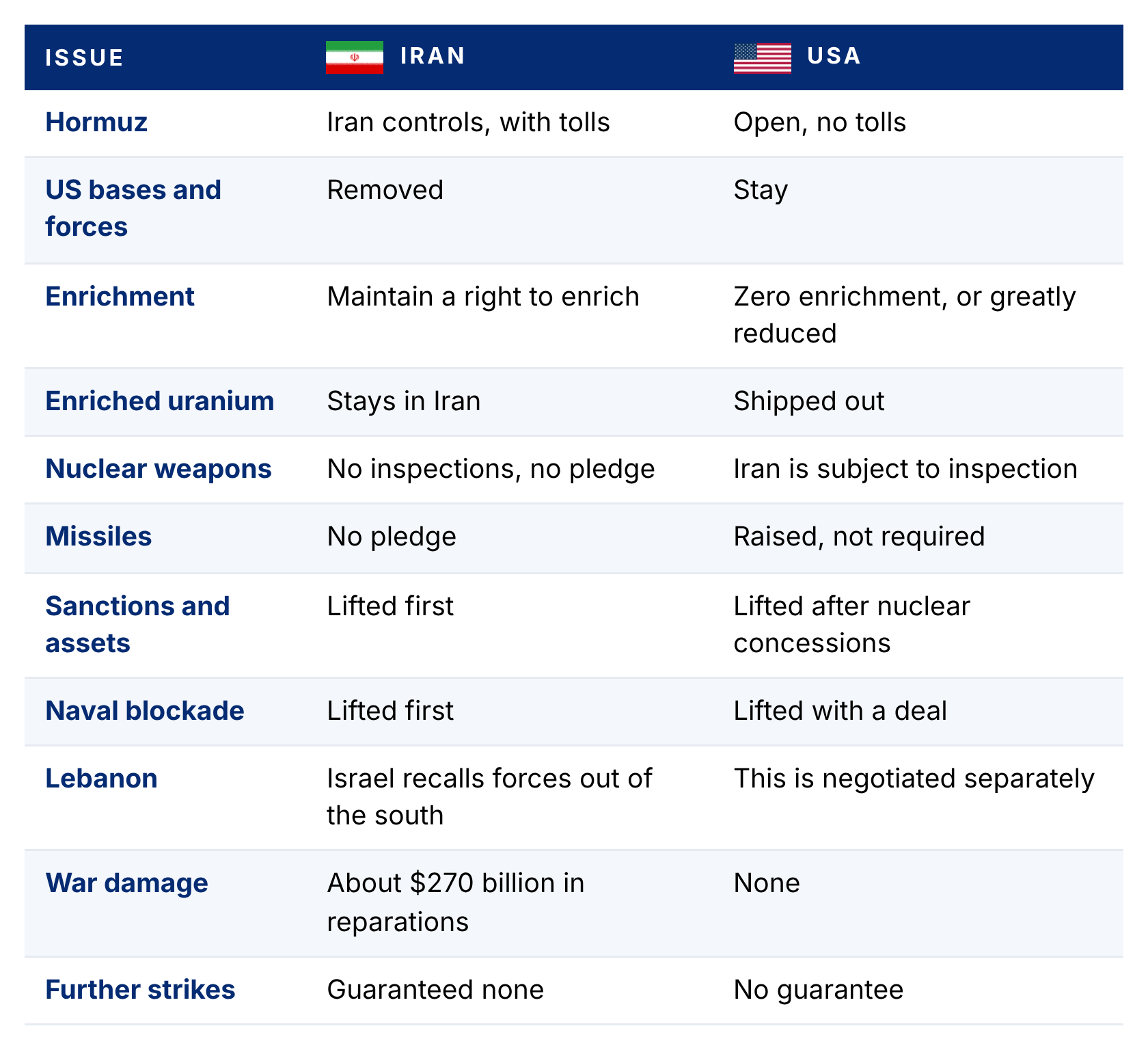 Source: see footnotes.¹⁰,¹¹
Likely outcome: The two sides seem too far apart on these issues to come to an agreement. However, America’s new Democratic legislative branch is expected to put increasing pressure on Trump to end the war. As we saw with Vietnam, Iraq, and Ukraine, ending wars is a challenge. Because a signed agreement is so unattractive, a de facto agreement may be more likely.
The war is likely to leave Iran at the nuclear threshold and thus it gives Saudi Arabia, Turkey, and the UAE reason to adopt similar nuclear-hedging strategies.
IV. Ukraine: No Guarantee Both Sides Can Sign
No Guarantees
Talks resumed in Abu Dhabi on November 10, centered on security guarantees. Russia rejected an immediate ceasefire.¹²
Russia will not accept a security guarantee for Ukraine that treats Ukraine as a de facto member of NATO. Recall that Ukraine's potential membership in NATO was a principal cause of the war.¹³
A Moving Front
For now, the war seems to have slowed down for Russia, which spends about 44% of its budget on the war. Ukraine is seeing its greatest successes since the spring/summer of 2023.
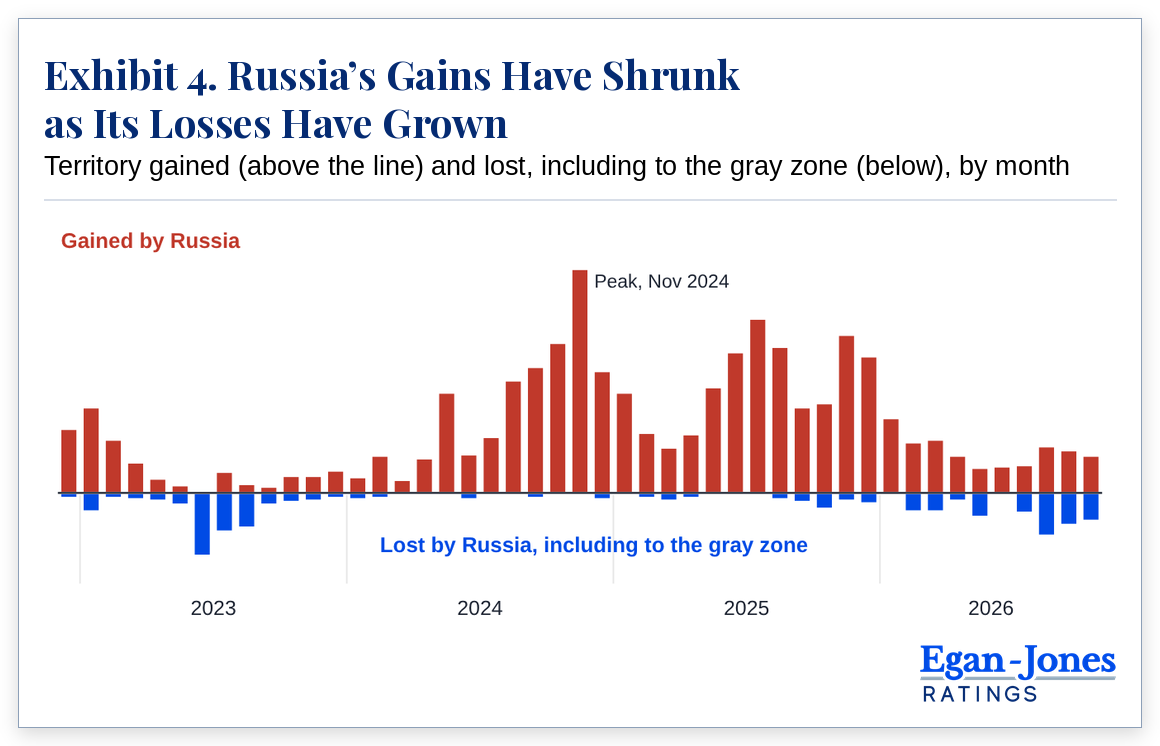 Source: Lex Fridman.¹⁴
Escalation Ladder
Relative to the significant damage that Ukraine has been able to do deep inside Russia, it's clear that Putin has shown restraint in doing the same to Ukraine's European and American backers. What is unclear at this point is how effective this activity will be to psychologically dissuade Russia from continuing the war or materially hamper Russia's capability to wage war. As we mentioned in our prior commentary, MAD World, hardening these assets is very difficult.
Of concern is that if Russia becomes more desperate, they may take more drastic action. Having staked his legacy in the war, Putin cannot survive a visible loss.
Putin has won concessions all the same: in October, with fuel supplies squeezed by the Iran war, Washington licensed Russian diesel sales through April 2027.¹⁵
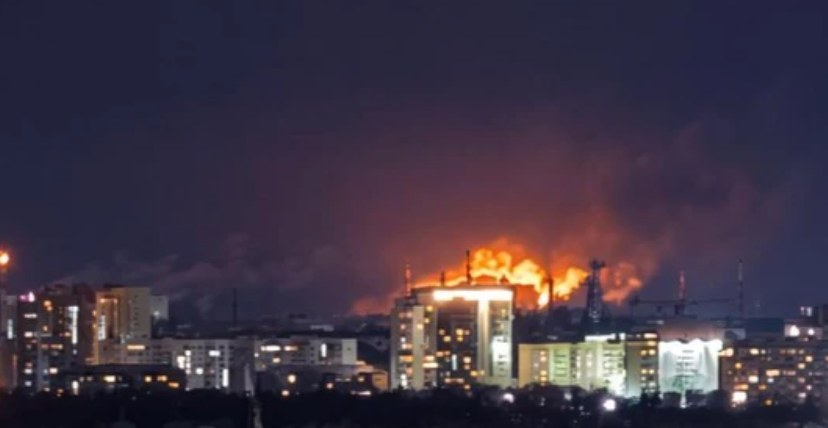 Ukraine Strikes Russia’s Omsk Oil Refinery (11/11/2026)
Likely outcome: Democrats bolster support for Ukraine and more aggressive strikes into Russia.
V. Win for China
China has won a material and propaganda victory from these wars.
Material: They distract American and European attention westward and gain concessions on critical matters such as the Taiwan Strait.
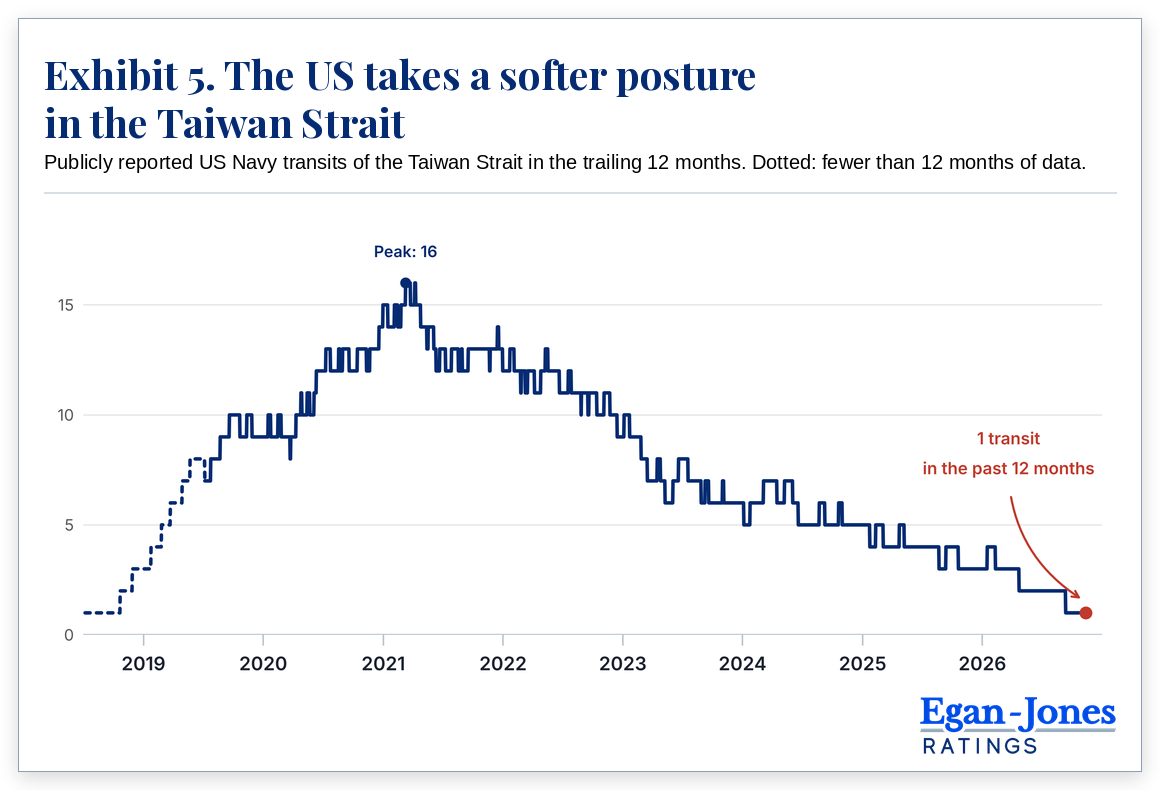 Dotted: fewer than 12 months of data. Ships only. Sources: US 7th Fleet and Indo-Pacific Command announcements; GMU Taiwan Security Monitor; USNI News. As of November 12, 2026
Propaganda: Western nations aren't seen as more peaceful or beneficial for global trade.Likely outcome: Probability of Chinese political change is reduced. America is less able to allocate resources or gather political will for Chinese containment.
VI. Conclusion
Despite the blue tsunami, these foreign entanglements cannot be waved away. America is likely to be exposed to them in some form for the foreseeable future, thus impacting inflation, valuations, and geopolitical risk.
Sources and Footnotes
1. The out-party taking both chambers on a single night for the first time since 2006: NBC News. 2. Seats lost by the president's party, 1950-2006: The American Presidency Project. 2026, preliminary: Republicans won 220 House seats in 2024 (Wikipedia); 161 Republican seats called and 22 races uncalled on AP calls through November 8, and seven Republican Senate seats flipped (Political.org, as of November 11); 174 Republican seats if current leads hold (WION, November 6). Mississippi's Senate race called for Democrat Scott Colom on November 11, with Sen. Hyde-Smith conceding: AP, via Democracy Docket. Alaska: Democrat Mary Peltola leading Sen. Sullivan 48.7% to 47.1%, with neither above 50% and ranked-choice tabulation due November 18: Alaska Public Media, November 11. 3. Perim (Barim), about 13 square kilometers: British from 1857, part of the Aden colony from 1937 and of an independent South Yemen from 1967. Encyclopaedia Britannica. 4. The Houthis taking Mayun (Perim) on September 11, after hostilities with Saudi Arabia that began in July: AFP and AP, via Ahram Online. 5. Suez Canal revenue of a record $10.25 billion in 2023 and $3.99 billion in 2024, with transits roughly halved: Suez Canal Authority figures reported by AP, via Arab News. 6. Saudi Arabia relying on the Red Sea and the Bab el-Mandeb for crude exports since Iran began targeting ships in Hormuz: AP, via The Atlanta Journal-Constitution. 7. The crown prince's two requests for US strikes on the Houthis, and the refusal: Axios. Saudi requests to France, Britain, Pakistan and Egypt for air-defense support as US interceptor stocks dwindled: AP, via Al Jazeera. 8. About 65% of the pre-war US Patriot inventory expended, with a rebuild measured in years: CSIS analysis, via Military Times. 9. An F-35 supply base of about 1,900 suppliers: Lockheed Martin. 10. Tehran's positions. Seven conditions drawn from June's Islamabad accord and officials' statements (Iran has published no official list): an end to hostilities on all fronts including Lebanon, the US naval blockade lifted, sanctions lifted as a first step, frozen assets released, US forces brought closer to pre-war levels, compensation (a government spokeswoman cited about $270 billion in damage) and assurances against further US strikes: Khaleej Times, November 2, updated November 7. Closure of all US bases in the Gulf and Hormuz transit fees among Iran's March demands: Iran International. Iran saying under the memorandum that it still intended to charge fees, and reaffirming that it shall not procure or develop nuclear weapons: Wikipedia. Fees charged for passage by Iran's Persian Gulf Strait Authority: US Treasury. Withdrawal of Israeli forces from Lebanese territory occupied in the war: Asharq Al-Awsat, June 16. No enriched uranium to leave Iran, and the program framed as a sovereign right: Al Jazeera, October 21. Missiles kept out of the talks: The New Arab, June 29. John Mearsheimer on Iran wanting US forces out of the region (Glenn Diesen interview, March 27, transcript via The Singju Post) and on Iran's demand to end the war in southern Lebanon and talk in Tehran of leaving the NPT (The Chris Hedges Report, September 25). 11. Washington's positions. "Zero uranium enrichment" (President Trump) or a "meaningful" cut in enrichment capacity (Vice President Vance), and enriched uranium moved out of Iran: Al Jazeera, October 7 and 21. Nuclear concessions before substantial sanctions relief, and reparations rejected: Khaleej Times. No fees or tolls at Hormuz, and an Iranian commitment never to develop or buy nuclear weapons, in the May draft: bne IntelliNews. The blockade lifted under the June memorandum, then reimposed in July: Wikipedia. US ships, aircraft and personnel to "remain in place in, and around, Iran" until a real agreement is fully complied with (Trump, April 8): Washington Examiner. Missiles: Secretary of State Rubio said they would "come up"; Trump defended leaving them out: The New Arab, June 29. Rubio on viewing Lebanon-Israel talks "as separate and distinct from Iran": Alhurra, May. Renewed strikes "highly unlikely" to be necessary if Iran signs a strong agreement (Trump, November 8): Colorado Politics. 12. The November 10 Abu Dhabi talks, their focus on security guarantees and Russia's rejection of an immediate ceasefire: The National. The first three-way round since February: Kyiv Post. 13. John Mearsheimer, video commentary on the Abu Dhabi talks, November 2026 (transcript supplied by the author), on indivisible security, the Russian veto, the security dilemma and an "ugly victory" for Russia. His longer-standing case that the battlefield will settle the war: Quincy Institute debate, February 2026. 14. Michael Kofman and Preston Stewart, "Russia-Ukraine War: Putin, Zelenskyy, Drones and the Future of Warfare," Lex Fridman Podcast #504, November 2026. Figures are the speakers' estimates. 15. The October 9 diesel deal and the Treasury license running to April 7, 2027: AP, via PBS NewsHour; Deccan Herald.
Additional Sources
- US diesel prices nearly doubling since the war began, and no Russian diesel reaching the United States under the October deal as of November 7: Al Jazeera. - 61% of Americans saying the Iran war had made life more expensive for their families (Politico poll, August): Al Jazeera. - Vice President Vance pointing to the Iran war as the reason Republicans lost, while the president blamed the candidates; about 6 in 10 voters calling the war the wrong decision: AP, via ITV News, November 5. - A campaign defined by frustration over the cost of living and perceived corruption, and seven Republican-held Senate seats flipped: NPR, via OPB. - The September Senate vote, which failed 50-49, as the 20th vote on an Iran war-powers resolution since the war began on February 28: The New York Times, via the Hawaii Tribune-Herald. - Officials telling Arab Gulf leaders to be prepared for a short, intense campaign after the midterm elections, citing a newspaper report: The National News Desk. - The president, in a November 8 CNN interview, saying renewed strikes are "highly unlikely" to be necessary if Iran signs a strong agreement: Colorado Politics. Secretary of State Rubio supporting continued economic pressure on Tehran, per Axios: Gulf News, November 3. - Shanghai to Rotterdam at about 10,600 nautical miles via Suez and 13,800 via the Cape of Good Hope, with 10 to 14 extra days common: Port Economics, Management and Policy. - The Houthis declaring navigation safe for all companies except Saudi vessels: AP, via CTV News. - Iran's Persian Gulf Strait Authority, which required ships to get its permission to transit Hormuz and charged fees for passage, with the proceeds going to the IRGC, sanctioned on May 27: US Treasury. - Hormuz to stay closed until Iran's conditions are met: Arab News; Al Jazeera, November 11. Mohsen Rezaei, Iran's security chief, saying no enriched uranium will leave the country: Al Jazeera, October 21. - Iran's seven conditions, drawn from June's Islamabad accord and officials' statements (Iran has published no official list): an end to hostilities on all fronts including Lebanon, the US naval blockade lifted, sanctions lifted as a first step, frozen assets released, US forces brought closer to pre-war levels, compensation (a government spokeswoman cited about $270 billion in damage) and assurances against further US strikes: Khaleej Times, November 2, updated November 7. Foreign Minister Araghchi's statement that the war's end is incomplete without the withdrawal of Israeli forces from Lebanese territory occupied in this war, and a report that Tehran will not sign a nuclear deal before that withdrawal: Asharq Al-Awsat, June 16. - Washington's position: "zero uranium enrichment" (President Trump) or a "meaningful" cut in enrichment capacity with a verifiable long-term commitment not to rebuild (Vice President Vance), and enriched uranium moved out of Iran: Al Jazeera, October 7 and 21. Nuclear concessions before sanctions relief, and Trump's rejection of reparations: Khaleej Times. The roughly 440 kg of near-bomb-grade uranium Washington wants removed: The New York Times, via The Nightly. Unrestricted passage through Hormuz with no fees or tolls in the May draft: bne IntelliNews. - JCPOA limits of 3.67% enrichment and a 300-kilogram stockpile for 15 years: Arms Control Association. - About 50 US B61 bombs reportedly stored at Incirlik; power to the base cut for nearly a week after the July 2016 coup attempt, and several high-ranking Turkish officers there arrested: Congressional Research Service. - The India-Pakistan missile exchange and ceasefire of May 2025: Arms Control Association. - Arms sales held "in abeyance" as a "very good negotiating chip": Congressional Research Service. A planned $14 billion package: AP, via WTOP; Taiwan Security Monitor, George Mason University. Taipei expecting continued congressional support after the midterms: Reuters, via bdnews24. - Yemen control map, January 2026: Al Jazeera, with the Sana’a Center for Strategic Studies. - The Islamabad Memorandum, signed June 17: a ceasefire, removal of the US naval blockade within 30 days, free passage through Hormuz for 60 days, waived US oil sanctions, a reconstruction plan of at least $300 billion and nuclear questions deferred to final talks; Iran closing Hormuz again on June 20 over Israeli strikes in Lebanon; the US revoking Iran's oil-sales license after attacks on shipping on July 7; President Trump calling the memorandum "over" on July 8; the pact seen in Washington as a strategic defeat, with some Republicans angry: Wikipedia. The blockade reinstated from July 14: Wikipedia. Each side accusing the other of violations, and the 60-day deadline passing in August without a deal: Al Jazeera, August 16. - John Mearsheimer on the June 17 memorandum as "a surrender document": The Chris Hedges Report, September 25.