Anthropic's Moat
November 16, 2026



I. Overview
Given the upcoming massive IPO of Anthropic expected on November 18¹, it’s worthwhile to consider the argument for its debt and equity valuations. As of the date of writing this piece, Polymarket is trading at the odds below for valuation.
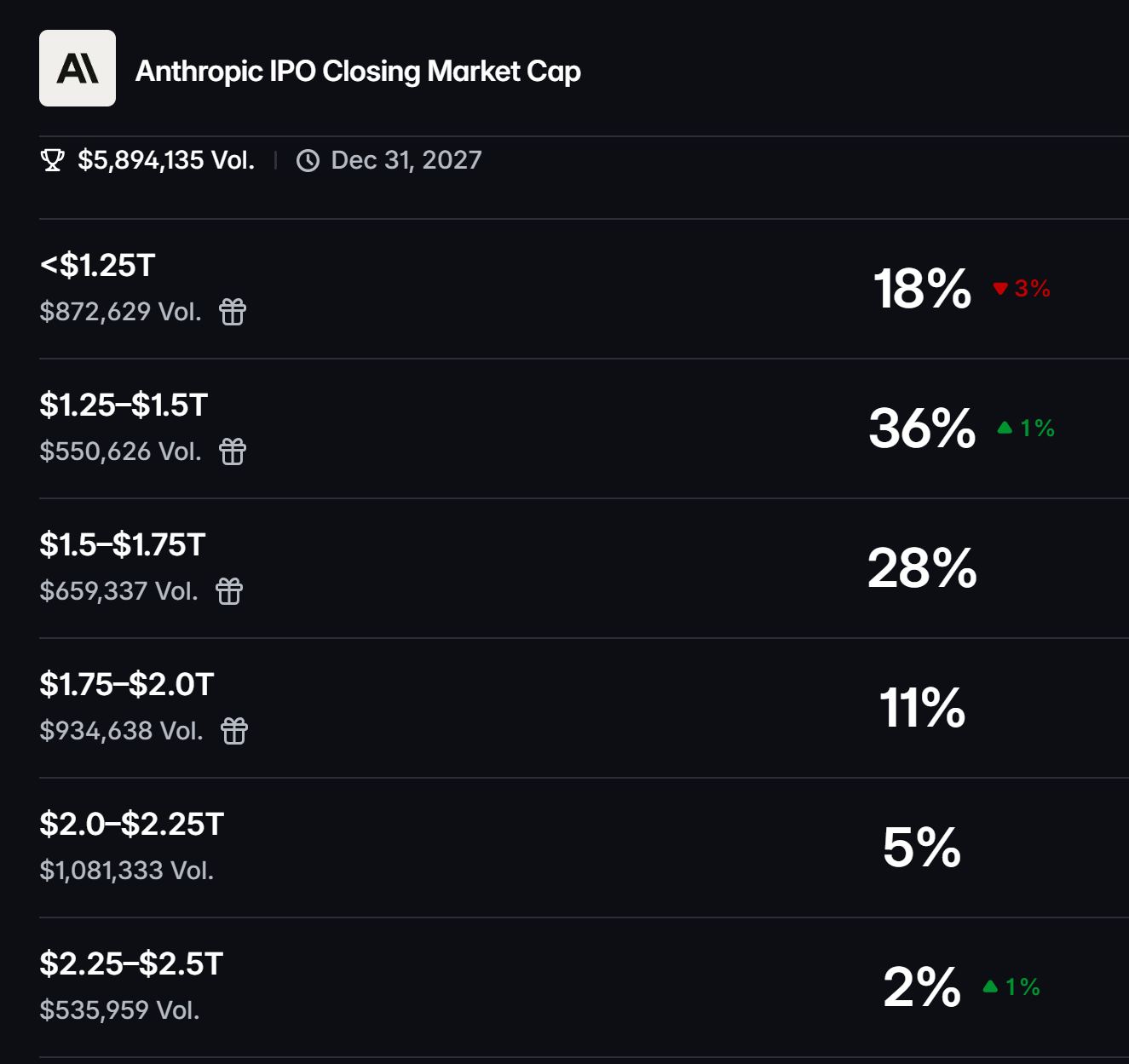 Source: Polymarket, “Anthropic IPO Closing Market Cap” market.
The company has amassed roughly 300 million monthly users since its founding nearly 6 years ago. Its moats, on the other hand, are at the very least in question: customers can switch at little cost, its compute is largely rented, and others own the platforms (e.g., hardware and social media) people use.
While Anthropic is certainly creating massive value for customers, the question for investors is how much of that value Anthropic can capture over the long term and how Anthropic can generate cash through novel services. This installment aims to provide a framework for sophisticated institutional investors and risk managers weighing that balance.
II. A Few Givens
1. Stellar growth - Third-quarter revenue was up over 10x from a year earlier, and adjusted operating income has turned positive (Exhibits 1 and 2).² The step change came at the start of 2026, built on Claude Code and extended by Cowork, the agent Anthropic launched in January.³ 2. Customer value - More than 11,900 customers paid Anthropic at least $100,000 over the past year, up from more than 950 a year earlier. 3. No debt is raised in the IPO - Separately, Anthropic already has two borrowing lines in place: a $15 billion credit facility, nearly all of it undrawn, and agreements under which investors may buy up to $77.0 billion of its notes, subject to conditions.²
III. By the Numbers
See key figures for Anthropic below.
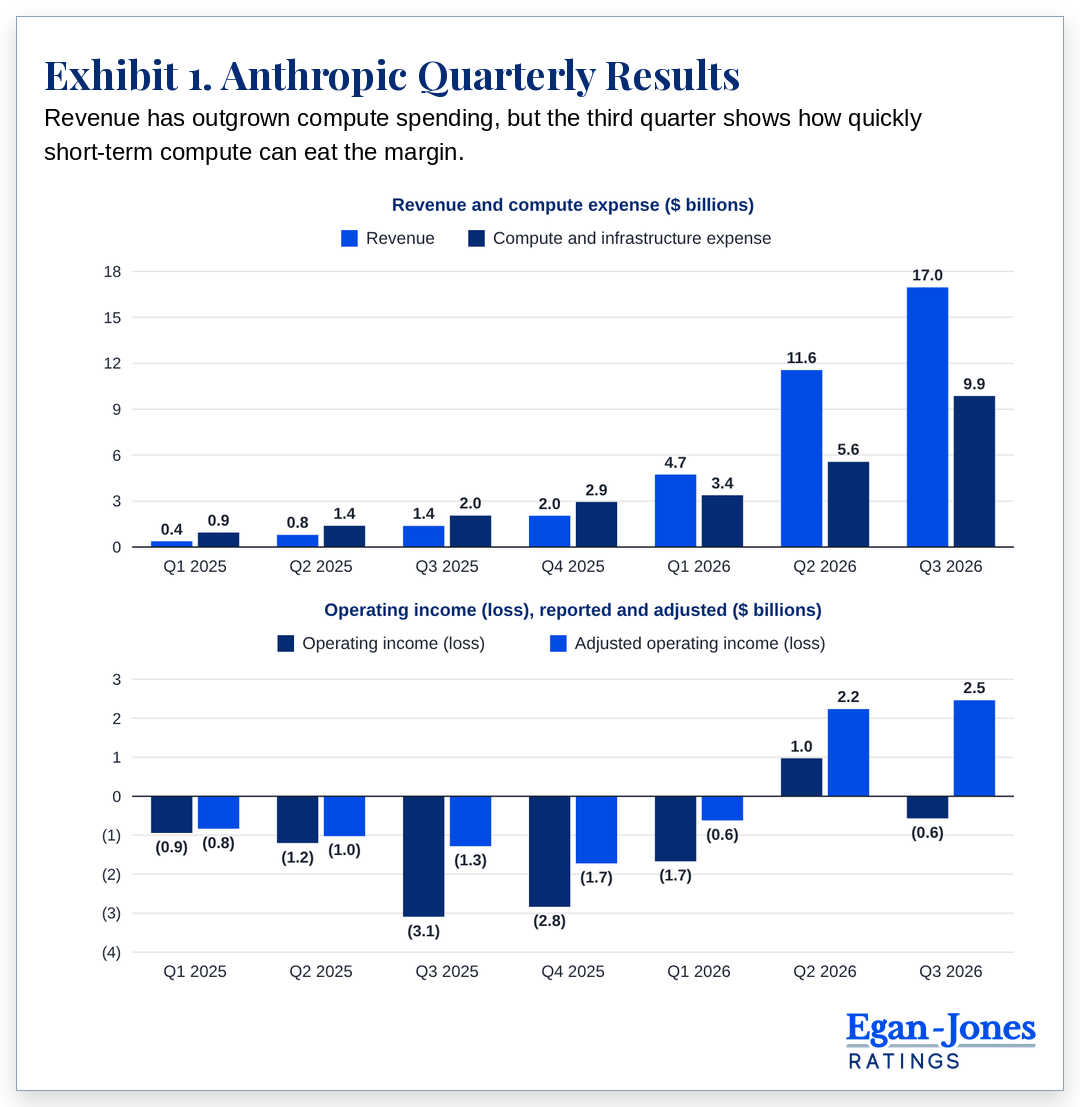 Source: Anthropic, PBC, Form S-1 (October 26, 2026) and Amendment No. 1 (November 2, 2026), quarterly results, unaudited. Adjusted operating income excludes stock-based compensation, non-cash charitable contributions and the $1.5 billion Bartz settlement in the third quarter of 2025.
Exhibit 2. Key Financials
Operating losses have narrowed sharply; the net loss is mostly non-cash fair value changes.
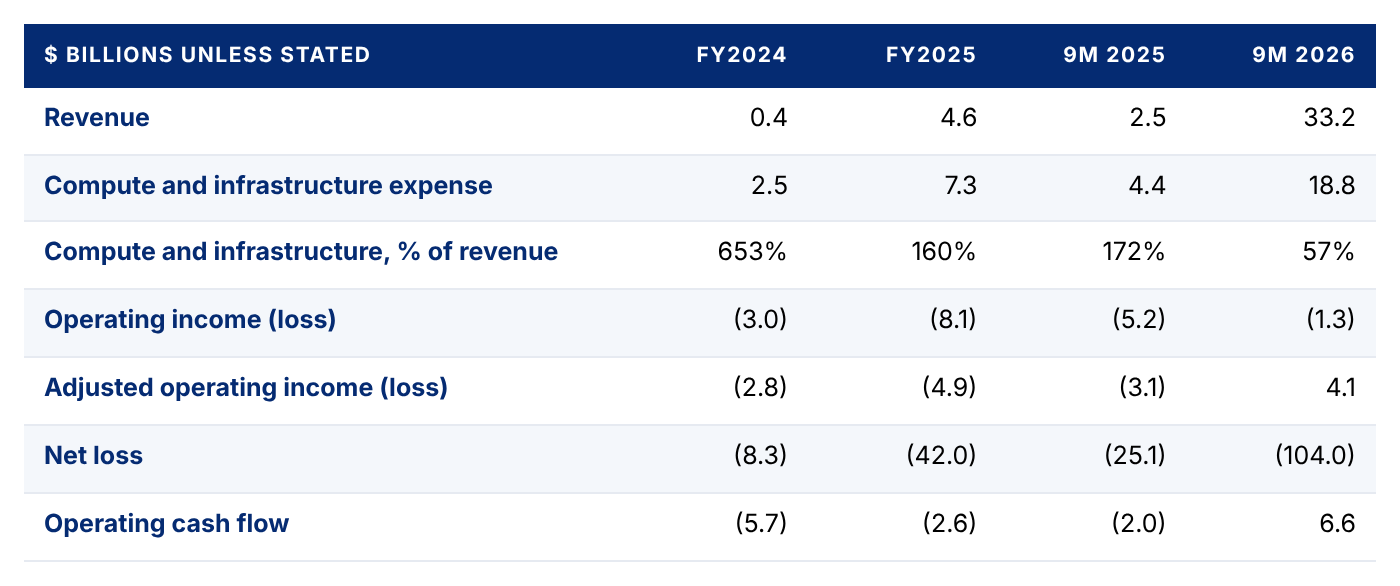 Source: Anthropic, PBC, Form S-1 and Amendment No. 1. Nine-month figures are unaudited. 2024 compute expense is derived from its reported ratio to revenue; nine-month 2025 figures sum the quarterly results.
IV. Arguing for Anthropic
- Large customer base - Anthropic has a massive customer base, which it could monetize for a variety of services. This customer base also provides Anthropic with proprietary training data that cannot be easily captured by others. - Rapid growth - Anthropic is growing in the number of total customers and the number of high-paying customers. - Strong capabilities - Anthropic has led the expansion of the artificial intelligence frontier, which reflects its strong management and execution capabilities. Notably, Anthropic has offered models on the intelligent end of the frontier, which should be most profitable. - Liquidity - Given Anthropic’s anticipated large IPO, it appears there is significant demand for exposure to the firm. - Little borrowed cash - On September 30, Anthropic’s only reported debt was $130.5 billion of convertible notes, carried at fair value. That value moves with the share price and reflects stock the holders are entitled to, so it overstates the cash Anthropic borrowed. Its $15 billion credit facility was almost entirely undrawn.² - Default option - People may keep choosing Claude simply because it is the default choice. - Additional services - Anthropic could compete directly in the software and professional services it is disrupting. However, offering direct services in legal, financial, and other professional services areas would likely serve as a distraction from its core business.
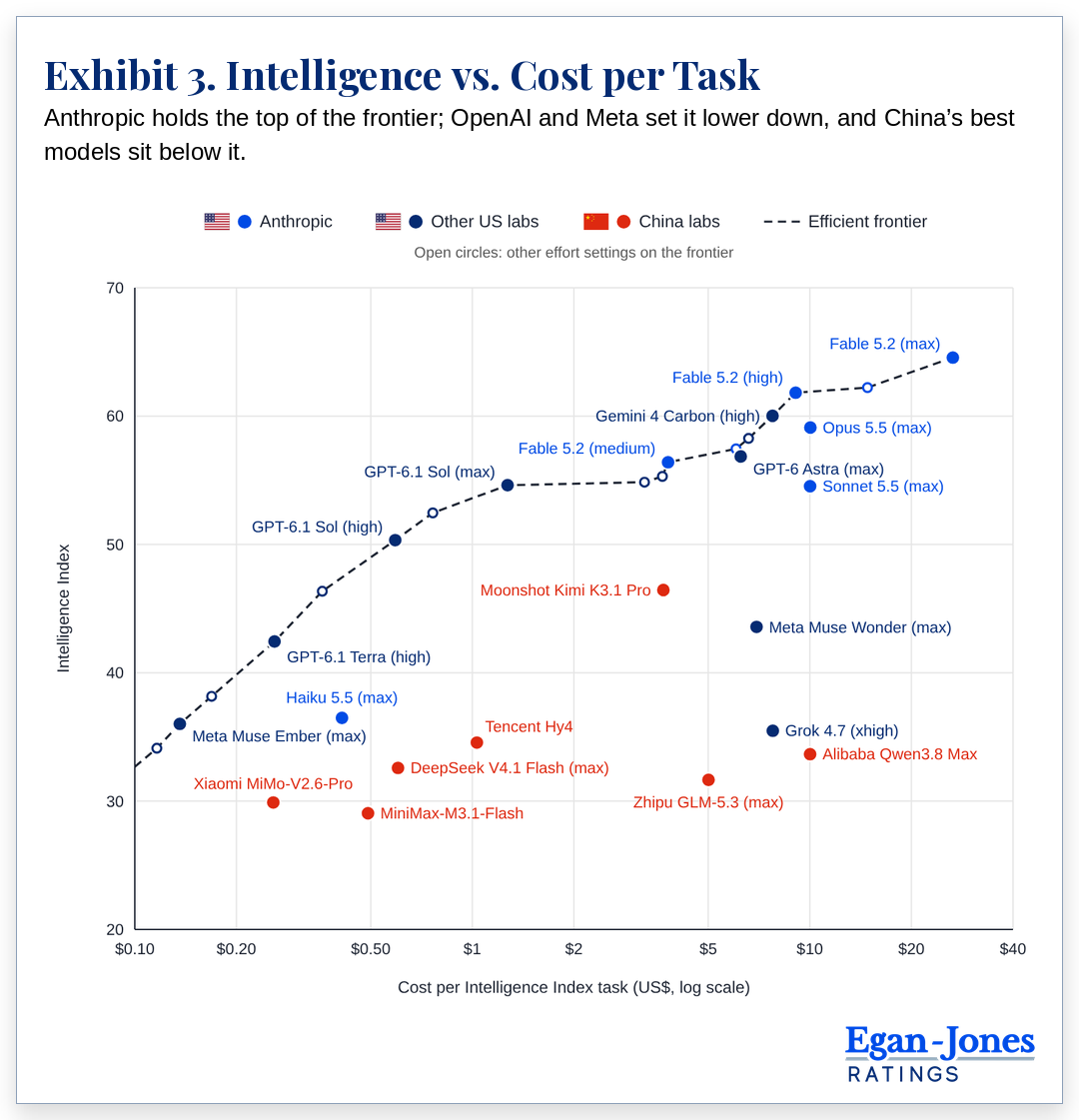 Source: Artificial Analysis, LLM Leaderboard, Intelligence Index v5.0.1 and cost per Intelligence Index task, accessed November 12, 2026. The frontier is drawn across all 96 current models and effort settings with a listed cost per task; four frontier settings below $0.10 sit off the chart, and models with no listed cost, such as Meta’s Muse Wonder Full, are excluded. Anthropic models run with Anthropic’s default fallback.
V. Arguing Against Anthropic
- Potential overcommitment - Anthropic has massive capital commitments over the next few years. Should demand for its services slow, this would be a massive issue. The commitments run to 2045 and dwarf its current resources, and the Amazon, Google and Microsoft contracts require minimum payments whether or not the capacity is used (Exhibit 4).² - Low switching costs - Although enterprise accounts, which bill annually, increase stickiness for Anthropic, generally it’s easy to switch platforms, particularly for APIs. Consumption-based fees (which include API fees) made up 79% of revenue in the first nine months of 2026.²
Anthropic’s filing says many top customers have no long-term contract or one that expires soon and can reduce spending at any time.²
Memory is portable. Anthropic launched a tool in March that imports a user’s memory from ChatGPT, Gemini and Copilot,⁴ and rivals can build the same door in reverse.
Further, Anthropic has a limited ability to nudge users to continue to use its services, unlike Apple, because it does not own hardware that customers use. Investors should investigate the relationship between Anthropic’s model strength and client retention.
- External reliance - About 44% of revenue came through cloud marketplaces,² where Amazon, Google and Microsoft stand between Anthropic and the buyer and sell competing models.
The SpaceX contract, worth up to $120.5 billion, can be cancelled by either side on 90 days’ notice once its initial terms end in early 2027,²,⁵ and SpaceX builds the competing Grok models. When demand outran its contracts last quarter, Anthropic bought $5.0 billion of short-term compute at what it calls significantly higher prices.²
- Model distillation and competition - Of significant concern is competitors distilling Anthropic’s models, thereby creating a capable alternative at a much lower cost. Further, others may innovate and create stronger models. - Feature replication - Claude differentiates itself based on its application’s features, such as sending several messages while Claude works. However, these will soon be replicated. - Limited hardware moat - Anthropic’s lack of vertical integration, by renting much of its hardware rather than owning it, may mean that it has less of a defensive moat here than one would anticipate. The counterargument is that the business is less capital-intensive than it would be otherwise. - Local models - Claude may face increasing competition from users running models locally on hardware such as AMD’s Ryzen AI Halo.
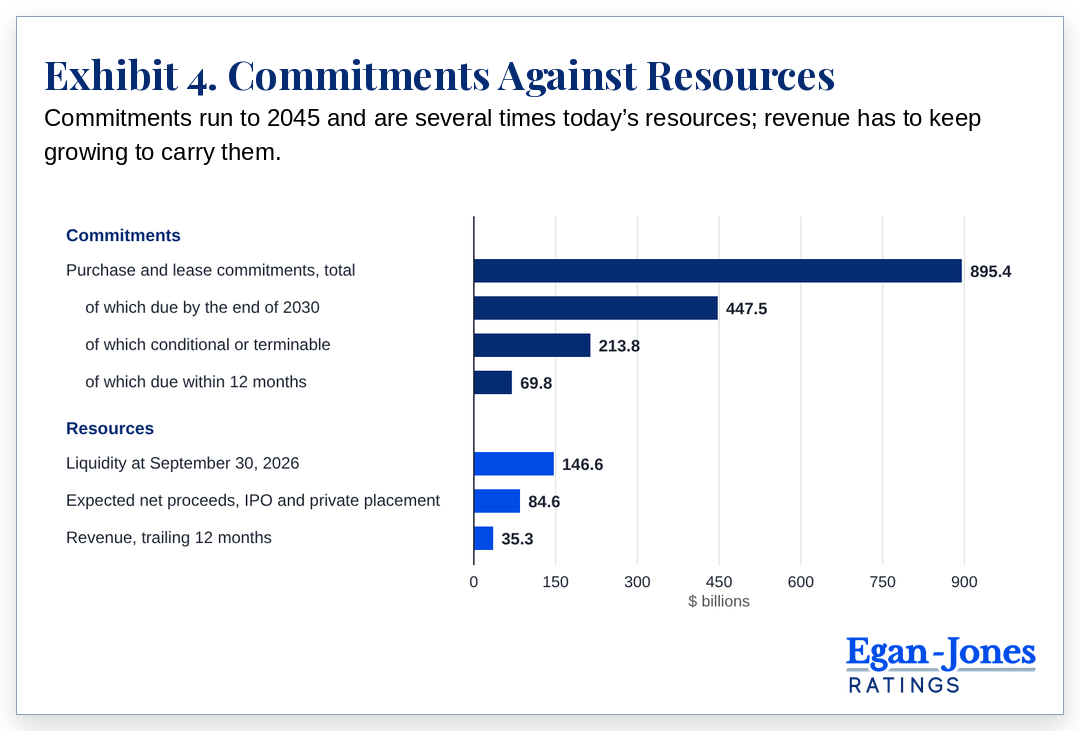 Source: Anthropic, PBC, Amendments No. 1 and No. 2 to Form S-1. Commitments include leases not yet commenced and agreements signed after September 30, and exclude an estimated $150 billion to $175 billion with no fixed commitment. Liquidity is cash, short-term investments and undrawn credit; net proceeds assume the $74 midpoint.
VI. Unknowns
New platform - A goal of many tech companies is to become a platform, such as Apple’s iPhone or Nvidia’s CUDA. Offering a platform reduces reliance on other vendors and increases lock-in of customers. Meta has long been concerned by Apple’s control of the App Store and thus has sought to create its own platform, such as augmented reality, to the extent that the firm renamed itself after its “Metaverse” efforts.
We expect a valuable role of Claude is as a tool that makes other applications more capable and easier to access in a “headless” fashion. Stated otherwise, a user can access their applications via Claude rather than opening each application’s user interface. This is much like how one can access any bank via an ATM, without the need to visit a bank branch.
However, it is not clear if Claude should be considered a platform in a similar way to Google, which has a significant share of the market and high switching costs.
Regulatory role - Given the massive shift in the American legislative branch to the Democratic Party, it seems likely that over time there will be increased regulation. Many argue that Anthropic will benefit from regulatory capture by reducing competition. However, increased regulation could also stifle the growth of Anthropic.
Much can change in the next two years before a potential Democratic president takes office in America. Control of the executive branch will be necessary to implement regulation on AI companies such as Anthropic.
VII. Conclusion
There are still massive questions left unanswered about Anthropic, with massive potential still left to be realized.
The world is changing rapidly. This installment aims to provide a framework of possible major shifts for the benefit of sophisticated institutional investors and risk managers.
Sources and Footnotes
1. Forbes, “Anthropic IPO Targets $1.3 Trillion Valuation And A $90 Billion Raise,” November 10, 2026 (pricing and listing dates; private placement buyers). 2. Anthropic, PBC, Amendment No. 1 to Form S-1, SEC, November 2, 2026. Quarterly and nine-month figures are unaudited. 3. Outlook Business, “SaaSpocalypse Explained: Decoding Claude Cowork & Plugins that Triggered Havoc in IT,” 2026, citing Bloomberg. 4. PCWorld, “Claude can now import chat histories from ChatGPT (and other AIs),” March 3, 2026. 5. Simon Willison, “Quoting SpaceX S-1,” May 20, 2026 (termination on 90 days’ notice).
Additional Sources
- CNN via KVIA, “Anthropic’s new AI tool sends shudders through software stocks,” February 4, 2026. - Anthropic, PBC, Amendment No. 2 to Form S-1, SEC, November 10, 2026 (price range, shares offered, concurrent private placement, selling stockholders and use of proceeds). - FourWeekMBA, “Anthropic Said to Start IPO Roadshow Next Week; No Price Yet,” November 6, 2026, citing the Financial Times and Axios. - Android Central, “Meta’s smart glasses success is getting harder to ignore,” 2026, citing EssilorLuxottica. - AI Chat Daily, “Anthropic to pull account emails from Claude Code context after User-Agent leak,” November 2026; FourWeekMBA, “Claude Code Got an Email Check 108 Days After First Report,” November 2026. - Zenity Labs, “Claude in Chrome: From alert(1) to Full Account Takeover,” August 5, 2026. - Infosecurity Magazine, “Chinese AI Firms Hit Claude with Distillation Attacks, Anthropic Warns,” February 2026. - The Hacker News, report on Anthropic’s disclosure of distillation by seven China-based labs, September 2026. - TechCrunch, “Anthropic, Blackstone bet the next trillion-dollar AI business is implementation, not just models,” July 15, 2026. - MacRumors, “Anthropic Will Now Train Claude on Your Chats, Here’s How to Opt Out,” August 28, 2025. - First Page Sage, Claude usage statistics (monthly active users). - Braindetox, “Anthropic S-1/A Q3: $17B revenue, $895.4B commitments,” November 3, 2026 (reading of the amended filing, including commitments and termination terms by counterparty). - sec-api.io, “Anthropic, PBC (ANT), Financial Analysis,” October 27, 2026 (annual results for 2024 and 2025 and quarterly results for 2025). - Decrypt, “Anthropic Sets IPO Price Range at $70 to $78, Valuing Company at Up to $1.4 Trillion,” November 10, 2026 (market value at the range, citing CNBC). - Egan-Jones, “Nipping at the Heels,” Risk Commentary No. 224, October 2026. - Egan-Jones, “Play It Again; China’s Fast-Follower Playbook Reaches AI,” Risk Commentary No. 203, July 2026. - Exhibit 1 - Anthropic, PBC, Form S-1 and Amendment No. 1, quarterly results of operations, first quarter of 2025 to third quarter of 2026 (unaudited). - Exhibit 2 - Anthropic, PBC, Form S-1 and Amendment No. 1, annual and nine-month results. - Exhibit 3 - Artificial Analysis, LLM Leaderboard, Intelligence Index v5.0.1 and cost per Intelligence Index task, accessed November 12, 2026. - Exhibit 4 - Anthropic, PBC, Amendments No. 1 and No. 2 to Form S-1, commitments, liquidity and expected net proceeds.