An Unholy Alliance; The Emerging New World Order
September 17, 2026
Overview
Technology has yet again upended prior assumptions. In this case, the order which has existed for centuries is threatening to unravel with, of course, massive consequences.
As usual, this Commentary is written for the benefit of sophisticated institutional investors and risk managers.
I. The Way We Were
For the past few centuries, nations were built on the notion of free trade whereby most nations could trade with others and the global economy benefited from the increased efficiency. That is, if one had an advantage in growing wheat, the excess supply could be transported at relatively low cost via vessel to other nations in exchange for goods and currency. Over the last several decades this system became known as the petrodollar system whereby the all-important petroleum products could be shipped out of the Middle East, thereby fueling manufacturing and tech developments globally.
II. Sea Change
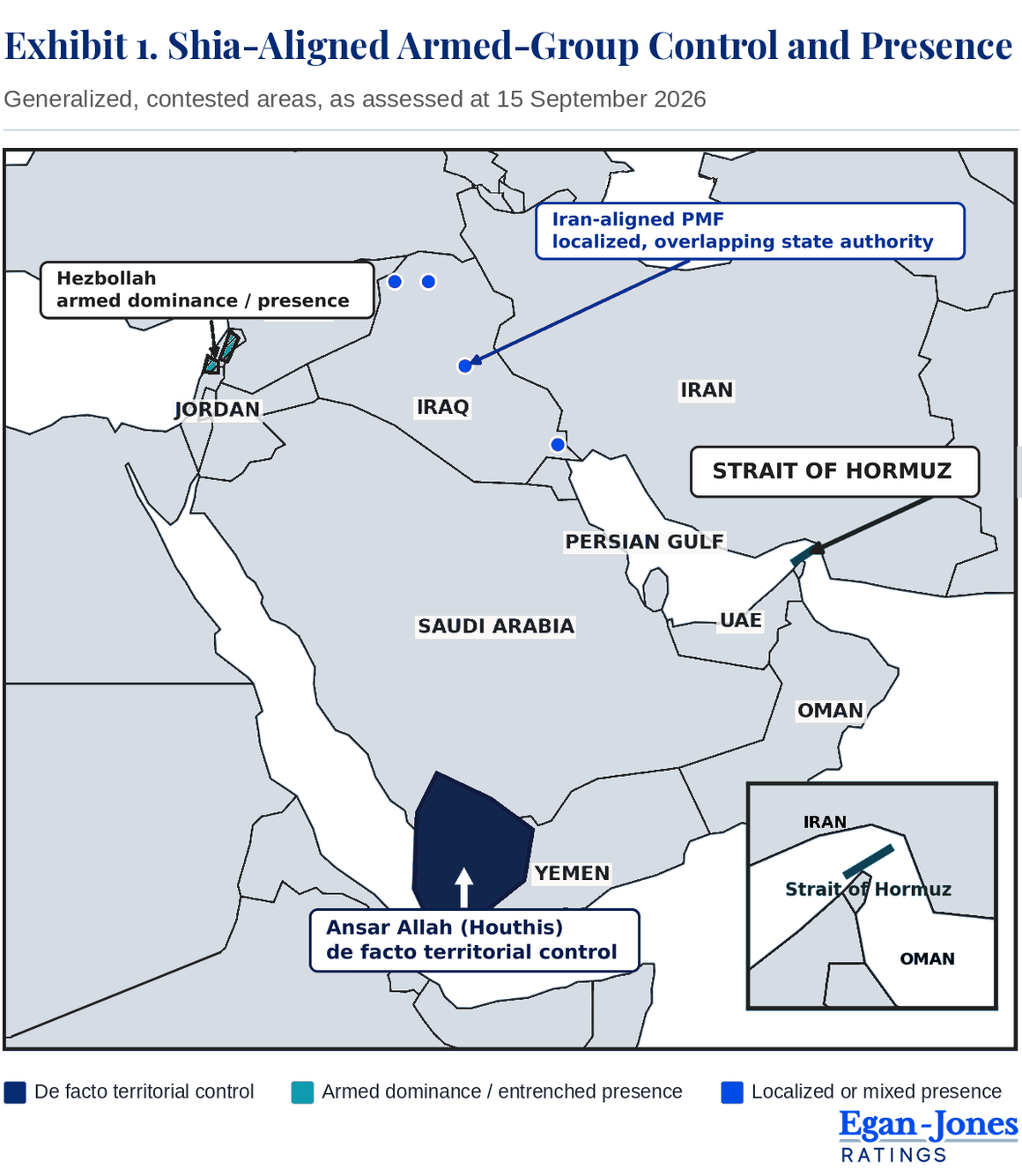
While this system worked for many, some felt disenfranchised. Perhaps this is always the case, but with the development of more sophisticated arms, the disenfranchised now have leverage. With newly developed, relatively inexpensive missiles and drones, Shiite groups can shut down a significant portion of petroleum exports from the Middle East. The below map highlights the Shiite strongholds and, as can be seen, they are present at the major choke points for Middle East petroleum exports.
III. Stubborn Resistance
The latest development is the Yemen-based Houthis gaining control of the strategic island of Mayun in the Red Sea, and the shutdown of the cross-peninsula Saudi Arabian pipeline after drones launched from Iraq struck it.¹ Saudi Arabia has been fighting the Houthis for the past decade and has not been successful, perhaps because of the difficult terrain of Yemen (the mountains provide easy cover) and the indomitable spirit of the fighters. While U.S. vessels cleared mines near the Strait of Hormuz, the missile and drone attacks remain a credible threat.
IV. No Boots
In years past, England or the U.S. would send in troops to clear the pirates and restore maritime order. (Hence the Marine anthem “to the shores of Tripoli”). However, punishing wars in Afghanistan and Iraq have chastened the U.S. against similar engagements. Compounding the problem are concerns that the current administration’s efforts in Iran appear to be bogged down.
Turning to other nations that have a stake in the current system, the EU has difficulty agreeing on much of anything and is probably more concerned about Russia’s activities in Ukraine. In the case of China, India, and Japan, all are threatened, but presumably can rely on some energy from Indonesia and other locales, and to an increasing extent are shifting to electric vehicles and other power sources.
V. A Game of Chicken
The current strategy of the West appears to be one of starving Iran of economic resources in an attempt to rein in the IRGC (Islamic Revolutionary Guard Corps). The underlying premise is that if the population suffers, at some point, they will rise up and overthrow the current regime. The deterioration of the value of Iran’s currency is an indication of the pain, but is not a guarantee of a successful uprising, particularly when the regime is willing to kill scores of demonstrators. (The rial weakened from roughly 186,500 per dollar in 2021 to 2.3 million in September 2026, an approximately 91.9% loss in dollar value.)
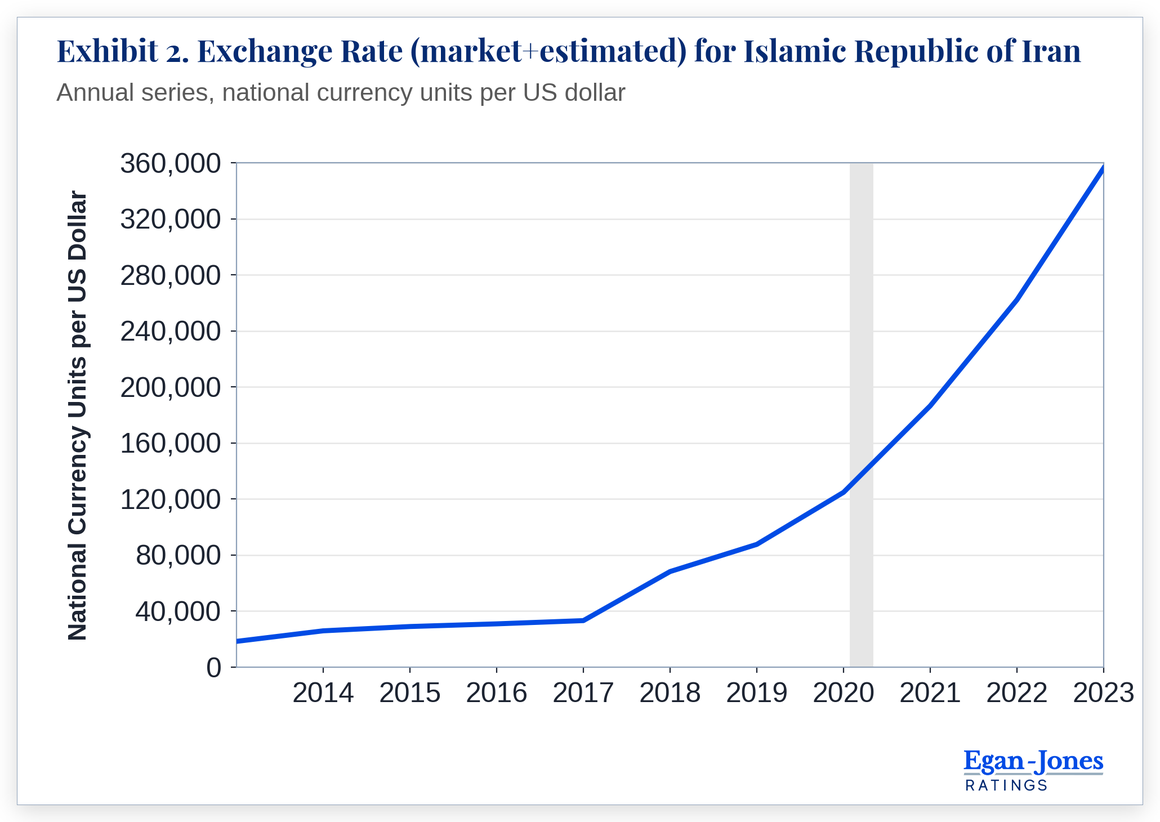 Sources: University of California, Davis; University of Groningen via FRED. Shaded area indicates a U.S. recession.
The series is annual and its last observation is 2023. The September 2026 figure cited above is the current Tehran open-market quote, which is measured on a different basis and is not part of this series.
Alternatively, the IRGC’s strategy appears to be one of restricting the transport of energy until the West accepts its key demands, which appear to be securing nuclear weapons and control of the Strait of Hormuz. Given the cooperation of Iran with nuclear-armed states of N. Korea, Russia, and China, it is probably a good assumption that Iran could easily secure nuclear material, but perhaps the IRGC wants a more fully developed, credible program.
VI. End Game
Now for the difficult part of assessing likely outcomes. A reasonable view is that the primary motivators of the IRGC leaders are the normal ones of power and money (as opposed to a religious reordering of the world). If that is the case, watch for the push for a tolling system for the movement of petroleum and either covert or overt gaining of nuclear access. While such an outcome is unpalatable and is likely to result in the nuclear arming of other Gulf states, over time, it is probably manageable.
Alternatively, the curtailment of Middle East energy exports will result in a very different world, and major economic distress. Essentially all economies based on petroleum, natural gas and derivatives will need to make major adjustments. Perhaps the starting place is food production (which typically relies on petroleum-based fertilizer) and transportation. Global GDP would likely take a major hit at a time when sovereigns and many other creditors are struggling to stay ahead of obligations.
VII. Conclusion
We have prided ourselves on providing advanced warning to sophisticated institutional investors and risk managers of pending developments. We hope we are wrong about conditions, but typically it is best to understand underlying conditions and adjust rather than ignore emerging threats.
Czech Republic
Rating Analysis | 8/13/26
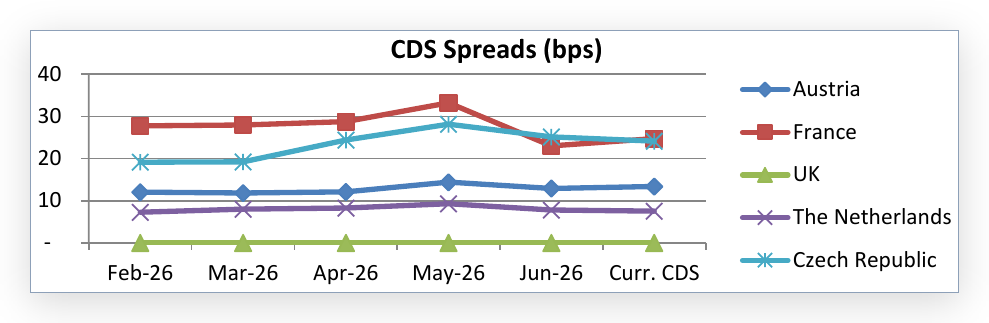
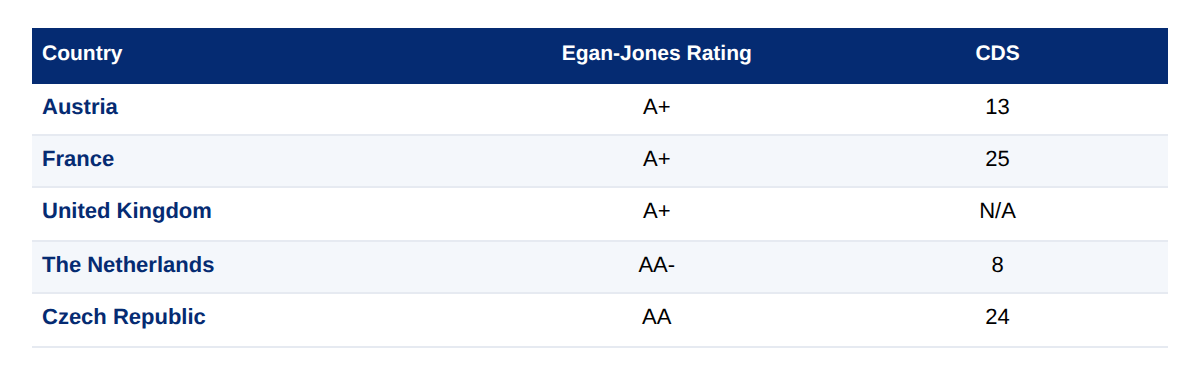
Egan-Jones Senior Rating (Current / Projected): AA / AA. This is a non-NRSRO rating.
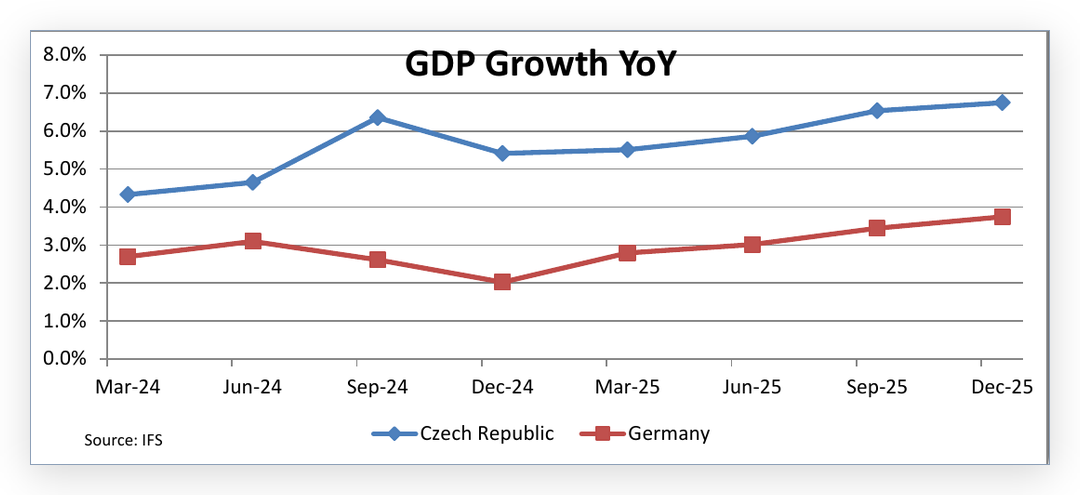
Economic growth in the Czech Republic is projected to accelerate through 2026, with GDP rising from 1% in 2024 to 1.9% in 2025 and reaching 2.2% in 2026. By mid-2026, the ongoing improvement in real disposable income for households continues to fuel strong consumer demand, supporting domestic consumption as the key growth driver.
However, persistent uncertainty around global trade policies and the imposition of new trade restrictions, particularly in the automotive industry, remain significant constraints on investment and export activity. On a positive note, Germany’s fiscal expansion in 2025-2026 and the increased utilization of EU recovery and resilience funds are now delivering tangible growth momentum, contributing to faster expansion in 2026. Headline inflation has gradually declined and is now close to the Czech National Bank’s (CNB) 2% target, stabilizing price expectations across the economy. The 2026 outlook remains subject to downside risks, especially if trade tensions intensify further, which could hamper growth prospects. Affirming.
Economic Growth
In 2026, solid growth in private consumption, fueled by rising real disposable incomes, remains the primary engine of Czech economic expansion. While trade policy uncertainty restrained investment growth in 2025, the increased absorption of EU funds has now driven a clear rebound in investment activity in 2026. Export performance remains muted due to heightened trade restrictions, especially in the automotive sector, but Germany’s fiscal stimulus is now partially offsetting this, supporting regional demand and Czech export margins. Productivity improvements observed in 2025-2026 are helping to contain labor cost increases, contributing to the gradual decline in inflation toward target levels. However, risks remain skewed to the downside. Any further escalation in trade or geopolitical tensions could undermine business confidence, dampen foreign demand, and trigger renewed disruptions in global supply chains, affecting Czech manufacturing and export-oriented sectors in 2026.
Fiscal Policy
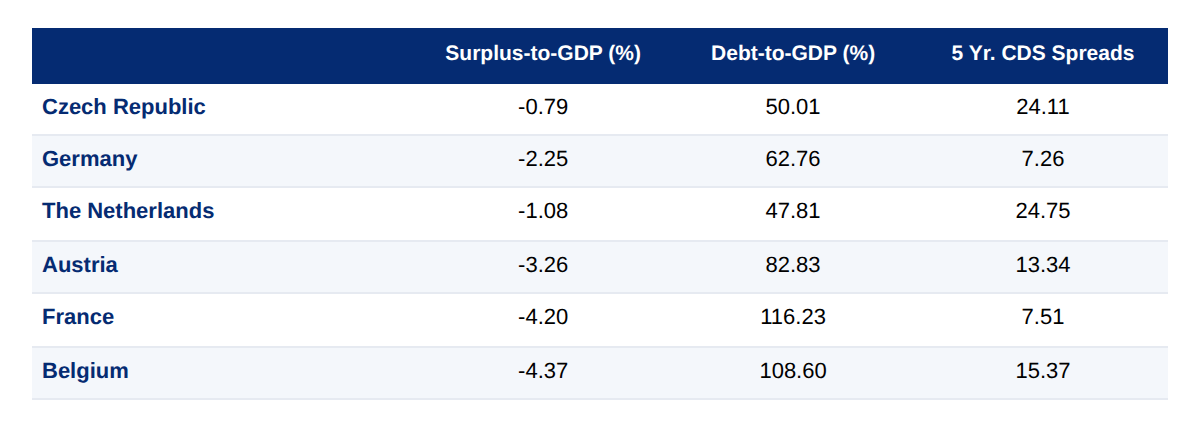
The Czech Republic’s fiscal position in 2026 continues to reflect a commitment to fiscal discipline alongside targeted investment. The general government deficit remains within the EU’s Stability and Growth Pact threshold, with the structural balance improving to approximately -1.9% of GDP, comfortably below the national fiscal rule ceiling of 2.75% of GDP. The government debt-to-GDP ratio has declined slightly and is now trending lower, stabilizing around 42-43%, indicating a stable and sustainable debt outlook.
Unemployment
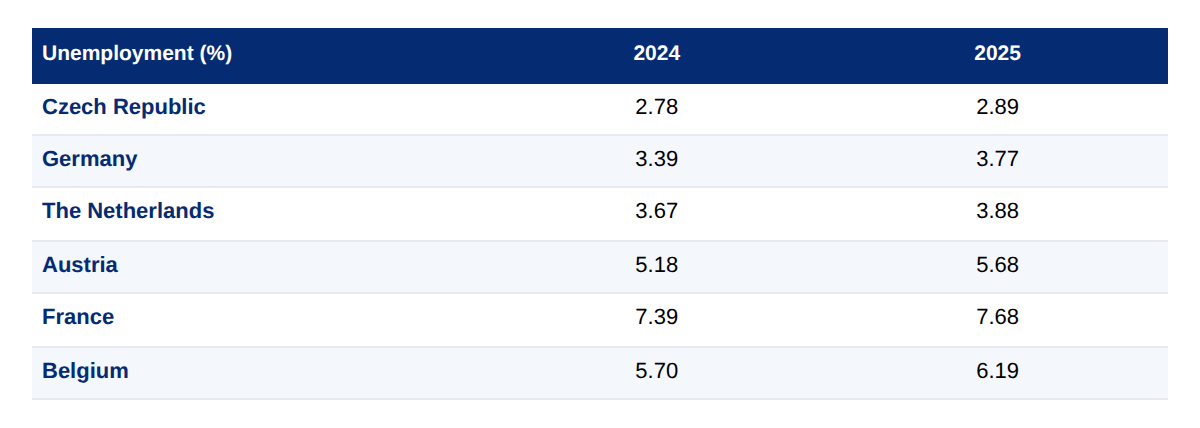
The Czech Republic’s unemployment rate remained stable at 4.3% in early 2026, reflecting continued labor market stability despite a slight uptick from previous years. This figure marks the highest level since 2017 but remains well below the historical peak of 9.69% in 2004 and is low by both historical and international standards. The country’s long-term average unemployment rate from 1990 to 2026 is approximately 5.1%, underscoring the resilience of the Czech labor market.
Banking Sector
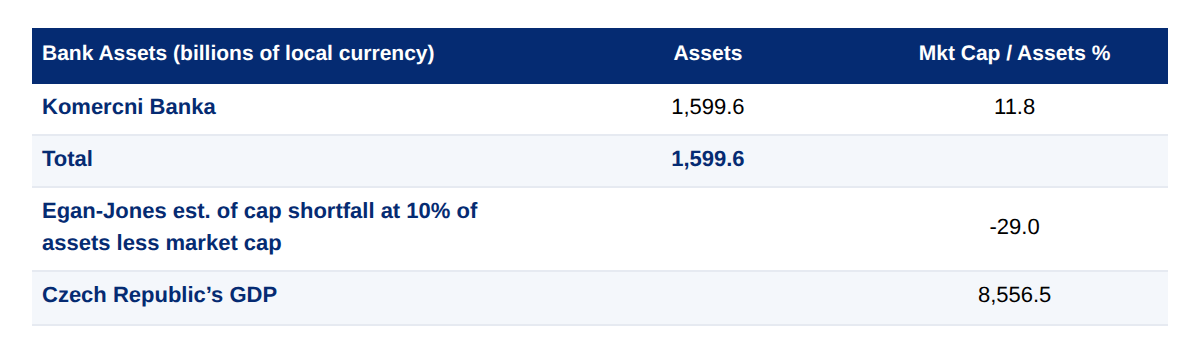
The Czech banking sector in 2026 is characterized by steady asset growth, robust fundamentals, and a strong regulatory environment aligned with EU standards. Total banking sector assets have continued to grow, reaching approximately CZK 11.7-11.8 billion by mid-2026, with the pace of asset growth moderating to around 5-5.5% year-on-year, reflecting a more normalized growth trajectory after the higher 7.1% seen in 2024.
Funding Costs
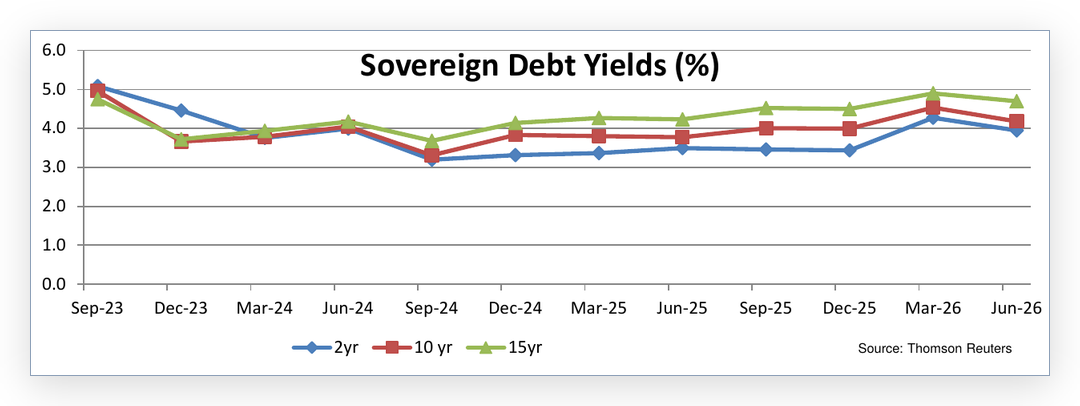
In 2026, corporate funding costs in the Czech Republic have declined following the CNB’s continued easing cycle. The two-week repo rate was reduced to 3.50% in May 2025 and has remained stable through early 2026, with the discount rate at 2.50% and the Lombard rate at 4.50%. This easing was driven by inflation falling to 1.8% in April 2025 and the Czech koruna strengthening significantly against the euro and dollar.
Ease of Doing Business
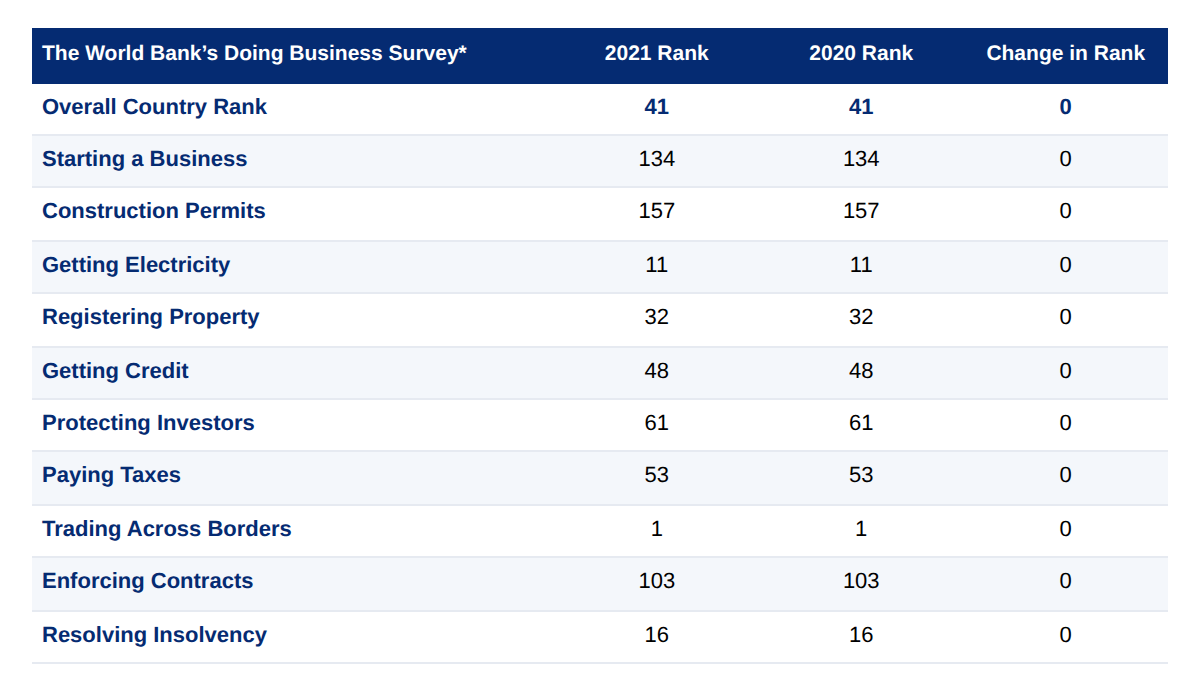
Major factors for growing the economy are the ease of doing business and the economic freedom; although not the sole factor for determining economic growth, a country which makes it easy for businesses to operate and provides a reasonably free environment to conduct business has a good chance for growth. The table below indicates that with an overall rank of 41 (1 is best, 189 worst) the Czech Republic is above average.
Economic Freedom
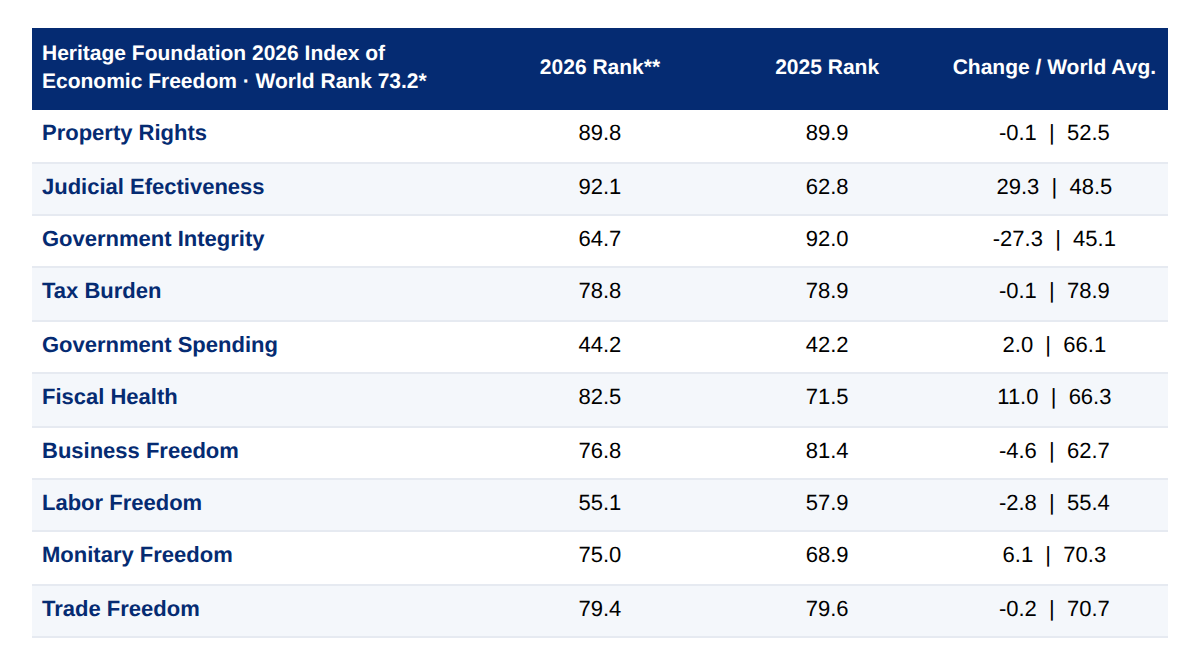
As can be seen below, the Czech Republic is above average in its overall rank of 73.2 for Economic Freedom with 100 being best.
Credit Quality Driver: Taxes Growth
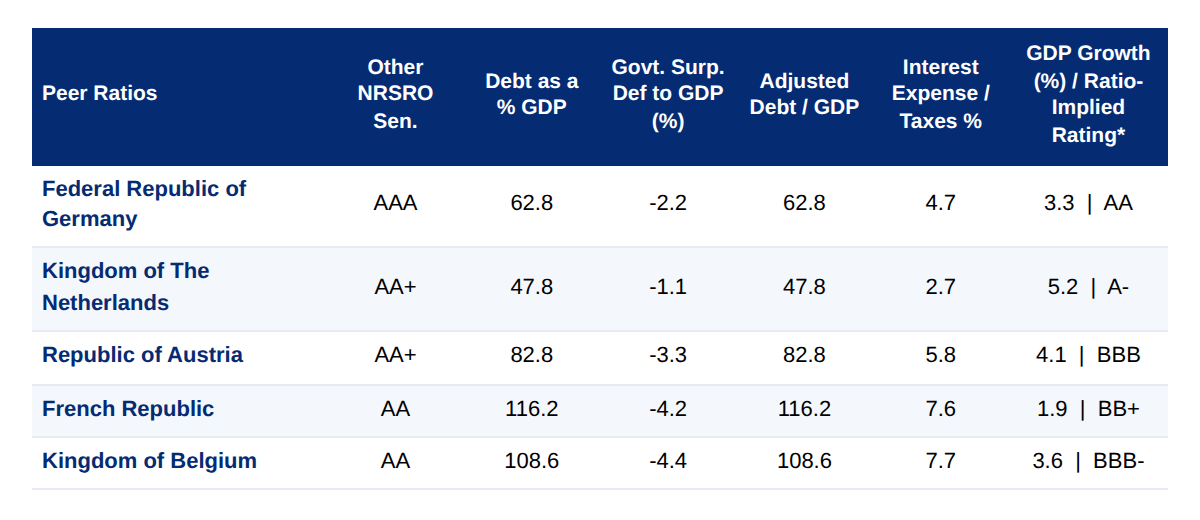
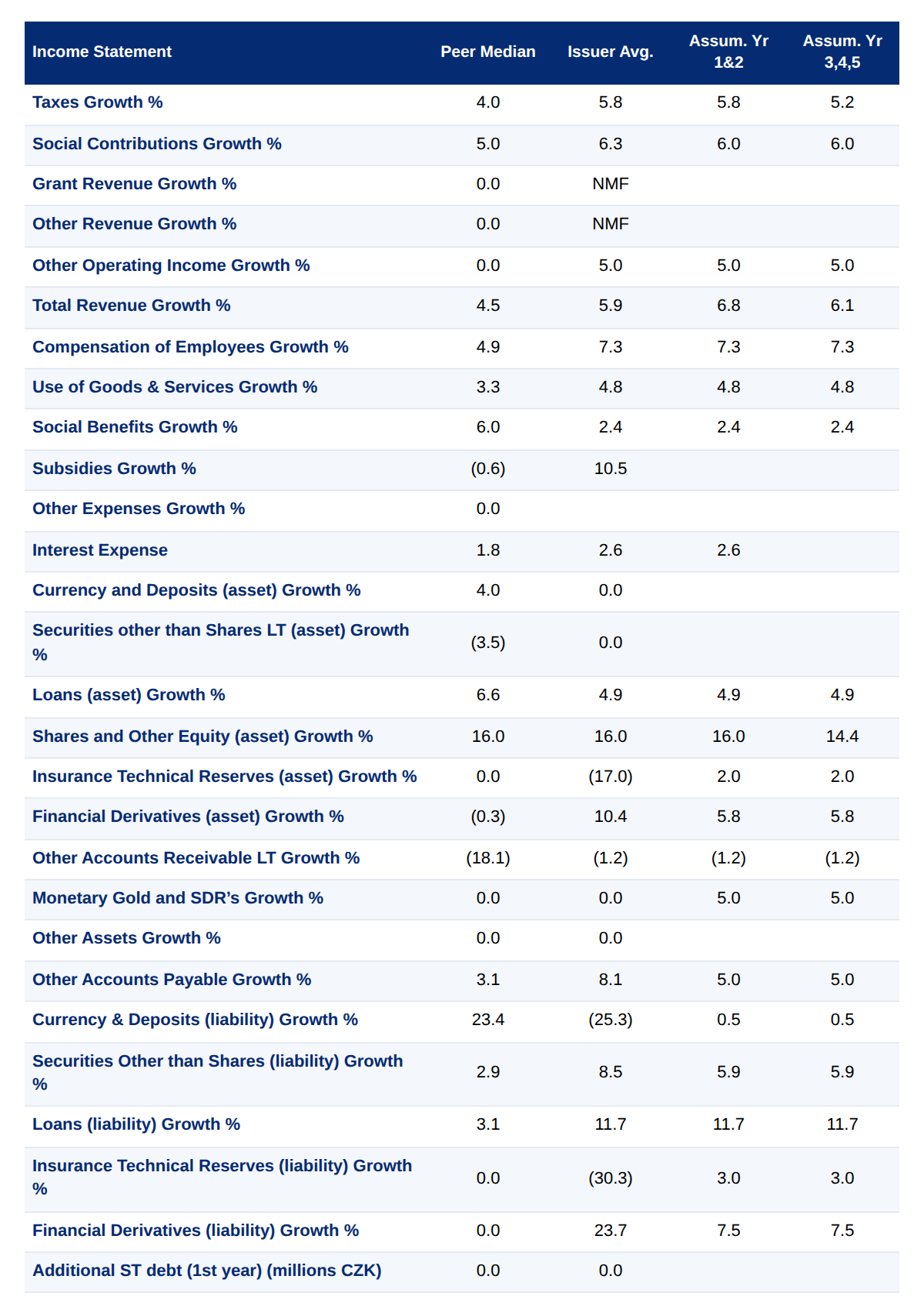
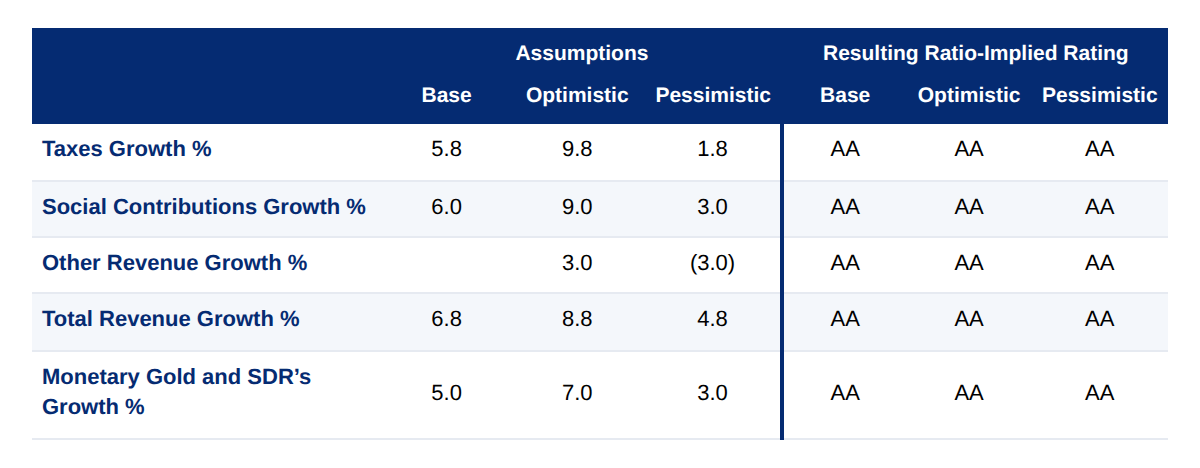
The Czech Republic has grown its taxes of 5.8% per annum in the last fiscal year which is more than the average for its peers. We expect tax revenues will grow approximately 5.8% per annum over the next couple of years and 5.2% per annum for the next couple of years thereafter.
Credit Quality Driver: Total Revenue Growth
CZECH REPUBLIC’s total revenue growth has been more than its peers and we assumed a 6.8% growth in total revenue over the next two years.
Annual Income Statements
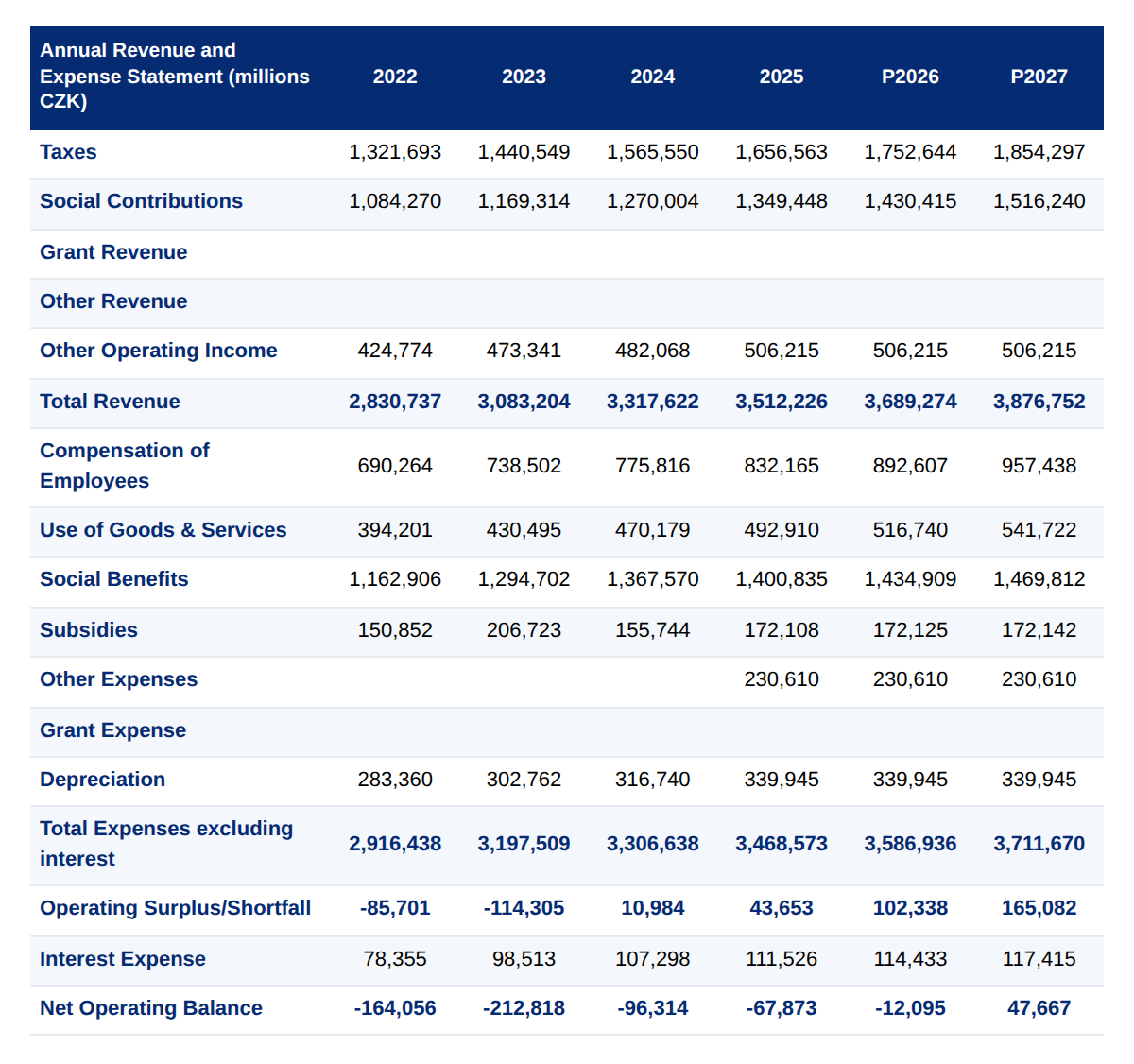
Below are the Czech Republic’s annual income statements with the projected years based on the assumptions listed in the credit quality driver section.
Annual Balance Sheets
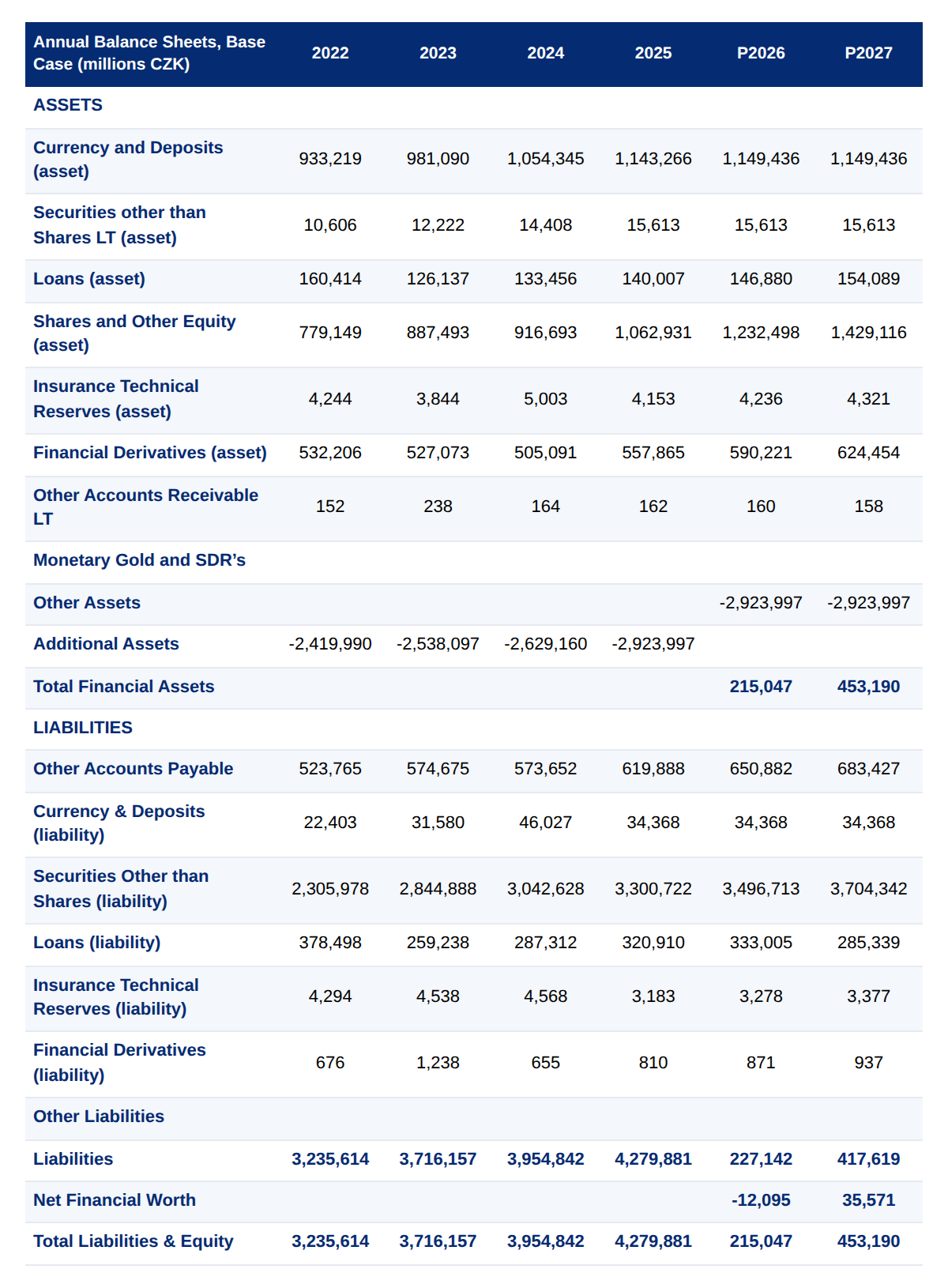
Below are the Czech Republic’s balance sheets with the projected years based on the assumptions listed in the credit quality driver section.
Comments on the Difference between the Model and Assigned Rating
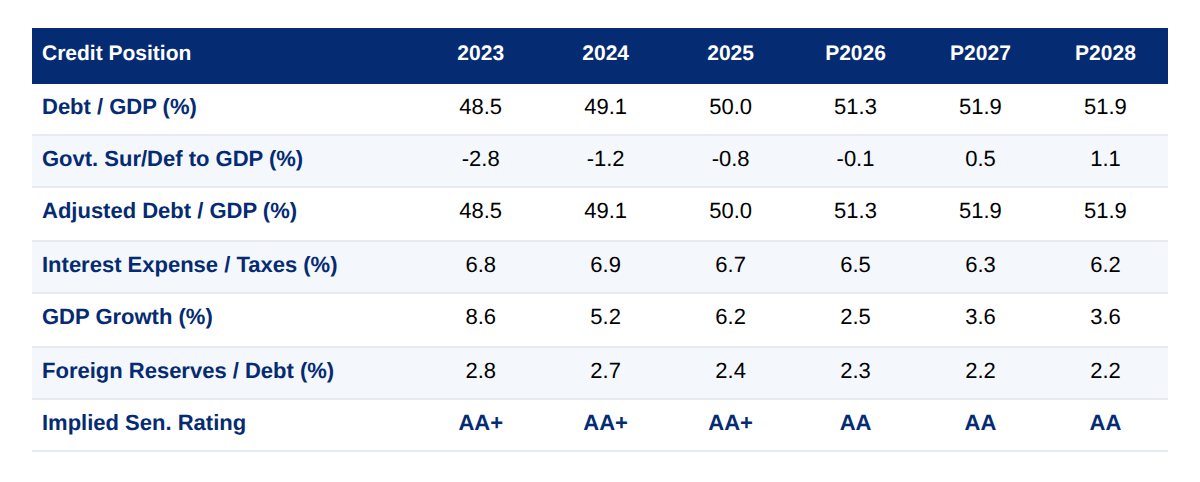
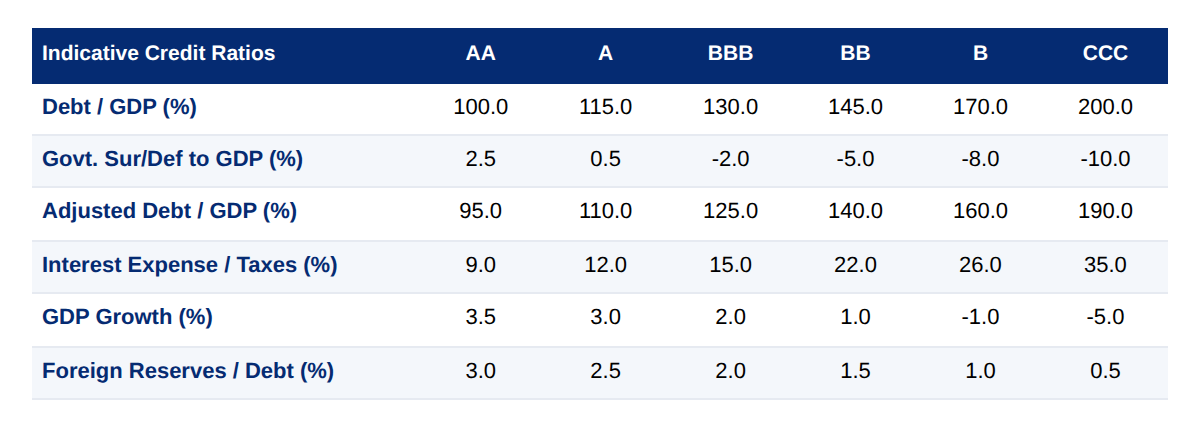
In this case, there has been little change in the recent results and therefore we have used our best judgement in making adjustments which are reflected in the results for the projected ratings. We have assigned a rating of “AA” whereas the ratio-implied rating for the most recent period is “AA+”; we expect results to decline slightly.
Changes in Indicative Ratios
We have not made any adjustment in the indicative ratios at this time.
SEC Rule 17g-7(a) Disclosure
Below are the disclosures as required by Paragraph (a) of Rule 17g-7.
1. The symbol in the rating scale used to denote the credit rating categories and notches within categories and the identity of the obligor, security, or money market instrument as required by Paragraph (a)(1)(ii)(A) of Rule 17g-7:
For the issuer CZECH REPUBLIC with the ticker of 1040Z CP we have assigned the senior unsecured rating of AA. There are three notches in our rating categories (e.g., A-, A, and A+) other than those deep into speculative grade; for CC, C, and D there are no notches.
2. The version of the procedure or methodology used to determine the credit rating as required by Paragraph (a)(1)(ii)(B) of Rule 17g-7:
We are using the methodology version #16 available via egan-jones.com under the tab at the bottom of the page “Methodologies”.
3. The main assumptions and principles used in constructing the procedures and methodologies used to determine the credit rating as required by Paragraph (a)(1)(ii)(C) of Rule 17g-7:
The credit rating assigned reflects our judgement regarding the future credit quality of the issuer. Regarding the specific assumptions used, please refer to the credit quality driver section of this Rating Analysis Report.
4. The potential limitations of the credit rating as required by Paragraph (a)(1)(ii)(D) of Rule 17g-7:
Our rating pertains solely to our view of current and prospective credit quality. Our rating does not address pricing, liquidity, or other risks associated with holding investments in the issuer.
5. Information on the uncertainty of the credit rating as required by Paragraph (a)(1)(ii)(E) of Rule 17g-7:
Our rating is dependant on numerous factors including the reliability, accuracy, and quality of the data relied used in determining the credit rating. The data is sourced from publicly-available 10Q and 10K statements, quarterly reports, 8K filings, earnings reports, and other similar sources. In some cases, the information is limited because of issues such as short operating histories, the lack of reported data, a delay in reporting data, restatements, inaccurate accounting, and other issues. Such shortcomings are not always readily apparent. Egan-Jones aims to identify such shortcomings and make adjustments using its best judgement.
6. Whether and to what extent third-party due diligence services have been used in taking the rating action as required by Paragraph (a)(1)(ii)(F) of Rule 17g-7:
Egan-Jones does not utilize third-party due diligence services.
7. How servicer or remittance reports were used, and with what frequency, to conduct surveillance of the credit rating as required by Paragraph (a)(1)(ii)(G) of Rule 17g-7:
Servicer or remittance reports normally pertain to structured finance issuers; this report does not pertain to a structured finance issuer (Egan-Jones is not an NRSRO for structured finance or sovereigns / municipal issuers). Regarding surveillance, the minimum time period for corporation issuers is normally one year.
8. A description of the data that were relied upon for the purpose of determining the credit rating as required by Paragraph (a)(1)(ii)(H) of Rule 17g-7:
Egan-Jones uses 10Q and 10K statements, quarterly reports, 8K filings, earnings reports, governmental filings and other similar sources for ratings on publicly-traded issuers. In the case of private issuers, Egan-Jones relies on information provided mainly by issuers.
9. A statement containing an overall assessment of the quality of information available and considered in the credit rating as required by Paragraph (a)(1)(ii)(I) of Rule 17g-7:
The information is generally high quality and readily avail.
10. Information relating to conflicts of interest as required by Paragraph (a)(1)(ii)(J) of Rule 17g-7:
This rating is unsolicited.
11. An explanation or measure of the potential volatility of the credit rating as required by Paragraph (a)(1)(ii)(K) of Rule 17g-7:
Our rating aims to assess the probability of the payment of obligations in full and on-time. Factors which affect such probability, and in turn our rating, include changes in the operating performance of the issuer, changes in capital structure, and merger and acquisition events.
12. Information on the content of the credit rating as required by Paragraph (a)(1)(ii)(L) of Rule 17g-7:
Regarding the historical performance of the credit rating, our rating transition matrix is available in our Form NRSRO, exhibit 1. The expected probability of default and the expected loss in the event of default is listed on the first page of this report.
13. Information on the sensitivity of the credit rating to assumptions as required by Paragraph (a)(1)(ii)(M) of Rule 17g-7:
Below is a summary of the impact of the 5 assumptions which independently would have the greatest impact on our “ratio-implied rating”:
14. If the credit rating is assigned to an asset-backed security, a description of: (i) the representations, warranties, and enforcement mechanisms available to investors; and (ii) how they differ from the representations, warranties, and enforcement mechanisms in issuances of similar securities, as required by Paragraph (a)(1)(ii)(N) of Rule 17g-7:
This credit rating is not assigned to an asset-backed security.
Attestation Form
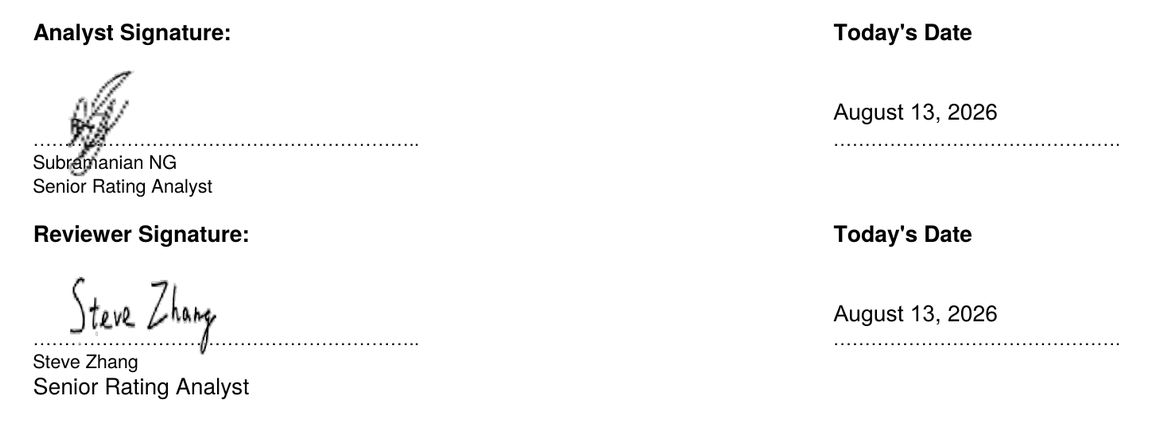
In compliance with the US Securities and Exchange Commission (SEC) Rule 17g-7(a), the Egan-Jones analyst who published the report is responsible for the rating action and to the best knowledge of the person:
- No part of the credit rating was influenced by any other business activities, - The credit rating was based solely upon the merits of the obligor, security, or money market instrument being rated, and - The credit rating was an independent evaluation of the credit risk of the obligor, security, or money market instrument.
Sovereign Rating Methodology (Non-NRSRO)
Scope and Limitations. Sovereign Issuer Credit Quality Ratings (CQR) are a forward-looking assessment of a sovereign’s capacity and willingness to honor its existing and future obligations in full and on time. Sovereigns are assigned two CQRs: a Local-Currency CQR, which reflects the likelihood of default on debt issued and payable in the currency of the sovereign, and a Foreign-Currency CQR, which is an assessment of the credit risk associated with debt issued and payable in foreign currencies.Key Rating Drivers. Egan-Jones’ approach to sovereign risk analysis is a synthesis of quantitative and qualitative judgments. The quantitative factors Egan-Jones uses are:
- Debt in relation to GDP. - Surplus or deficit in relation to GDP. - Debt plus potential under-funding of major banks in relation to GDP. - Interest expense in relation to taxes. - GDP growth. - Foreign reserves in relation to debt.
Debt levels for many sovereign issuers have increased at an accelerating rate over the past decade, affecting implied ratings. Egan-Jones also considers unemployment levels and funding costs. Egan-Jones recognizes that no model can fully capture all the relevant influences on sovereign creditworthiness, meaning that its sovereign ratings can and do differ from those implied by the rating model. Some of the qualitative factors that impact its ultimate assessment of credit quality include the flexibility, stability and overall strength of the economy, efficiency of tax collection, acceptance of contract law, ease of doing business, trade balances, prospects for future growth and health and monetary policy, and economic freedom. These subjective and dynamic qualitative issues are not captured by the model but affect sovereign ratings.
For additional information, please see Exhibit 2: Methodologies in Egan-Jones’ Form NRSRO.
Copyright ©2026, Egan-Jones Ratings Company, Inc. (“Egan-Jones”). All rights reserved. The information upon which Egan-Jones ratings and reports are based is obtained by Egan-Jones from sources Egan-Jones believes to be accurate and reliable. Egan-Jones relies on third party reports and information and data provided and Egan-Jones has not, unless required by law or internal policies/procedures, independently verified or performed due diligence related to the accuracy of information, data or reports. Egan-Jones has not consented to, nor will consent to, being named an “expert” under federal securities laws, including without limitation, Section 7 of the Securities Act of 1933. Please note that expected or final ratings are not recommendations to buy, hold or sell the securities. Egan-Jones is not an advisor and is not providing investment advice, strategy or related services. Egan-Jones and its third-party suppliers (“Suppliers”) hereby disclaim any representation or warranty, express or implied, as to the accuracy, timeliness, completeness, merchantability, and fitness for any particular purpose or non-infringement of any of such information. In no event shall Egan-Jones or its directors, officers, employees, independent contractors, agents, representatives, or Suppliers (collectively, Egan-Jones Representatives) be liable (1) for any inaccuracy, delay, loss of data, interruption in service, error (negligent or otherwise) or other circumstance or contingency within or outside the control of Egan-Jones or any Egan-Jones Representative, in connection with or related to obtaining, collecting, compiling, analyzing, interpreting, communicating, publishing or delivering any such information. Ratings and other opinions issued by Egan-Jones are, and must be construed solely as, statements of opinion and not statements of fact as to credit worthiness or recommendations to purchase, sell or hold any securities. A report providing an Egan-Jones rating is neither a prospectus nor a substitute for the information assembled, verified and presented to investors by the issuer and its agents in connection with the sale of the securities. Egan-Jones is not responsible for the content or operation of third party websites accessed through hypertext or other computer links and Egan-Jones shall have no liability to any person or entity for the use of such third party websites. This publication may not be reproduced, retransmitted or distributed in any form without the prior written consent of Egan-Jones. Egan-Jones ratings are subject to disclaimers. Egan-Jones is not an NRSRO (as defined by the SEC) for sovereign/municipal issuers and structured finance/ABS issuers.
Appendix A - Recent CLO Rating Actions
Egan-Jones against the other NRSRO on the same tranche, with collateral test cushions.
The ten most recent Egan-Jones CLO tranche ratings are shown below alongside the other NRSRO’s equivalent rating on the same tranche and the current collateral test cushions. Every rated tranche is listed in the complete Egan-Jones CLO ratings table at [egan-jones.io/non-nrsro-ratings/clo](https://egan-jones.io/non-nrsro-ratings/clo).
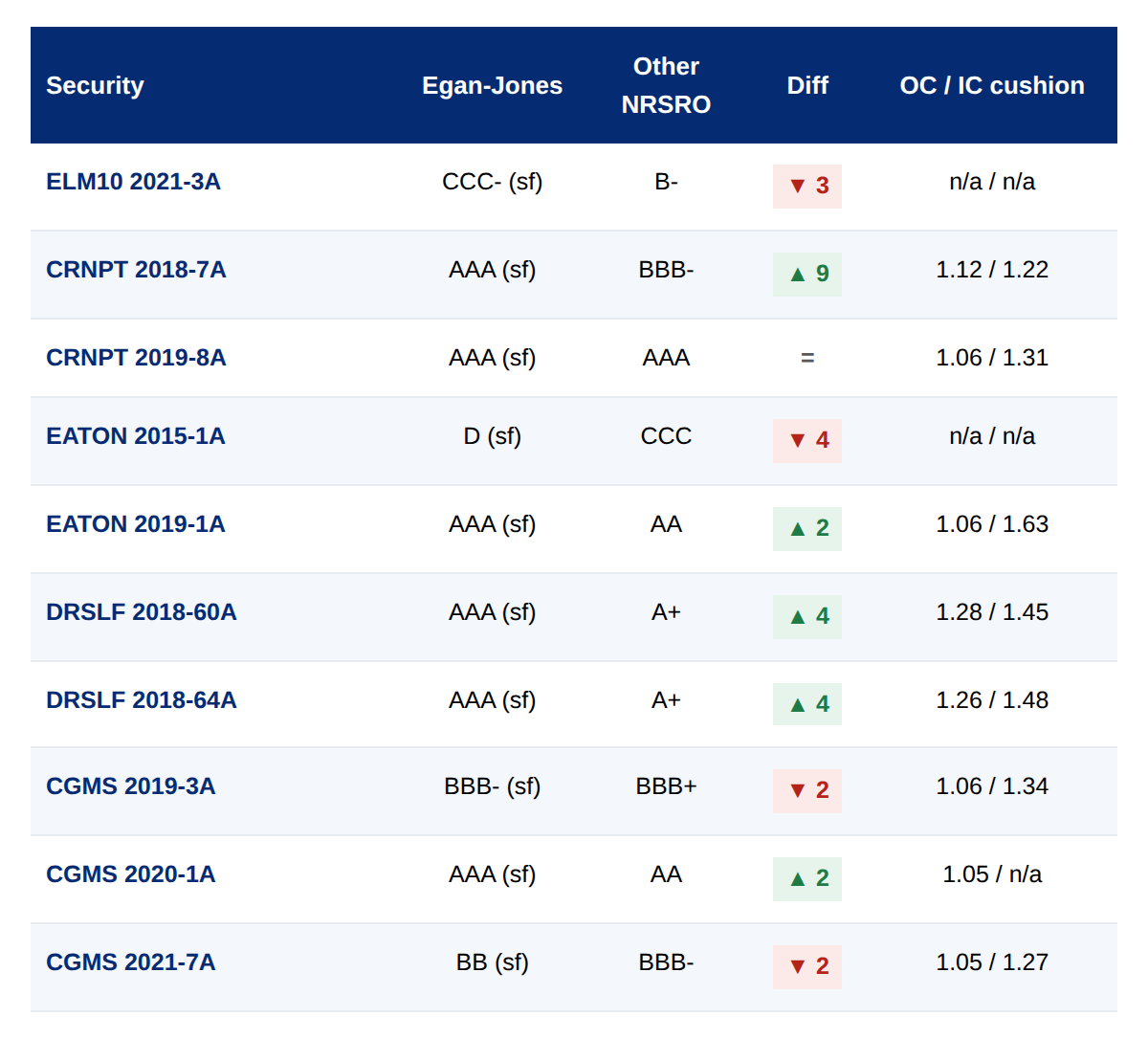 Egan-Jones Ratings Company CLO rating reports; report data as of 08/12/26.
Diff is the gap in notches between the Egan-Jones rating and the other NRSRO’s equivalent rating on the same tranche, measured on a 22-step scale from AAA to D. Green is Egan-Jones higher; red is Egan-Jones lower; “=” is a match.Cushion is the current test level divided by its trigger, so a figure below 1.00 means the test is failing. “n/a” appears where the report shows no test of that type for the class. Egan-Jones ratings shown here are not NRSRO ratings.
Sources and Footnotes
1. The Houthi capture of Mayun (Perim) island at the entrance to the Red Sea, and the precautionary shutdown of Saudi Arabia’s East-West Crude Oil Pipeline after it was struck, reported by NPR, September 12, 2026. The pipeline strike itself was carried out by drones launched from Iraqi territory and no group has claimed responsibility (Al Jazeera).
Additional Sources
- Exhibit 1: Egan-Jones assessment of Shia-aligned armed-group control and presence at 15 September 2026; no third-party source. Areas are generalized and contested. - Exhibit 2: annual exchange-rate series from the University of California, Davis and the University of Groningen via FRED, series XRNCUSIRA618NRUG; shaded area indicates a U.S. recession. - The September 2026 rial figure cited in the text is the Tehran open-market quote of 2,305,000 rials per US dollar at 15 September 2026 via AlanChand. - US Central Command’s clearance of Iranian sea mines from the Strait of Hormuz transit lanes, announced 28 August 2026 (Stars and Stripes). - Appendix A CLO table: Egan-Jones Ratings Company CLO rating reports, published at [egan-jones.io/non-nrsro-ratings/clo](https://egan-jones.io/non-nrsro-ratings/clo). - Czech Republic rating analysis: Egan-Jones Ratings Company, Czech Republic - Rating Analysis, August 13, 2026 (non-NRSRO sovereign rating). Annual ratios sourced to the IMF; peer and fiscal figures to Thomson Reuters and International Financial Statistics.